













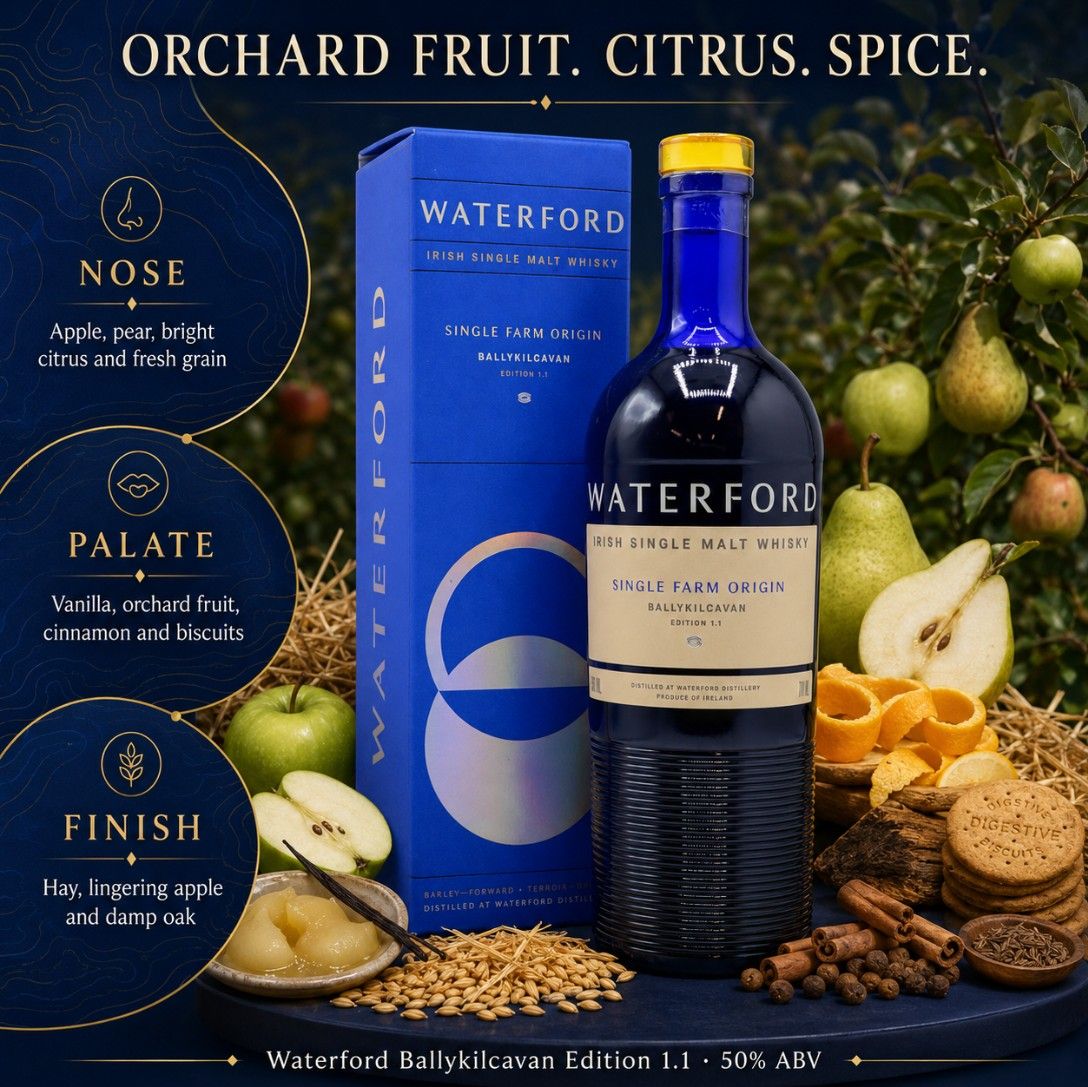
Most single malt whiskey tells the story of a distillery. Waterford Ballykilcavan Edition 1.1 goes further, tracing its identity back to one farm, one grower and one particular barley harvest.
The whisky was produced entirely from Taberna barley grown by David Walsh-Kemmis at Ballykilcavan Farm in County Laois. Harvested in 2015 and distilled at Waterford in 2016, the spirit was matured in a carefully composed selection of American oak, French oak and Vin Doux Naturel wine casks before being bottled in 2020 at 50% ABV.
It became one of the earliest Single Farm Origin releases from Waterford Distillery and a defining example of the company’s original philosophy: barley should not be treated as a neutral source of alcohol, but as a flavour-producing ingredient shaped by variety, soil, weather, season and farming location.
The result is a distinctly agricultural Irish single malt. Redcurrants, grapes and berries meet fresh foliage, cut grass and earthy farmyard notes on the nose. Cooked banana, brown sugar, mulled wine and cinnamon develop across an oily palate before a dry, spicy and persistent finish.
With an outturn of 8,640 bottles, Ballykilcavan 1.1 records an important moment in modern Irish whiskey: the beginning of Waterford’s ambitious attempt to explore flavour one farm at a time.
Waterford Ballykilcavan 1.1 at a Glance
- Distillery: Waterford
- Series: Single Farm Origin
- Edition: Ballykilcavan 1.1
- Whiskey type: Irish Single Malt Whiskey
- Farm: Ballykilcavan Farm
- Grower: David Walsh-Kemmis
- Location: County Laois, Ireland
- Barley variety: Taberna
- Harvest: 2015
- Vintage: 2016
- Bottled: 2020
- Age: 3 years old
- Bottle size: 70cl
- Strength: 50% ABV
- Cask composition: American oak, premium French oak and Vin Doux Naturel casks
- Outturn: 8,640 bottles
- Colour: Natural
- Filtration: Non-chill filtered
- Key flavours: Redcurrant, grapes, foliage, fresh grass, cooked banana, brown sugar, mulled wine and cinnamon
Published production details record a cask composition of 45% first-fill American oak, 37% premium French oak and 18% casks previously used for Vin Doux Naturel fortified wine.
What Is Waterford Ballykilcavan 1.1?
Waterford Ballykilcavan 1.1 is a single malt Irish whiskey made exclusively from barley grown on Ballykilcavan Farm in County Laois.
The name tells the drinker where the barley came from rather than simply identifying the distillery that processed it.
Waterford kept the Ballykilcavan barley separate through malting, fermentation, distillation and maturation. This allowed the distillery to present the crop as an individual Single Farm Origin release instead of combining it immediately with barley from several farms.
The 1.1 designation identifies it as the first edition created from that particular farm origin. A later Ballykilcavan 1.2 revisited the same farm with additional maturation and a different balance of casks.
Ballykilcavan 1.1 was therefore not intended to be the final or definitive expression of the farm. It was the first chapter in an evolving record of how spirit from the same agricultural source could change through maturation and cask composition.
One Farm Rather Than One Distillery
The idea of single malt is normally tied to one distillery.
A single malt Irish whiskey must be made entirely from malted barley and produced at one distillery. However, the barley used for a conventional release can come from many farms, growing regions and harvest years.
Waterford narrowed the focus.
For the Single Farm Origin series, each release was made from barley supplied by one named Irish farm. The barley was processed separately so that the final whiskey could retain a clear connection with its source.
That distinction makes Ballykilcavan 1.1 more specific than a conventional single malt.
It is:
- From one distillery
- Made entirely from malted barley
- Produced from one named farm
- Connected with one grower
- Based on one barley variety
- Drawn from one harvest year
The whisky was still matured in several types of cask, but the agricultural raw material remained consistent across the release.
The Waterford Terroir Philosophy
Waterford Distillery was founded around the belief that barley contributes substantially more to whiskey flavour than much of the wider industry acknowledges.
Founder Mark Reynier had previously led the revival of Bruichladdich Distillery on Islay, where he became closely associated with locally grown barley, detailed provenance and experimental production.
When he established Waterford in 2015, he transferred those ideas into an even more systematic project.
The distillery worked with Irish growers across different regions, soil types and farming systems. Each crop was recorded and kept separate, allowing Waterford to compare spirit made with barley from different places while keeping the distillation process as consistent as possible.
By 2024, Waterford’s wider project had sourced barley from 97 Irish farms covering 19 soil types. The resulting range included conventional Single Farm Origins, organic crops, biodynamic barley, heritage varieties, peated releases and later cuvées combining several farms.
What Does Terroir Mean in Whiskey?
Terroir is most commonly associated with wine.
The term refers to the combined influence of place on an agricultural product, including:
- Soil
- Climate
- Rainfall
- Sunlight
- Temperature
- Altitude
- Local ecology
- Farming decisions
- Crop variety
- The conditions of a particular season
Waterford applied the concept to barley.
Its argument was that barley grown in two different locations could develop different chemical and sensory characteristics, even when the same variety was cultivated and the resulting grain was processed through the same distillery.
Those differences could then influence the aroma and flavour of the fermented wash and new-make spirit.
Cask maturation would naturally add another powerful layer, but Waterford maintained that the character created in the field and distillery would remain part of the final whisky rather than disappearing entirely beneath the oak.
Is Whisky Terroir Scientifically Proven?
Waterford supported its production philosophy through a study conducted with researchers from Teagasc and Oregon State University.
The peer-reviewed research examined barley grown in different Irish environments over two seasons. The crops were micro-malted, fermented and distilled under controlled conditions before the resulting new-make spirits were examined through chemical and sensory analysis.
Published in the journal Foods in 2021, the study found that growing environment and season influenced the aromatic and sensory character of the resulting new-make spirit.
The research did not demonstrate that place is the only influence on whisky. Variety, fermentation, distillation and maturation remain essential. It did, however, provide evidence that environmental growing conditions can create measurable differences before the spirit enters a cask.
Ballykilcavan 1.1 should be understood within that broader experiment.
The bottle does not ask the drinker merely to accept a general claim that Irish barley matters. It names the farm, grower, variety and vintage so that its profile can be tasted beside other Waterford origins.
The Story of Ballykilcavan Farm
Ballykilcavan is a long-established family farm near Stradbally in County Laois.
The Walsh family has farmed the estate since 1639, with the property passing through 13 generations. The farm covers approximately 440 hectares of agricultural land and forestry and is now also home to Ballykilcavan Brewery.
David Walsh-Kemmis grows malting barley as one of the farm’s principal crops.
The estate’s combination of shelter, fertile land and clay-loam soil made it particularly well suited to Waterford’s Single Farm Origin project. The 2015 Taberna crop was selected and kept separate before being transported for malting and eventual distillation.
Ballykilcavan’s farming heritage gives the release additional depth.
This was not anonymous grain purchased through a general commodity market. It came from a named working farm with a documented family history, identifiable fields and a grower directly connected with the final bottle.
Who Is David Walsh-Kemmis?
David Walsh-Kemmis is the farmer behind the barley used for Ballykilcavan 1.1.
He represents the type of grower Waterford wanted to place at the centre of its whiskey story. Instead of allowing the distillery and blender to receive all of the attention, Single Farm Origin labels recognised the person responsible for producing the raw material.
Waterford’s approach treated the grower as an essential contributor rather than a distant supplier.
Every decision made in the field could influence the harvested barley:
- When the crop was planted
- How the soil was managed
- The effect of rainfall and temperature
- The timing of the harvest
- The final quality and condition of the grain
The 2015 Taberna harvest used for Ballykilcavan 1.1 was sufficiently successful that Walsh-Kemmis became closely identified with the earliest stage of the Waterford project.
His name remains part of the bottle’s provenance, allowing the whiskey to preserve a direct connection between farm and glass.
Why Taberna Barley Matters
Ballykilcavan 1.1 was produced from the Taberna barley variety.
Modern distilling barley is often selected for practical qualities including:
- Reliable agricultural performance
- Resistance to disease
- Effective malting
- High extract potential
- Consistency during brewing and fermentation
Waterford accepted that yield and technical performance matter but wanted to explore whether different barley varieties and growing locations could also contribute recognisable flavour.
Taberna was one of the varieties used during Waterford’s earliest distilling seasons. The 2015 Ballykilcavan harvest was distilled separately in 2016, preserving the connection between that variety and its County Laois growing environment.
The whisky should not be described as tasting a certain way solely because it uses Taberna.
Its character was created by the complete combination of farm, season, malting, fermentation, distillation and cask maturation. The variety remains an important part of that record rather than a simple guarantee of flavour.
Distilled in 2016
Waterford began distilling in 2016, making Ballykilcavan 1.1 part of the distillery’s earliest production.
The spirit was created at Waterford’s facility in a converted former Guinness brewery on the banks of the River Suir. The site had previously been equipped for large-scale brewing, giving the new whisky company access to substantial fermentation and processing infrastructure.
Waterford adapted the brewery for malt whiskey production while retaining equipment that could support its detailed farm-by-farm programme.
Long fermentations and slow distillation were used to develop flavour before the spirit entered oak. The distillery then kept the maturing stocks separated and recorded their cask composition through its traceability system.
Waterford distilled its first spirit in 2016 and released its first mature whiskies in 2020, making Ballykilcavan 1.1 one of the bottles that introduced the distillery to the public.
A Three-Year-Old Whiskey with a Serious Production Story
Ballykilcavan 1.1 carries a three-year age statement.
In a market where age is often treated as one of the easiest indicators of prestige, that number may initially appear modest. Waterford did not attempt to hide it.
The whiskey was released relatively soon after it met the legal maturation requirement because its purpose was to reveal the earliest mature expression of the farm’s spirit.
This makes it very different from a whiskey designed around prolonged oak extraction.
Ballykilcavan 1.1 retains:
- Fresh cereal character
- Green foliage
- Grass and herbs
- Bright red fruit
- A vigorous spirit-led texture
- Noticeable pepper and spice
- Clear interaction between young malt and active oak
The whisky is not intended to imitate a 12-, 18- or 21-year-old Irish whiskey. Its youth is part of the experiment.
It allows the barley-led and agricultural flavours to remain visible before extended maturation has had the opportunity to dominate the spirit.
Why Waterford Bottled It at 50% ABV
Ballykilcavan 1.1 was bottled at 50% ABV.
This higher strength gives the whisky greater texture and aromatic concentration than a typical entry-level Irish whiskey bottled at 40%.
It also provides room for experimentation.
At full strength, the whiskey presents its most concentrated combination of berries, grass, cereal, brown sugar and spice. Adding a few drops of water can soften the alcohol and reveal more fruit, sweetness and malt.
A fixed 50% ABV also allowed Waterford to present different Single Farm Origin bottlings on a broadly equal basis.
When Ballykilcavan, Bannow Island, Sheestown and other farms were tasted side by side, differences were less likely to be caused simply by one whisky being bottled at a significantly higher or lower strength.
The Cask Composition
Although the barley came from one farm, Ballykilcavan 1.1 was not matured in only one type of cask.
Its published composition was:
- 45% first-fill American oak
- 37% premium French oak
- 18% Vin Doux Naturel casks
This multi-cask approach allowed Waterford to build structure and complexity around a relatively young spirit.
The casks were not intended to become the sole subject of the whisky.
Instead, the distillery attempted to use high-quality oak while preserving enough of the spirit’s identity for comparisons between farms to remain meaningful.
First-Fill American Oak
First-fill American oak forms the largest component of Ballykilcavan 1.1.
These casks commonly contribute:
- Vanilla
- Caramel
- Coconut
- Honey
- Sweet oak
- Citrus
- Baking spice
The American oak helps explain the cooked banana, brown sugar and sweeter cereal notes found on the palate.
Because the casks were being used for Irish whiskey for the first time, their influence was relatively active. This was particularly important for a young spirit that had spent less than four years in wood.
Premium French Oak
French oak accounts for 37% of the maturation recipe.
Compared with American oak, French oak often provides a firmer and spicier structure. Its influence can include:
- Cloves
- Cinnamon
- Pepper
- Toasted nuts
- Cocoa
- Dry wood
- Tannin
- Savoury spice
These qualities support Ballykilcavan’s cinnamon and dry finish, preventing the banana, brown sugar and wine-derived fruit from becoming overly soft.
The substantial French oak proportion also gives the whisky a more structured profile than might be expected from its age.
Vin Doux Naturel Casks
The remaining 18% was matured in casks previously used for Vin Doux Naturel.
Vin Doux Naturel is a French fortified wine category produced by adding grape spirit during fermentation, preserving a proportion of the grapes’ natural sweetness.
Depending on the wine and production method, its casks can introduce:
- Raisins
- Red berries
- Grapes
- Plums
- Honey
- Candied fruit
- Sweet spice
- Wine-like richness
This part of the recipe connects naturally with the redcurrant, grape and mulled-wine notes found in Ballykilcavan 1.1.
The wine casks add fruit and sweetness, while the American and French oak provide vanilla, body and spice.
Waterford Ballykilcavan 1.1 Tasting Notes
Ballykilcavan 1.1 is an oily, fruit-led and distinctly agricultural Irish single malt.
Colour
Light hay with pale gold highlights.
Despite its relatively light colour, the whiskey produces visible oils around the glass, suggesting a fuller texture than its appearance might initially imply. The bottle was released without added colouring.
Nose
Berries, redcurrants and grapes lead the aroma.
Fresh foliage and newly cut grass bring a distinctly green character, followed by earth, cereal and a lightly farmyard-like note. These aromas make the connection with the whiskey’s agricultural origin particularly clear.
The wine-cask influence becomes more apparent as the whiskey rests. Darker fruit and a suggestion of mulled wine emerge behind the fresher berries, while American oak brings vanilla and light sweetness.
At 50% ABV, the nose is concentrated but not entirely dominated by alcohol. A few drops of water reveal additional grass, fruit and soft malt.
Palate
The palate is oily and full-bodied.
Cooked banana and brown sugar create a sweet opening, followed by malt, caramel and a mixture of red fruit and warming spice.
Mulled-wine character develops through the middle, bringing grape, fruit and cinnamon. White pepper and ginger provide structure, while the young malt retains a fresh cereal quality.
The palate moves between sweetness and dryness rather than remaining in one direction. Banana and brown sugar are balanced by spice, grass and oak.
Finish
The finish is dry, oily and warming.
Cinnamon, pepper and cereal remain after the sweeter fruit begins to fade. A final syrup-like sweetness appears beneath the drier oak, leaving malt, spice and light wine character.
The finish is long enough for the different components to separate, particularly after a small amount of water has been added.
Does Ballykilcavan 1.1 Taste Young?
Yes, but its youth is not necessarily a flaw.
The whiskey displays several characteristics often associated with younger single malt:
- Fresh cereal
- Green grass
- Strong barley character
- Direct pepper and spice
- Less integrated oak
- A lively alcohol presence
However, the active cask composition gives it more fruit, sweetness and structure than a simple ex-bourbon maturation might have achieved in the same period.
The question is not whether Ballykilcavan 1.1 tastes like an older whiskey. It does not.
Its purpose is to show the farm’s spirit at an early stage, when barley, fermentation and distillation remain particularly visible.
Drinkers who expect the deep oak integration of an older Irish single malt may find it unusually direct. Those interested in production, provenance and spirit character should find that directness central to its appeal.
Is Ballykilcavan 1.1 Sweet?
The whisky contains clear sweetness, but it remains balanced by grass, spice and dry oak.
Sweeter flavours include:
- Cooked banana
- Brown sugar
- Caramel
- Grapes
- Red berries
- Mulled wine
Drier flavours include:
- Fresh grass
- Foliage
- Pepper
- Cinnamon
- Cereal
- French oak tannin
The Vin Doux Naturel casks add wine-derived fruit, while American oak contributes vanilla and brown-sugar sweetness.
French oak and the lively young spirit prevent the whiskey from becoming syrupy.
Is Waterford Ballykilcavan Peated?
No deliberate peat influence is identified in Ballykilcavan 1.1.
Its earthy and farmyard-like aromas come from the combination of barley, fermentation, spirit and cask rather than heavily peated malt.
Drinkers should expect grass, earth, fruit, cereal and spice rather than the smoke, iodine or medicinal character associated with a peated Islay whisky.
Waterford later explored peat through releases such as Ballybannon 1.1 Peated Whiskey and other Arcadian farm bottlings.
How to Drink Waterford Ballykilcavan 1.1
Ballykilcavan 1.1 rewards comparative and analytical tasting.
Neat
Begin with a small neat measure in a tulip-shaped whisky glass.
Allow it to rest for several minutes. The extra time helps the alcohol settle and brings the berries, grass and malt into clearer focus.
With Water
The 50% ABV strength makes water particularly useful.
Add two or three drops initially. This can reveal:
- Brighter red fruit
- More fresh grass
- Softer banana
- Sweeter malt
- Reduced pepper heat
- A creamier texture
Continue adding water gradually until the preferred balance is reached.
Beside Another Waterford Farm
The most revealing way to explore Ballykilcavan is beside another Single Farm Origin.
Tasting it alongside Bannow Island, Sheestown, Hook Head or Ballymorgan allows the drinker to compare the fruit, cereal, earth and spice associated with different farms and cask recipes.
Over Ice
A single large cube softens the spirit and makes the brown sugar and cooked fruit more prominent.
However, cooling reduces some of the green and earthy aromas that make the bottle particularly distinctive.
In Cocktails
The whiskey has enough strength for cocktails, but its limited outturn and farm-specific character make neat comparative tasting more appropriate.
A carefully made Old Fashioned could work, but heavy sugar and bitters would conceal much of the barley-led profile.
Food Pairings
Ballykilcavan 1.1 works particularly well with foods that reflect its cereal, fruit and agricultural character.
Recommended pairings include:
- Mature Irish cheddar
- Soda bread
- Oatcakes
- Apple tart
- Banana bread
- Fruit cake
- Redcurrant preserve
- Toasted walnuts
- Roast pork
- Charcuterie
- Dark chocolate
- Malt loaf
Irish cheddar brings salt and savoury richness, giving the red fruit greater brightness.
Oatcakes and soda bread reinforce the malt and cereal flavours without overpowering the whiskey.
Banana bread creates a direct connection with the cooked-banana note, while fruit cake reflects the mulled wine, grape and cinnamon.
Ballykilcavan 1.1 Versus Ballykilcavan 1.2
The most direct comparison is Waterford Ballykilcavan 1.2.
Both releases originate from Ballykilcavan Farm and were produced from the same broader farm-origin concept. The second edition received additional maturation and used a different cask composition.
Ballykilcavan 1.1
- 2016 vintage
- 3 years old
- 50% ABV
- 8,640 bottles
- 45% first-fill American oak
- 37% premium French oak
- 18% Vin Doux Naturel casks
- Redcurrants, grapes and foliage
- Cooked banana and brown sugar
- Dry cinnamon finish
Ballykilcavan 1.2
- 2016 vintage
- 4 years old
- 50% ABV
- Longer maturation
- Revised cask composition
- Greater dried-fruit and earthy depth
- More developed spice and toffee
Edition 1.2 was matured for several months longer than 1.1, allowing the oak and spirit additional time to integrate.
The earlier 1.1 remains the more historically important bottle because it was the first public Ballykilcavan edition.
The 1.2 provides a useful demonstration of how the same farm’s spirit changed through additional maturation and altered cask selection.
Ballykilcavan 1.1 Versus Bannow Island 1.1
Waterford Bannow Island 1.1 was another of Waterford’s earliest Single Farm Origin releases.
Both were distilled in 2016, bottled at three years old and presented at 50% ABV.
The primary difference lies in the barley’s origin.
Bannow Island came from a coastal County Wexford farm, while Ballykilcavan was grown inland in County Laois.
Ballykilcavan tends towards red berries, grass, earth and mulled spice. Bannow Island provides a different combination of fruit, cereal and coastal agricultural character.
The two bottles were particularly important because they gave drinkers an immediate side-by-side introduction to Waterford’s central argument. The distillation philosophy was consistent, but the barley came from two clearly identified places.
Ballykilcavan 1.1 Versus Sheestown 1.1
Waterford Sheestown 1.1 is another 2016-vintage, three-year-old Single Farm Origin bottled at 50% ABV.
Its barley came from a separate farm near Kilkenny, creating another opportunity to compare spirit from the same distillery and production period.
Ballykilcavan’s profile places greater emphasis on redcurrant, grape, foliage and cinnamon.
Sheestown offers a different balance of orchard fruit, malt, spice and agricultural character.
Collecting the two gives the owner more than a pair of Waterford labels. It provides two samples from the same broad experiment, each connected to a different farm.
Ballykilcavan 1.1 Versus Organic Gaia 1.1
Waterford Organic Gaia 1.1 belongs to the Arcadian Series rather than the standard Single Farm Origin collection.
It was produced from certified organic Irish barley and bottled at 50% ABV.
Gaia 1.1 explores the influence of an alternative farming system, while Ballykilcavan focuses on one conventional farm and harvest.
Its profile includes orange zest, malted figs, salted caramel and cereal, creating a richer and more confectionary comparison with Ballykilcavan’s berries, grass and brown sugar.
Ballykilcavan 1.1 Versus Hook Head 1.1
Waterford Hook Head 1.1 uses barley from a farm exposed to the coastal conditions of County Wexford.
It was distilled in 2017 and bottled at three years old and 50% ABV.
Hook Head allows drinkers to compare Ballykilcavan’s sheltered County Laois environment with a more exposed coastal growing location.
The contrast is especially relevant to the idea of terroir. The barley variety, season and exact production details vary, but the bottles show how Waterford built its range around agricultural diversity rather than one permanent flavour profile.
Ballykilcavan 1.1 Versus Ballymorgan
Waterford Ballymorgan 1.2 was produced from barley grown by Robert Milne in County Wexford.
Ballymorgan 1.2 is a four-year-old whiskey bottled at 50% ABV and matured in first-fill American oak, virgin American oak, premium French oak and Vin Doux Naturel casks.
Its profile includes red apple, plum, milk chocolate, vanilla custard, toffee, fudge and cloves.
Compared with Ballykilcavan 1.1, Ballymorgan is more dessert-led and oak-rich.
Ballykilcavan retains more green foliage, redcurrant and fresh agricultural character, while Ballymorgan shows the increased sweetness and structure created by additional maturation and virgin oak.
From Single Farms to Cuvées
Waterford did not view the Single Farm Origin bottles as the ultimate end point.
The individual farms acted like components available to a blender. Once their separate characters had been studied, several origins could be combined to create a more complex cuvée.
This approach was influenced by wine.
A winemaker may bottle one vineyard separately to demonstrate its individual character while also combining several sites to create a complete estate wine.
Waterford adopted a similar structure:
- Single farms revealed individual origins
- Organic and biodynamic releases explored farming methods
- Heritage releases examined older barley varieties
- Cuvées combined several origins into larger compositions
Ballykilcavan 1.1 is therefore both a finished whiskey and one part of a much wider flavour library.
More Waterford Whiskeys to Explore
The Waterford collection at HTFW includes Single Farm Origins, Arcadian releases, heritage barley experiments and multi-farm cuvées.
Waterford Ballykilcavan 1.2
Waterford Ballykilcavan 1.2 is the essential companion bottle.
It revisits the same farm with additional maturation, allowing drinkers to compare two stages in the development of Ballykilcavan spirit.
Waterford Bannow Island 1.1
Waterford Bannow Island 1.1 was one of the releases that introduced Waterford’s Single Farm Origin concept.
Its coastal County Wexford barley provides an important contrast with inland Ballykilcavan.
Waterford Sheestown 1.1
Waterford Sheestown 1.1 is another early 2016-vintage farm release bottled at 50% ABV.
It is particularly relevant for anyone assembling a collection of the first Waterford origins.
Waterford Organic Gaia 1.1
Waterford Organic Gaia 1.1 moves beyond location to explore certified organic barley.
Its orange, fig, caramel and malt profile provides a richer comparison with Ballykilcavan’s fresh berries and grass.
Waterford Hook Head 1.1
Waterford Hook Head 1.1 captures barley from an exposed coastal farm.
It shows how the Single Farm Origin project expanded beyond the first 2016 distillations into later harvests and growing locations.
Waterford Ballymorgan 1.2
Waterford Ballymorgan 1.2 combines four-year maturation with a substantial virgin-oak component.
Its apple crumble, toffee, fudge and clove profile is fuller and more oak-led than Ballykilcavan 1.1.
Waterford The Cuvée Argot
Waterford The Cuvée Argot combines several Irish farm origins rather than presenting one farm in isolation.
Bottled at 47% ABV, it offers a more accessible introduction to Waterford’s wider flavour-led philosophy.
Waterford Cuvée Koffi
Waterford Cuvée Koffi is a six-year-old Irish single malt bottled at 50% ABV.
It represents the later and more mature development of the cuvée concept, combining origin-led stocks after additional time in cask.
Customers can also browse the wider Irish whiskey collection at HTFW.
Is Ballykilcavan 1.1 Collectable?
Ballykilcavan 1.1 has several qualities that make it particularly relevant to collectors of modern Irish whiskey.
It was:
- One of Waterford’s earliest releases
- The first Ballykilcavan edition
- Produced from one named farm
- Made with a documented barley variety and harvest
- Distilled during Waterford’s first production year
- Limited to 8,640 bottles
- Bottled at natural colour
- Released without chill filtration
- Part of a discontinued original-era sequence
Its collectability is based on production history rather than decorative packaging alone.
The bottle records the opening stage of an unusually detailed Irish whiskey experiment. Later Waterford releases became older and increasingly complex, but they could not recreate the importance of the first Single Farm Origin editions.
The Original Waterford Era
Waterford entered receivership in November 2024 after financial pressure brought production at the site to a halt.
In March 2026, the receivers entered a binding agreement to sell the distillery, Waterford brand portfolio and associated intellectual property to Tennessee Distilling Group. The large inventory of maturing whiskey was handled separately from the sale of the core assets. Waterford’s official website now states that the brand is back and that further developments are planned.
This gives Ballykilcavan 1.1 additional historical context.
The bottle belongs to Waterford’s original Mark Reynier-led era, when the distillery’s releases were constructed around an intensive farm-by-farm terroir programme.
The Waterford name may continue into a new period, but this bottle will always represent the philosophy and production system that established the original project.
Who Will Enjoy Waterford Ballykilcavan 1.1?
This bottle is particularly well suited to drinkers who enjoy:
- Irish single malt whiskey
- High-strength whisky
- Barley-forward spirit
- Agricultural and grassy flavours
- Red berries and wine-cask influence
- Detailed bottle provenance
- Experimental distilleries
- Comparing different farms or vintages
- Natural-colour, non-chill-filtered whisky
- Collecting early distillery releases
It may be less suitable for someone seeking an exceptionally soft or heavily aged Irish whiskey.
The 50% strength, young cereal character and firm spice make it more intense than many mainstream Irish expressions.
Is Waterford Ballykilcavan 1.1 Worth Buying?
Waterford Ballykilcavan Edition 1.1 is compelling because every important part of its production story can be traced.
The barley came from Ballykilcavan Farm. David Walsh-Kemmis grew it in County Laois. The variety was Taberna. The crop was harvested in 2015, distilled in 2016 and bottled in 2020.
American oak adds banana, brown sugar and vanilla. French oak provides cinnamon, spice and dryness. Vin Doux Naturel casks bring grapes, berries and mulled-wine richness.
The whisky’s youth remains visible, but that is part of its purpose.
Ballykilcavan 1.1 was created to show the earliest mature form of one farm’s barley rather than burying its identity beneath decades of oak.
Its flavours are energetic and distinctive: redcurrants, fresh grass, cooked banana, brown sugar, pepper and cinnamon, carried by a noticeably oily texture at 50% ABV.
For drinkers, it offers an unusual and highly transparent Irish single malt.
For collectors, it preserves one of the opening chapters of Waterford’s original Single Farm Origin experiment.
Frequently Asked Questions
What is Waterford Ballykilcavan 1.1?
It is a Single Farm Origin Irish single malt produced entirely from barley grown at Ballykilcavan Farm in County Laois.
Who grew the barley?
The barley was grown by David Walsh-Kemmis.
What barley variety was used?
Ballykilcavan 1.1 was made from Taberna barley.
When was the barley harvested?
The barley was harvested in 2015.
When was the whiskey distilled?
It was distilled at Waterford in 2016.
How old is Ballykilcavan 1.1?
It carries a three-year age statement and was bottled in 2020.
What strength is it?
It is bottled at 50% ABV.
What size is the bottle?
The HTFW release contains 70cl.
What casks were used?
The published composition was 45% first-fill American oak, 37% premium French oak and 18% Vin Doux Naturel casks.
What is Vin Doux Naturel?
Vin Doux Naturel is a French fortified wine made by adding grape spirit during fermentation, retaining part of the grapes’ natural sweetness.
How many bottles were released?
The declared outturn was 8,640 bottles.
Is it natural colour?
Yes. Ballykilcavan 1.1 was released at natural colour.
Is it chill filtered?
No. It was bottled without chill filtration.
What does Ballykilcavan 1.1 taste like?
Its profile includes redcurrants, grapes, berries, fresh foliage, cut grass, cooked banana, brown sugar, mulled wine, pepper and cinnamon.
Is it a single-cask whiskey?
No. It combines several cask types.
“Single Farm Origin” refers to the source of the barley rather than one maturation cask.
Is it a single malt?
Yes. It was made entirely from malted barley at Waterford Distillery.
Is Ballykilcavan 1.1 peated?
No deliberate peat influence is identified.
Why is it called 1.1?
The number identifies it as the first edition released from Ballykilcavan Farm.
What is the difference between Ballykilcavan 1.1 and 1.2?
Edition 1.2 received additional maturation and used a revised cask composition, creating a more developed profile.
Should water be added?
A few drops can reveal additional fruit, malt and sweetness while softening the pepper and alcohol.
Is it suitable for beginners?
Its 50% strength and young agricultural character may be challenging for complete beginners, although water makes it more approachable.
Is Ballykilcavan 1.1 collectable?
Its limited outturn, early release date, single-farm provenance and position within Waterford’s original series give it clear collector interest.
Is Waterford Distillery still operating?
The original business entered receivership in 2024. An agreement to acquire the distillery, brand and intellectual property was announced in March 2026, and the official Waterford site now states that the brand is returning.
Where can I buy Waterford Ballykilcavan 1.1?
Waterford Ballykilcavan 1.1 Irish Single Malt Whiskey is available from Hard To Find Whisky while stocks remain.
From the Fields of County Laois to the Glass
Whiskey production is often described from the moment malt enters the distillery.
Waterford Ballykilcavan 1.1 begins its story earlier.
It begins in the soil of a family farm in County Laois, with a 2015 crop of Taberna barley grown by David Walsh-Kemmis. It continues through malting, long fermentation and distillation in Waterford before developing in American, French and fortified-wine casks.
The finished whisky does not conceal that agricultural beginning.
Fresh foliage, grass, berries and cereal remain alongside cooked banana, brown sugar, mulled wine and cinnamon. Its 50% ABV strength preserves an oily texture and gives the drinker room to explore the whiskey with water.
Waterford Ballykilcavan 1.1 is therefore more than an early three-year-old single malt.
It is a detailed record of a farm, grower, variety and harvest. It captures Waterford’s original belief that the source of barley deserved to be discussed with the same seriousness as the distillery and cask.
Whether every drinker agrees with the full concept of whisky terroir is almost secondary. Ballykilcavan 1.1 gives them the opportunity to taste the evidence and reach their own conclusion.