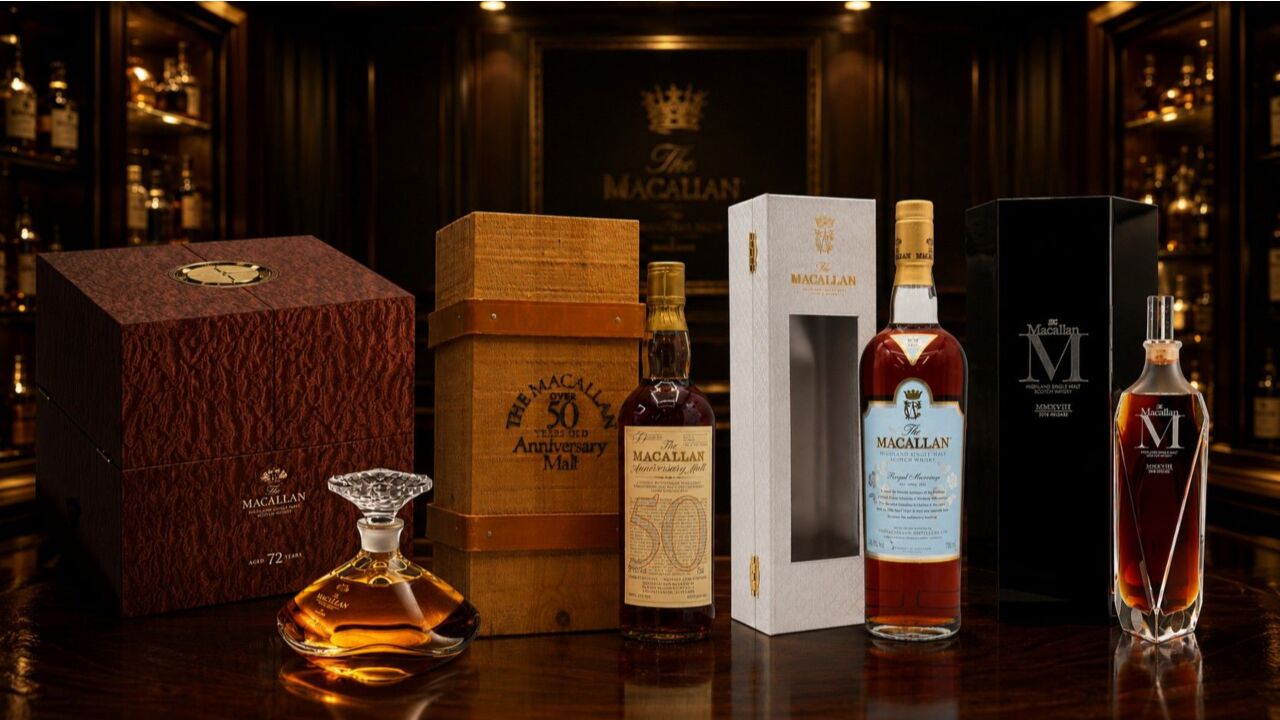






















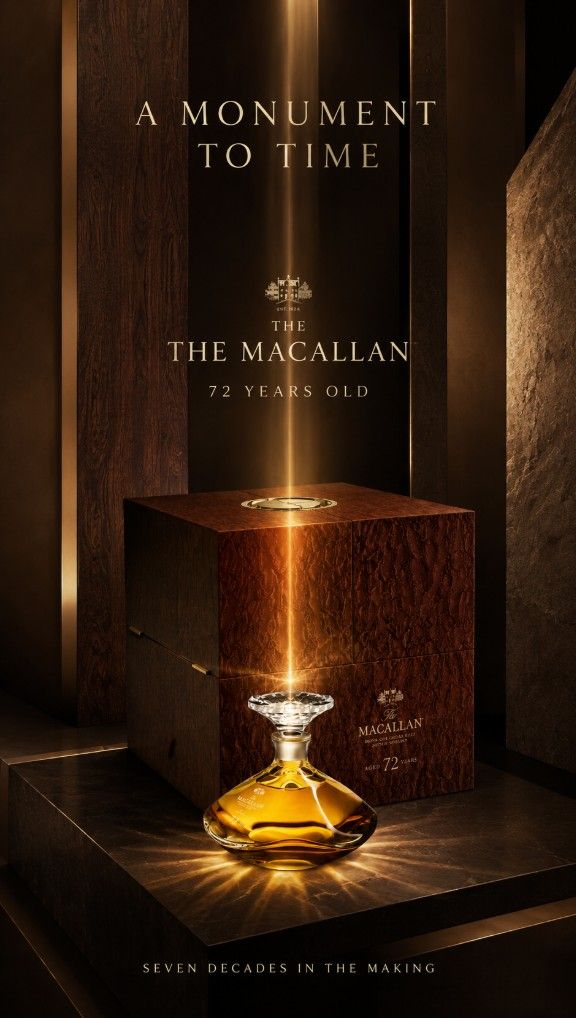
Few whisky releases combine age, rarity, design and distillery history on the scale of The Macallan 72 Year Old Genesis Lalique Decanter.
Released in 2018, The Genesis was created to commemorate a defining moment in The Macallan's history: the opening of its new distillery and visitor experience on the Macallan Estate in Speyside.
The whisky itself had already been waiting for that moment for more than seven decades.
Distilled during the 1940s and matured for 72 years, the extraordinarily old single malt was presented at 42% ABV in an individually numbered Lalique crystal decanter. Only 600 examples were produced worldwide.
Yet the presentation is almost as significant as the whisky.
Lalique designed the crystal decanter to echo the flowing architectural lines of The Macallan's new distillery, while the elaborate presentation case incorporates details derived directly from the building itself.
For collectors exploring the upper reaches of The Macallan range at HTFW or the wider world of Old & Rare Whisky, The Genesis represents a particularly important meeting point between whisky history and contemporary design.
What Is The Macallan 72 Year Old Genesis?
The Macallan Genesis 72 Year Old is an exceptionally limited single malt Scotch whisky released in a bespoke Lalique crystal decanter.
The key details are:
- 72 Year Old Macallan single malt
- 70cl
- 42% ABV
- Distilled during the 1940s
- Released in 2018
- Presented in a bespoke Lalique crystal decanter
- Limited to 600 individually numbered examples worldwide
- Created to commemorate The Macallan's new distillery
- Bespoke presentation case
- Golden amber natural colour
- Official Macallan limited release.
At the time of its release, The Macallan described The Genesis as being among the oldest single malts it had ever released.
The house has subsequently released even older whiskies, but that does little to diminish the significance of Genesis.
It remains a 72-year-old Macallan available in only 600 Lalique decanters and was created for one of the most important moments in the modern history of the distillery.
Why Is It Called The Genesis?
The name is directly connected with a new beginning.
The Genesis was released as The Macallan entered a new era with the opening of its dramatically redesigned distillery and visitor experience in 2018. The house describes the release as marking a “new beginning” in its story.
The concept therefore works on several levels.
The whisky comes from the past.
Its design celebrates the present.
And the building that inspired it represented The Macallan's future.
That relationship is why Genesis feels particularly appropriate.
Rather than simply placing an extremely old whisky into an expensive crystal bottle, The Macallan and Lalique constructed the entire release around a specific chapter in the distillery's history.
Only 600 Decanters Worldwide
Scarcity is one of the clearest parts of the Genesis story.
The Macallan produced only 600 individually numbered decanters worldwide.
That is a remarkably small outturn for a release from one of the world's most internationally recognised whisky producers.
Each example therefore represents one of a fixed number produced for the original 2018 release.
For collectors, the distinction matters.
There cannot simply be another production run of the identical numbered Genesis release once those original 600 have entered private collections, retailers or institutions.
This places the bottle naturally alongside the exceptional releases found within HTFW's Whisky Over £2,000 collection, where extremely old, discontinued and collectable whiskies occupy a very different market from everyday single malt.
A Whisky Distilled in the 1940s
The Macallan states that the spirit inside Genesis was distilled in the 1940s and began its maturation journey during the optimistic post-Second World War period.
That historical context is extraordinary in itself.
The spirit was produced long before:
The modern Scotch whisky boom.
The development of today's international luxury whisky market.
The widespread adoption of single malt as a global category.
The opening of The Macallan's current distillery.
And even many of the collections in which bottles of Genesis now reside.
It then remained in maturation for 72 years.
Few whiskies ever spend anything close to seven decades in oak while retaining sufficient balance and alcoholic strength to be released as a single malt.
What Does 72 Years Old Mean?
Under Scotch whisky rules, an age statement refers to the age of the youngest whisky contained in the bottle.
Therefore, a whisky labelled 72 Years Old must contain no spirit younger than 72 years.
That does not simply make Genesis an old bottle.
It makes the liquid itself extraordinarily mature.
For comparison, even a 25 or 30-year-old single malt is already considered highly mature.
At 72 years, the maturation period is more than twice that.
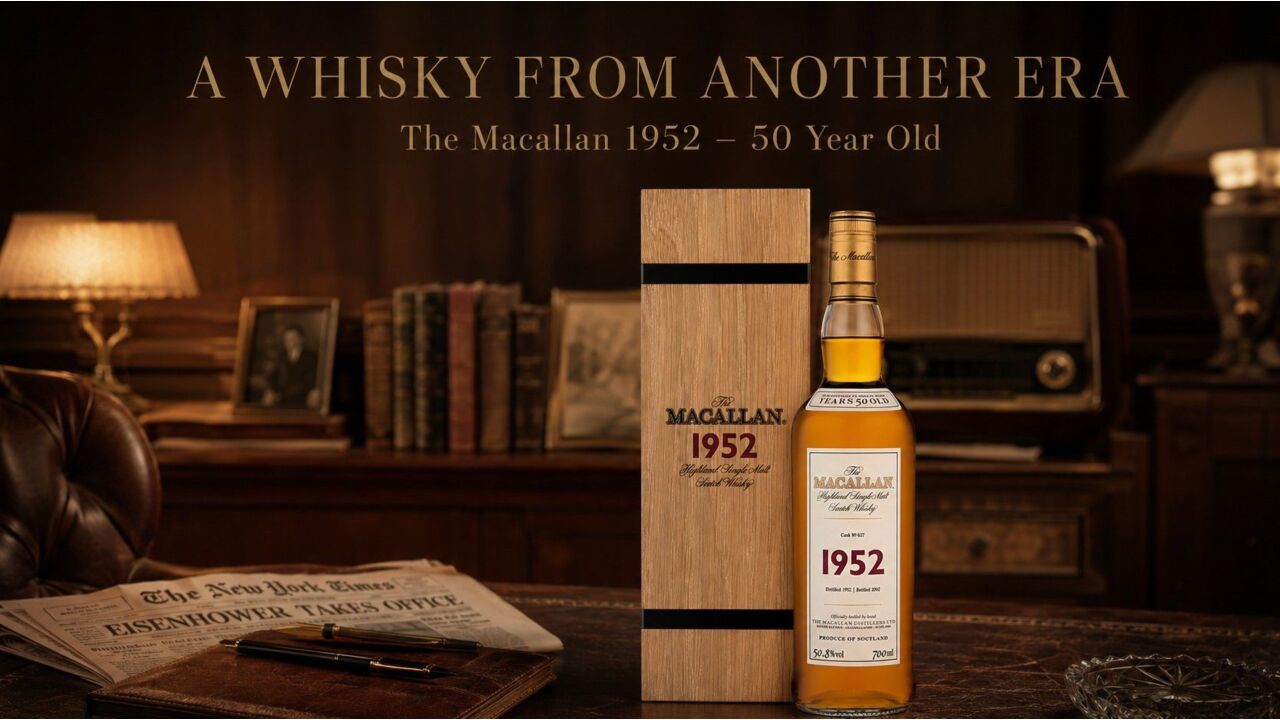
Collectors interested in comparing different generations of mature Macallan can explore releases such as the Macallan Fine & Rare 1952 50 Year Old, another exceptional example of long-aged Macallan available through HTFW.
The Macallan and Lalique
The Genesis belongs to a much broader relationship between The Macallan and French crystal house Lalique.
The two luxury names collaborated for more than a decade on the celebrated Macallan in Lalique Six Pillars Collection.
That collection included limited decanters containing Macallan aged:
50 Years
55 Years
57 Years
60 Years
62 Years
and
65 Years.
Each crystal design interpreted one of The Macallan's traditional “Six Pillars” – the principles the distillery considers fundamental to its identity.
The partnership combined three things particularly effectively:
Old Macallan whisky
Lalique crystal craftsmanship
and
limited production.
The 72 Year Old Genesis extended that relationship into a new chapter.
Instead of representing one of the historic Six Pillars, it looked forward to the new distillery.
What Are The Macallan's Six Pillars?
The Macallan describes six principles at the heart of its identity and whisky-making philosophy.
These include its connection with the Estate, distinctive stills, exceptional oak casks, sherry seasoning, natural colour and the mastery involved in whisky production.
These ideas also help explain the long-running relationship with Lalique.
The Macallan places considerable emphasis on craftsmanship beyond the liquid itself.
The decanter becomes part of the story.
That philosophy remains visible elsewhere in the range, including the Macallan M Decanter 2022 Release and Macallan M Decanter Copper 2022.
These releases occupy a similar world in which whisky, material, architecture and luxury design are deliberately brought together.
The Lalique Genesis Decanter
The Genesis decanter is not simply a generic Lalique bottle carrying Macallan branding.
Its shape was created specifically around the architecture of the new distillery.
The Macallan explains that the rising and falling horizon of the crystal mirrors the distillery roofline, reproducing its clean lines and natural curves.
That roof is one of the most visually distinctive elements of the modern Macallan site.
Rather than appearing as a conventional industrial building, the distillery was designed to integrate into the surrounding Speyside landscape.
Lalique effectively miniaturised that architectural language into crystal.
The bottle therefore becomes an interpretation of the building that Genesis was created to celebrate.
The Presentation Case
The case surrounding the decanter continues the architectural concept.
According to The Macallan, the presentation case features a curved wooden roof positioned above the decanter, while its footprint was taken from the circular layout of the new distillery's three still houses.
The case was designed by Burgess Studio and handcrafted by Royal Warrant-holding cabinet makers NEJ Stevenson.
That level of detail is significant.
With many collectable spirits, the presentation box exists primarily to protect the bottle.
With Genesis, the case is deliberately part of the artwork.
Bottle, case, architecture and whisky are intended to be understood as one complete object.
For a serious collector, retaining the complete original presentation is therefore especially important.
The New Macallan Distillery
The Macallan's new distillery opened in 2018, the same year Genesis was released.
Designed by internationally acclaimed architects Rogers Stirk Harbour + Partners, the building was conceived to sit within the landscape of the Macallan Estate rather than dominate it.
Its distinctive undulating roof became the visual inspiration for the Genesis decanter.
The contrast is particularly interesting.
The whisky was distilled in the 1940s.
The building opened around seven decades later.
The release therefore connects two entirely different eras of Macallan production within one object.
The Macallan Estate
The modern distillery sits on the historic Macallan Estate in Speyside.
The Macallan describes the Estate as approximately 485 acres, incorporating Easter Elchies House, the distillery and a section of the River Spey.
Easter Elchies House has become one of the most recognisable symbols associated with the brand and appears on Macallan packaging.
Although the architecture has changed dramatically during the centuries of production, the geographical connection remains.
This sense of place is one reason collectors often explore Macallan through both modern and historic releases.
HTFW's Macallan collection spans standard age statements, vintage bottles, Fine & Rare releases, Lalique decanters and numerous discontinued editions.
For a wider overview, HTFW's guide to The Macallan and its most collectable whiskies provides another useful starting point.
The Importance of Macallan's Oak Casks
Seventy-two years in oak makes cask management extraordinarily important.
The Macallan identifies exceptional oak casks as the single greatest contributor to the quality, flavour and natural colour of its whisky. The company controls detailed specifications for American and European oak, cask construction and sherry seasoning.
For modern Macallan production, the process of producing these casks can take approximately five years from oak selection through construction and seasoning.
A whisky such as Genesis, however, also reflects an earlier period of Macallan history.
The casks in which its spirit matured began their work decades before today's tightly codified luxury positioning existed.
The fact that the resulting whisky remained sufficiently elegant after 72 years is part of what makes the release so remarkable.
Natural Colour
The colour of Genesis is officially described as golden amber.
The Macallan places particular emphasis on natural colour across its whiskies, stating that colour is drawn from interaction between spirit and maturation oak rather than artificial colouring.
After 72 years, the relationship between spirit and wood becomes especially important.
Long maturation can produce extraordinary concentration and complexity.
But there is always a danger that oak will eventually overpower the spirit.
The official Genesis tasting profile suggests that this has not happened.
Citrus, green apple, vanilla and raisins remain clearly identifiable alongside mature oak and smoke.
Is The Macallan Genesis Peated?
One of the most interesting aspects of Genesis is its subtle peat character.
Modern Macallan is not usually associated with obvious peat smoke, yet the official tasting notes for the 72 Year Old open with delicate peat, followed by aged oak smoke.
That gives the whisky a fascinating historical dimension.
Whisky produced during the 1940s can reflect production practices and raw materials very different from those associated with the modern Macallan house style.
The peat does not dominate.
Instead, it runs alongside citrus, fruit, vanilla, raisins and mature oak.
For collectors familiar primarily with contemporary sherry-led Macallan, Genesis therefore offers a glimpse into a considerably older style of spirit.
What Does The Macallan Genesis 72 Year Old Taste Like?
Despite more than seven decades of maturation, the official tasting notes retain surprising freshness.
Colour
Golden amber.
The colour reflects extraordinary maturation while remaining notably lighter than some intensely sherry-driven Macallan releases.
Nose
The aroma begins with delicate peat.
This develops into soft, aged oak smoke before a much fresher side appears.
Expect:
- Lemon
- Green apple
- Vanilla pods
- Raisins
- A very subtle hint of ginger.
That combination is particularly striking.
A 72-year-old whisky might reasonably be expected to smell almost entirely of antique wood and tertiary flavours.
Genesis instead retains obvious citrus and orchard fruit.
Palate
Delicate peat smoke continues onto the palate alongside soft vanilla and sweet oak smoke.
Gentle wood spice builds before the smoke gradually recedes.
Then citrus and subtle green apple return across a viscous, mouth-coating texture.
The balance between old oak and fresh fruit is arguably the most interesting aspect of the whisky.
Finish
The finish is officially described as medium and fruity, with a sweet oaky mouthfeel.
That relatively restrained finish is another reminder that extreme age does not automatically mean extreme intensity.
Genesis appears to favour elegance over sheer power.
Why Does an Old Macallan Have Green Apple and Lemon Notes?
Age does not necessarily erase fresh fruit.
Maturation transforms whisky, but the final character depends on the spirit, oak, storage conditions and the particular casks selected for release.
In Genesis, citrus and green apple survive alongside:
Peat
aged oak smoke
vanilla
raisins
and
ginger.
That freshness is especially important at 72 years.
Without it, the whisky could easily have become dominated by dry wood.
Instead, fruit continues to provide contrast.
42% ABV After 72 Years
The HTFW bottle is listed at 42% ABV.
That is significant because whisky gradually loses alcohol and volume during extended maturation.
After 72 years, simply retaining sufficient strength to remain Scotch whisky represents an extraordinary period of cask survival.
The resulting 42% ABV also suits the profile.
Genesis is not presented as a powerful cask-strength whisky.
Its focus is age, nuance, texture and historical character.
The Angel's Share Over Seven Decades
Whisky slowly evaporates while it matures.
This loss is traditionally known as the angel's share.
Over a few years, that reduction is simply part of normal whisky maturation.
Over more than seven decades, it becomes a defining factor in rarity.
Every year reduces the quantity of spirit remaining in the cask.
That is one reason whiskies reaching 50, 60 or 70 years old are inherently difficult to produce.
The distillery has to possess suitable stocks, appropriate casks and enough surviving whisky to create a release decades after the spirit was originally distilled.
That scarcity is reflected throughout HTFW's Old & Rare Whisky collection, where the oldest bottles exist in tiny numbers compared with normal production releases.
Genesis vs The Macallan in Lalique 65 Year Old
Before Genesis, The Macallan and Lalique completed the Six Pillars Collection with a 65 Year Old, released in 2016.
The Macallan says only 450 individually numbered bottles of the 65 Year Old were produced. Its Lalique design was inspired by a single drop of Macallan spirit and represented the final chapter of the Six Pillars series.
Genesis then moved the partnership forward.
Macallan Lalique 65 Year Old
- 65 years old
- Final release in the Six Pillars Collection
- 450 numbered bottles
- Decanter inspired by a drop of Macallan spirit.
Macallan Genesis 72 Year Old
- 72 years old
- Released in 2018
- 600 numbered decanters
- Created around the opening of the new distillery
- Decanter inspired by the building's architecture.
The two therefore represent different moments.
The 65 Year Old closed one celebrated Lalique collaboration.
Genesis marked the beginning of a new architectural era for The Macallan.
Genesis vs The Macallan M Decanter
The Macallan M Decanter provides another useful comparison.
Both releases combine exceptional Macallan whisky with highly elaborate presentation.
But the focus is different.
Macallan M
The M collection explores The Macallan's approach to maturation, natural colour and craftsmanship through sculptural Lalique crystal.
Genesis
Genesis is specifically:
- 72 years old
- Linked to one historical moment
- Limited to 600 decanters
- Architecturally inspired
- A 2018 commemorative release.
For collectors interested primarily in design-led Macallan, both are relevant.
For those specifically seeking extraordinary age statements and historic scarcity, Genesis sits in a different tier.
HTFW also carries the Macallan M Copper 2022 Release, another Lalique presentation exploring the relationship between Macallan whisky and its distillation heritage.
Genesis vs Macallan Fine & Rare
The Fine & Rare Collection tells the Macallan story in another way.
Instead of centring primarily on contemporary design, Fine & Rare focuses heavily on historic vintages and individual moments from the distillery's past.
For example, HTFW's Macallan Fine & Rare 1952 50 Year Old Single Cask #627 was distilled in 1952, matured for 50 years and bottled in 2002 at 50.8% ABV.
Genesis approaches history differently.
It contains even older spirit but connects that whisky with a modern architectural milestone.
Fine & Rare says:
This is a moment from Macallan's past.
Genesis says:
This is Macallan's past meeting its future.
Both approaches contribute strongly to the brand's collector reputation.
The Macallan No. 6 Lalique Decanter
Collectors interested specifically in the relationship between Macallan and Lalique can also explore the Macallan 1824 Master Series No. 6 Lalique Decanter.
The No. 6 demonstrates how Lalique crystal has become an important design language within high-end Macallan.
Genesis takes that relationship much further because the decanter is tied directly to the architecture of the distillery itself.
For SEO and customer navigation, these releases form a natural internal family:
Genesis
Macallan in Lalique
M Collection
No. 6
and
Fine & Rare.
All can be explored through the broader Macallan whisky collection at HTFW.
The Golden Age of Travel and Lalique
Another particularly interesting Macallan and Lalique collaboration available through HTFW is The Macallan Golden Age of Travel: The Airship.
That release contains Macallan distilled in 1940 and was created with Lalique as part of a series celebrating the glamour of historic international travel.
It provides an intriguing companion to Genesis.
Both contain Macallan connected with the 1940s.
Both combine whisky with Lalique crystal.
But one looks backwards towards the romance of travel.
Genesis deliberately looks forward towards a new distillery.
Is The Macallan Genesis Collectable?
Undoubtedly, although collectability and guaranteed investment return are not the same thing.
Genesis has several characteristics that make it highly relevant to serious whisky collectors.
72 Years of Age
Whiskies of this age are inherently scarce.
Only 600 Produced
Each decanter is individually numbered.
Lalique Crystal
The bottle is itself a piece of luxury crystal design.
Architectural Significance
Its design directly commemorates The Macallan's 2018 distillery.
Historic Spirit
The whisky was distilled in the 1940s.
Complete Presentation
The elaborate case is an integral part of the original release rather than merely protective packaging.
Macallan Provenance
The Macallan remains one of the most heavily collected single malt names internationally.
These factors explain why Genesis sits naturally within the specialist Old & Rare collection at Hard To Find Whisky.
Future financial performance, however, can never be guaranteed.
Why Condition Matters
With a release such as Genesis, provenance extends well beyond the level of liquid in the bottle.
Collectors should consider:
- Decanter condition
- Crystal stopper
- Original presentation case
- Interior fittings
- Numbering
- Labels and accompanying documentation
- Storage history
- Any visible damage
The presentation case is particularly important because it forms part of the original artistic concept.
Separating the decanter from its case removes part of the architecture-inspired design The Macallan intended.
For a bottle at this level, completeness matters.
Should You Open The Macallan Genesis?
That depends entirely on the owner.
As a collectable object, there is a clear argument for leaving the decanter sealed.
Only 600 were produced.
The Lalique presentation is significant.
The release marks a specific point in Macallan history.
But the liquid was also created to be whisky.
The official tasting notes suggest a fascinating profile quite unlike many contemporary Macallan releases, particularly the presence of delicate peat alongside citrus, green apple, vanilla and mature oak.
For someone fortunate enough to taste Genesis, opening it provides access to something that no photograph of the decanter can reproduce: Macallan spirit distilled more than seven decades before bottling.
There is no correct answer.
A museum-style collector and a whisky drinker will naturally view the bottle differently.
How Should a 72 Year Old Macallan Be Served?
If opened, simplicity would be essential.
There is little justification for adding ice or mixing a whisky of this age into a cocktail.
A small neat measure in a quality tasting glass would allow the aromas to develop gradually.
The 42% ABV strength means excessive dilution should not be necessary.
Most importantly, the whisky should be given time.
Delicate peat, aged oak smoke, citrus, green apple, vanilla, raisins and ginger are all present within the official profile.
A whisky matured for 72 years deserves more than a hurried tasting.
The Macallan Genesis and the Evolution of Luxury Whisky
Genesis also demonstrates how dramatically the definition of luxury whisky has changed.
Historically, the value of whisky centred overwhelmingly on the liquid.
Modern prestige releases increasingly combine spirit with:
Design
art
architecture
crystal
craftsmanship
and
storytelling.
The Macallan has become one of the most visible practitioners of this approach.
Releases such as Genesis, the M Decanter, the M Copper Decanter and the Golden Age of Travel Airship demonstrate different ways that whisky can become part of a much broader luxury object.
Genesis is perhaps one of the clearest examples because every element revolves around one concept.
The new distillery.
Is The Macallan Genesis 72 Year Old Worth Buying?
A bottle at this level cannot realistically be evaluated using the same criteria as an everyday single malt.
Someone simply looking for an excellent whisky to drink has thousands of considerably less expensive options within HTFW's wider Scotch Whisky collection.
Genesis exists for a different buyer.
Its appeal comes from the combination of:
72 years of maturation
1940s distillation
600 numbered decanters
Lalique crystal
bespoke cabinet making
architectural design
and
one of the defining moments in modern Macallan history.
Remove any one of those elements and the bottle becomes less remarkable.
Together they create something closer to a collectable design object containing extraordinarily old whisky.
For the serious Macallan collector, that distinction matters.
Frequently Asked Questions
How old is The Macallan Genesis?
The whisky is 72 years old.
What ABV is Macallan Genesis 72 Year Old?
The HTFW bottle is listed at 42% ABV.
What size is the bottle?
The Lalique decanter contains 70cl of whisky.
When was Macallan Genesis released?
The release was made available in 2018, coinciding with the opening of The Macallan's new distillery.
How many Macallan Genesis decanters were made?
Only 600 individually numbered decanters were produced worldwide.
When was the whisky distilled?
The Macallan states that the whisky was distilled during the 1940s.
Who made the Genesis decanter?
The bespoke crystal decanter was created by Lalique.
What inspired the bottle design?
The decanter was inspired by the architecture of The Macallan's new distillery, with the crystal horizon reproducing the rise and fall of its roofline.
Who designed the presentation case?
The case was designed by Burgess Studio and handcrafted by Royal Warrant-holding cabinet makers NEJ Stevenson.
What does Macallan Genesis taste like?
Expect delicate peat, aged oak smoke, lemon, green apple, vanilla, raisins and subtle ginger, followed by sweet oak, gentle spice and a fruity finish.
What colour is the whisky?
The Macallan describes Genesis as golden amber.
Is Macallan Genesis smoky?
Yes, but gently. The official profile includes delicate peat and soft aged-oak smoke rather than an intensely peated style.
Is Macallan Genesis part of the Lalique Six Pillars Collection?
The Genesis followed The Macallan and Lalique's celebrated Six Pillars collaboration and is presented alongside that partnership in The Macallan archive, but Genesis was specifically created to celebrate the new distillery rather than to represent another traditional Six Pillar.
Does HTFW sell other Macallan Lalique decanters?
HTFW carries a range of prestige Macallan presentations, including the Macallan No. 6 Lalique Decanter, Macallan M Decanter 2022 and Macallan M Copper 2022.
Where can I find more rare Macallan whisky?
The complete Macallan range at HTFW includes modern releases, vintage bottlings and collectable editions, while the Old & Rare Whisky collection and Whisky Over £2,000 sections concentrate on particularly scarce and high-value bottles.
Buy The Macallan 72 Year Old Genesis Lalique Decanter
The Macallan 72 Year Old Genesis Lalique Decanter is difficult to view simply as another old whisky.
The liquid alone would be extraordinary.
Distilled in the 1940s, matured for 72 years and bottled at 42% ABV, it retains an unexpectedly vibrant profile of delicate peat, aged oak smoke, lemon, green apple, vanilla and raisins.
But Genesis is also an architectural object.
Its Lalique crystal rises and falls with the roofline of The Macallan's new distillery.
Its wooden presentation case reflects the building's interior.
Its footprint echoes the three circular still houses.
And only 600 individually numbered examples were made.
That makes the release simultaneously a celebration of where The Macallan had come from and where it was heading in 2018.
For collectors wishing to explore that story further, the Macallan collection at HTFW includes historically important releases such as the Fine & Rare 1952 50 Year Old alongside design-led bottles including the Macallan M Decanter and Macallan No. 6 Lalique Decanter.
For the rarest bottles across multiple distilleries, browse the wider Old & Rare Whisky collection or HTFW's dedicated Whisky Over £2,000 selection.
The Genesis, however, occupies a category of its own.
Seventy-two years of Macallan history, captured inside Lalique crystal and limited to just 600 decanters worldwide.
Shop The Macallan 72 Year Old Genesis Lalique Decanter at Hard To Find Whisky.