














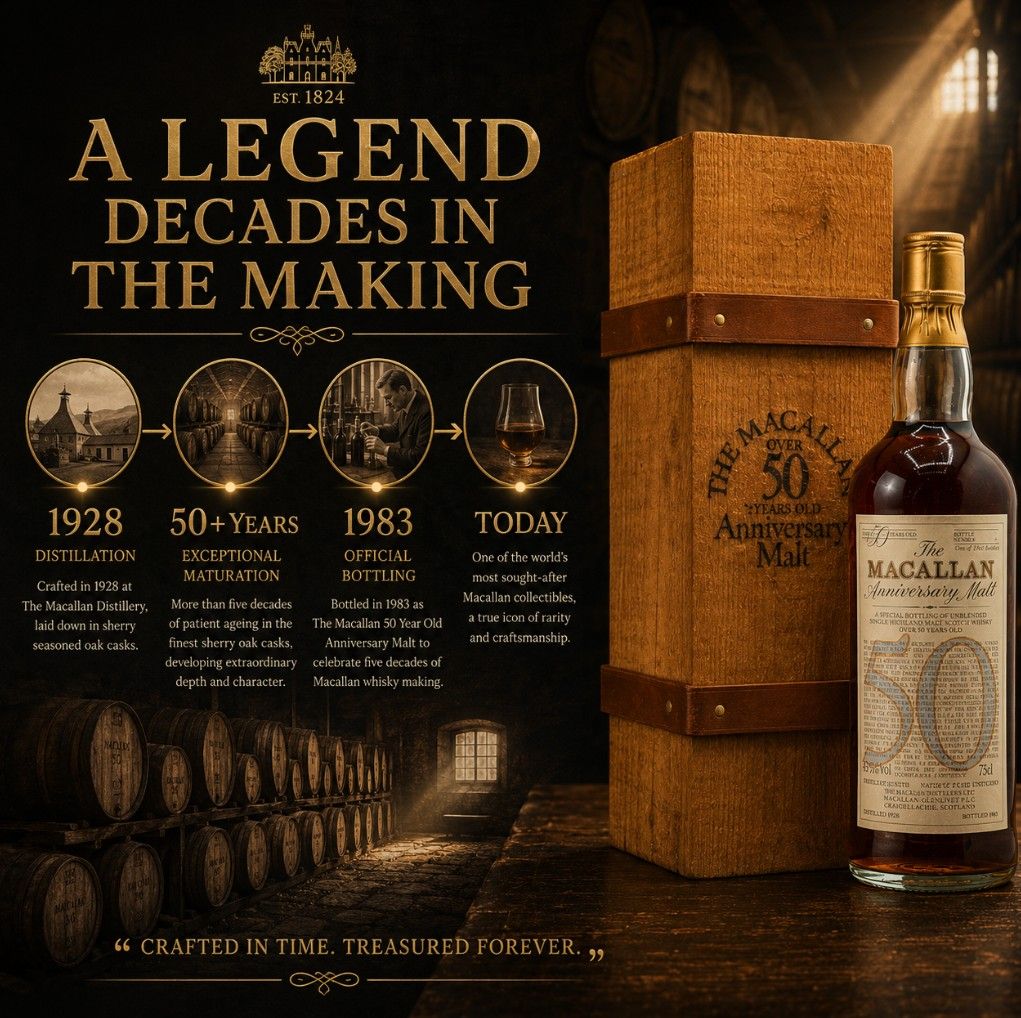
Few bottles illustrate the transformation of single malt Scotch whisky into a globally collected luxury category quite like The Macallan Anniversary Malt 1928 50 Year Old.
Released in 1983, this extraordinary distillery bottling was created from just three exceptionally old sherry casks: one filled in 1926 and two filled in 1928. Only 500 bottles were produced, each presented in a leather-strapped wooden case and accompanied by a personal letter from The Macallan’s then-chairman, Allan G. Shiach.
The label declares the whisky as a 50 Year Old Anniversary Malt and a 1928 vintage, but its history is more complicated than those details initially suggest. With the whisky bottled in 1983 and part of the composition dating from 1926, the liquid was older than the stated half-century age. The 50-year declaration should therefore be understood as a minimum age statement rather than the precise age of every component.
Bottled at a naturally reduced cask strength of 38.6% ABV, this is an important survivor from a very different period in the history of The Macallan. It predates the modern luxury releases, elaborate artistic collaborations and record-breaking auction bottles that now define much of the distillery’s international reputation.
Instead, the Anniversary Malt represents old-style Macallan in its purest form: long-aged spirit, traditional sherry casks, an exceptionally limited outturn and presentation that was remarkably restrained by modern standards.
For serious collectors, The Macallan Anniversary Malt 1928 50 Year Old is not simply another old whisky. It is one of the foundational bottles in the development of rare Macallan as a collectable category.
What Is The Macallan Anniversary Malt 1928 50 Year Old?
The Macallan Anniversary Malt 1928 is an exceptionally rare Speyside single malt Scotch whisky released in 1983 with a stated age of 50 years.
It was created from three historic sherry casks:
- One cask filled in 1926
- Two casks filled in 1928
The whiskies were brought together and bottled in 1983, producing an outturn of only 500 bottles.
The release was bottled at 38.6% ABV and supplied in a wooden presentation case secured with leather straps. Each example was originally accompanied by a signed letter from Allan G. Shiach, who was chairman of The Macallan at the time.
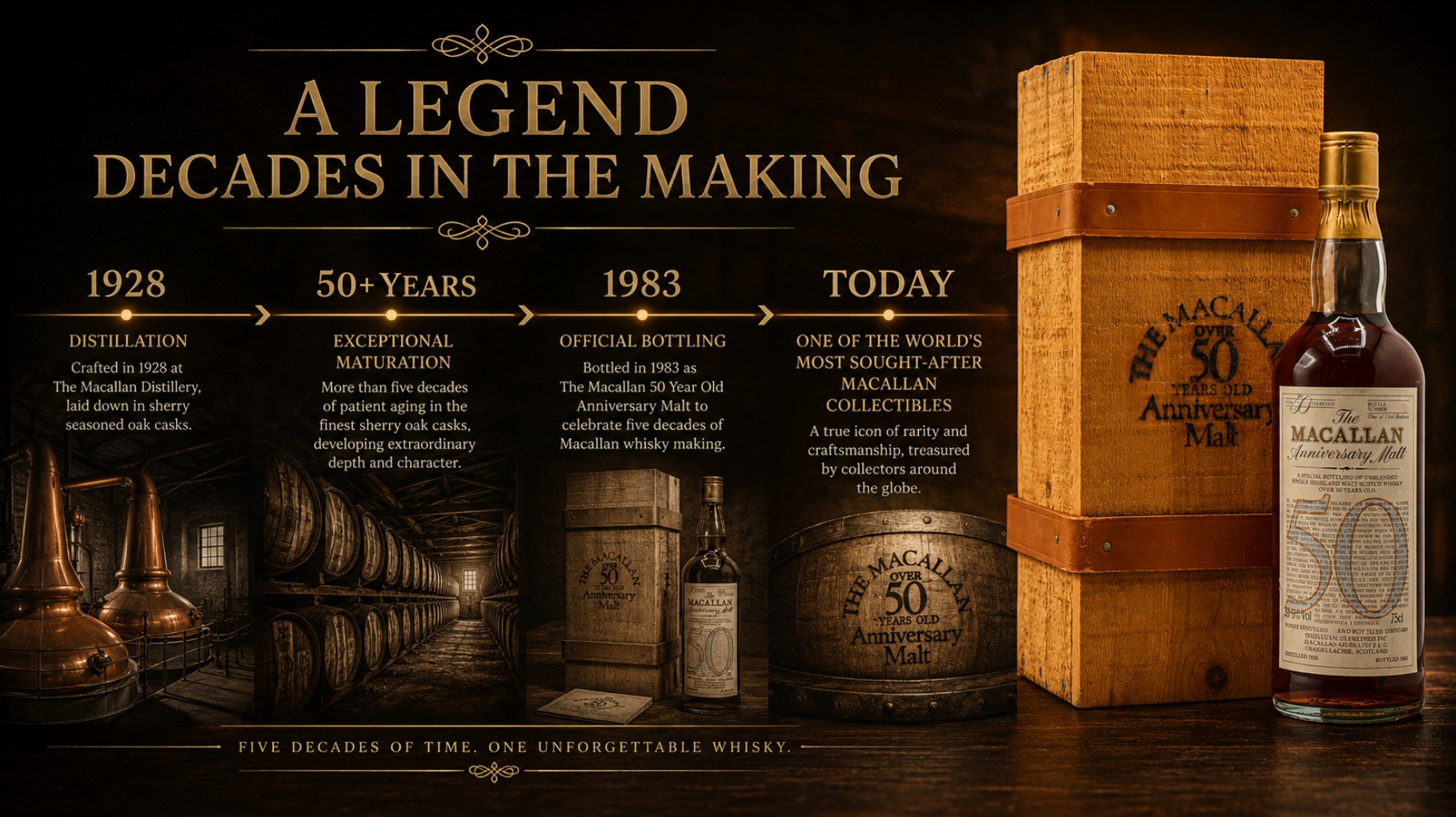
Its principal details are:
- Distillery: The Macallan
- Release: Anniversary Malt
- Stated vintage: 1928
- Stated age: 50 years old
- Year bottled: 1983
- Casks: Three sherry casks
- Composition: One 1926 cask and two 1928 casks
- Strength: 38.6% ABV
- Bottle size: 75cl
- Number produced: 500 bottles
- Packaging: Leather-strapped wooden presentation case
- Original documentation: Personal letter from chairman Allan G. Shiach
The example offered by Hard To Find Whisky is preserved in its original presentation and represents one of the most complete forms in which this bottle can survive.
Explore the Macallan Anniversary Malt 1928 50 Year Old, browse the wider Macallan whisky collection, or discover more historic bottles within HTFW’s old and rare whisky selection.
Is This Whisky Really 50 Years Old?
Yes, but the whisky was almost certainly older than the age printed on its label.
The Anniversary Malt was bottled in 1983. Two of its component casks were filled in 1928, which would place those whiskies at approximately 54 or 55 years old depending on their exact filling and bottling dates.
The third cask was filled in 1926, making that component approximately two years older again.
Under Scotch whisky rules, an age statement must refer to the youngest whisky in the bottle. A producer is free to declare a lower age than the youngest component, provided the statement is not exaggerated.
The Macallan could therefore label this a 50-year-old whisky even though the youngest spirit had matured for several additional years.
The most accurate way to describe the release is:
- It carries an official 50-year age statement.
- Its youngest component dates from 1928.
- It was bottled in 1983.
- Its liquid was therefore approximately 54 to 55 years old.
- The 1926 component was older still.
This discrepancy does not undermine the bottle. It makes the release even more interesting, demonstrating that The Macallan chose a clear half-century statement rather than attempting to account for every additional month in cask.
Why Is It Known as a 1928 Vintage When It Contains 1926 Whisky?
The bottle is conventionally catalogued and labelled as The Macallan 1928 Anniversary Malt, even though one of the three casks was filled in 1926.
Vintage statements normally indicate the year in which a whisky was distilled, but this release combines spirit from more than one year. The prominence of 1928 reflects the fact that two of the three casks came from that vintage and that it became the identifying year chosen for the bottle.
The 1926 component was older than the declared vintage and age, so its inclusion did not make either statement misleading from an age perspective.
For collectors, the full cask composition is more informative than the simplified vintage printed on the label. It reveals that this was not a single-vintage or single-cask whisky but a tiny vatting assembled from three ancient sherry casks.
That composition also connects the release with one of the most important periods in the history of The Macallan.
The Macallan in 1926 and 1928
The spirit used for this Anniversary Malt was distilled during the interwar period, when the Scotch whisky industry looked very different from the one known today.
Most malt whisky was produced for blending rather than sale under an individual distillery name. Single malt existed, but it had not yet developed into the large international category that emerged during the second half of the 20th century.
The Macallan was already recognised for producing substantial, richly flavoured malt whisky suited to sherry-cask maturation. However, the distillery’s modern position as a global luxury brand was still many decades away.
The whisky laid down in 1926 and 1928 would survive:
- The economic turbulence of the interwar years
- The Great Depression
- The Second World War
- Post-war restrictions and rationing
- The international expansion of Scotch whisky
- The emergence of single malt as a recognised category
- Major changes in distilling, warehousing and packaging
- More than half a century of maturation
By the time the casks were bottled in 1983, both the whisky industry and The Macallan had changed considerably.
The Anniversary Malt therefore captures spirit made under production conditions that can no longer be reproduced exactly. Differences in barley varieties, malting, peat use, yeast, fermentation, distillation, direct firing, cask sourcing and warehouse management all contributed to the character of historic Macallan.
Nettie Harbinson and The Macallan During the 1920s
The 1926 and 1928 casks were filled during the period in which Janet Isabella Harbinson, better known as Nettie Harbinson, played a leading role at The Macallan.
Nettie became closely involved with the distillery after the death of her husband, Alexander Harbinson, in 1918. At a time when female leadership in the Scotch whisky industry was highly unusual, she helped guide The Macallan through a difficult economic period.
Her importance has received renewed recognition through The Macallan’s film The Spirit of 1926, which explored her life and connection with the whisky distilled during that celebrated year.
The Macallan Anniversary Malt contains whisky made during her stewardship. The inclusion of a 1926 cask gives this release a direct connection to that chapter in the distillery’s history.
This matters because provenance in rare whisky extends beyond age and scarcity. A truly significant bottle can also preserve the work of the people who protected a distillery, filled its casks and kept its whisky maturing through periods of uncertainty.
The History of The Macallan Distillery
The Macallan was founded in 1824 by Alexander Reid on a plateau above the River Spey.
Reid was a barley farmer and schoolteacher who secured one of the earliest legal distilling licences issued after the Excise Act of 1823. Production developed around Easter Elchies, an estate whose historic manor house remains central to The Macallan’s identity.
The original name was connected with the older place name Maghellan. It is commonly explained as combining the Gaelic word magh, meaning fertile ground, with a reference to St Fillan.
Over the following two centuries, The Macallan developed a reputation for rich spirit and maturation in high-quality oak casks, particularly those seasoned with sherry.
The distillery’s modern reputation rests on several long-standing characteristics:
- A naturally weighty and fruity new-make spirit
- Small copper stills
- Careful selection of the spirit cut
- Extensive use of sherry-seasoned oak
- Long maturation
- A large archive of historic bottlings
- Strong continuity between the estate, wood policy and finished whisky
The Macallan is legally situated within the Speyside whisky region, although many historic labels describe the whisky as Highland single malt. Speyside forms part of the broader Highlands, and older labelling conventions often used Highland terminology more generally.
Customers can explore current and historic releases within the full Macallan whisky range.
Why Does the Bottle Say Highland Single Malt?
Historic Macallan bottles frequently use the description Highland single malt Scotch whisky, even though The Macallan is now normally categorised as a Speyside distillery.
This is not a contradiction.
Speyside is a legally recognised Scotch whisky region located within the wider Scottish Highlands. Historically, the boundaries and marketing use of these regional terms were less rigid than they appear today.
Many distilleries now described as Speyside producers once used Highland wording on their labels. The term communicated a broad geographical and stylistic identity rather than excluding the whisky from Speyside.
Modern product information generally lists The Macallan as Speyside. The original Anniversary Malt presentation should nevertheless be understood within the labelling conventions of its own period.
The Creation of the Anniversary Malt Range
The Macallan introduced its 25 Year Old Anniversary Malt as part of its regular output in 1983.
The series became one of the distillery’s most celebrated historic ranges. Each release combined substantial age, sherry-cask maturation and the traditional Macallan bottle and presentation style.
The 25 Year Old Anniversary Malt continued for around two decades, with releases carrying different vintages before the range was eventually replaced.
The 1928 50 Year Old was launched alongside the first 25 Year Old Anniversary Malt but occupied an entirely different level of rarity.
Where the 25 Year Old became a continuing annual series, the 50 Year Old was limited to only 500 bottles.
Its release helped establish several ideas that later became central to collectable Macallan:
- Exceptionally old age statements
- Historic vintages
- Very limited production
- Original distillery bottling
- Sherry-cask maturation
- Bespoke wooden presentation
- Documentary provenance
- A direct connection with the distillery’s past
In that respect, this bottle helped lay the foundations for later ranges such as Fine & Rare and The Macallan’s modern ultra-aged releases.
Why Was It Called the Anniversary Malt?
The Anniversary Malt name became associated with The Macallan’s prestigious aged releases during the 1980s.
The title communicated heritage and celebration without relying on the more elaborate collection names common in modern luxury whisky.
It was a simple proposition: mature Macallan released to mark the distillery’s history and continuity.
The restrained name now forms an important part of its appeal. Collectors recognise Anniversary Malt as one of the classic Macallan series, particularly in relation to the 25 Year Old vintages and this exceptionally rare 50 Year Old.
How Rare Is The Macallan 1928 50 Year Old?
Only 500 bottles were produced.
That number was small even when the whisky was released, but the surviving population will inevitably be lower today.
Over more than four decades, bottles may have been:
- Opened and consumed
- Damaged
- Lost
- Separated from their original cases
- Separated from their authenticity letters
- Stored incorrectly
- Affected by evaporation
- Sold into private collections and removed from public view
A surviving bottle with its complete wooden case, leather straps and original chairman’s letter is substantially more desirable than a bottle offered without its accompanying materials.
Rarity therefore has several levels:
- Only 500 bottles were originally created.
- Fewer remain unopened.
- Fewer still survive in excellent condition.
- Complete examples with original packaging and paperwork are scarcer again.
This makes the condition and completeness of each individual example critically important.
Why Is the Original Wooden Case Important?
The presentation case forms part of the bottle’s provenance and collector value.
The Macallan Anniversary Malt was supplied in a traditional wooden case secured by leather straps. Compared with modern luxury packaging, the design is restrained, but that simplicity accurately reflects the period in which the bottle was released.
Original packaging helps demonstrate that the whisky has been carefully preserved and has not been assembled from unrelated components.
Collectors examine:
- The condition of the wood
- The leather straps
- Hinges and fastenings
- Interior fittings
- Printed and branded details
- Signs of restoration or replacement
- Whether the bottle fits the case correctly
- Whether the case matches the known release
A complete package also presents the whisky as The Macallan originally intended.
For a bottle of this importance, the case is not merely a protective container. It is part of the artefact.
Why Is Allan G. Shiach’s Letter Significant?
The original release included a personal letter from Allan G. Shiach, chairman of The Macallan at the time.
Shiach was a member of the family connected with the distillery and also an accomplished writer and screenwriter. His association with both The Macallan and the later telling of Nettie Harbinson’s story adds particular interest to the documentation.
The letter provides:
- Contemporary confirmation of the release
- Direct association with The Macallan’s chairman
- Supporting provenance
- Historical context
- Greater completeness
- Additional protection against uncertainty over presentation
With high-value collectable whisky, supporting documents can be nearly as important as the packaging itself. They help establish a continuous and credible history for the bottle.
A Macallan 1928 Anniversary Malt retaining this letter represents the release in its most desirable original form.
What Did The Macallan 1928 Cost When Released?
The original retail price in 1983 was reportedly £50.
Even at the time, £50 represented a meaningful sum for a bottle of Scotch whisky. However, it appears remarkably modest beside the value now associated with the Anniversary Malt.
Its appreciation reflects several wider developments:
- The global growth of single malt whisky
- The rise of Macallan as a luxury brand
- Increasing demand for historic sherry-cask whisky
- The scarcity of very old distillery bottlings
- Expansion of the international whisky auction market
- The emergence of whisky as a collectable asset
- Record prices for rare Macallan releases
The contrast between its original price and modern value demonstrates how dramatically the rare whisky market has developed since the early 1980s.
It also shows that the bottle was created before ultra-aged whisky routinely carried five- or six-figure release prices.
Why Has Rare Macallan Become So Valuable?
The Macallan occupies a unique position within the collectable whisky market.
Several factors contribute to demand:
Historic Sherry-Cask Character
Older Macallan is closely associated with rich sherry-cask maturation. These historic bottlings display a style that many collectors consider increasingly difficult to reproduce.
Extensive Archive
The distillery has released notable vintages and old-age statements across several decades. This gives collectors a structured archive to pursue rather than isolated bottles.
Strong Visual Identity
Classic Macallan labels, shoulder bottles, wooden cases and vintage statements are immediately recognisable.
International Reputation
The Macallan has developed one of the strongest global reputations in Scotch whisky.
Auction Records
Record-breaking sales have drawn attention to rare Macallan and helped establish it as a leading collectable spirit.
Genuine Scarcity
The most important bottles were produced in very small quantities, and their surviving numbers continue to decline.
Provenance
Historic distillery bottlings are supported by records, presentation materials and established release histories.
The 1928 Anniversary Malt combines all of these qualities in one bottle.
Was This One of the First Record-Breaking Whiskies?
The Macallan Anniversary Malt 1928 50 Year Old has an important place in the early history of high-value whisky collecting.
Examples of the bottle achieved prices that helped demonstrate the growing market for rare single malt. It emerged before the modern period in which million-pound whisky sales and international auction headlines became familiar.
Later Macallan releases, particularly the 1926 60 Year Old bottles bearing labels by artists such as Valerio Adami and Sir Peter Blake, would establish even greater records.
However, the Anniversary Malt belongs to an earlier generation of collectables. It helped prove that a bottle of Scotch whisky could be valued not only as a drink but also as a historic object defined by age, provenance and rarity.
Is This the Same as The Macallan 1926 60 Year Old?
No. The Macallan Anniversary Malt 1928 50 Year Old is a separate release from the famous Macallan 1926 60 Year Old.
The names can cause confusion because the Anniversary Malt contains one component cask filled in 1926.
The Macallan Anniversary Malt 1928 50 Year Old
- Three-cask vatting
- One 1926 cask and two 1928 casks
- Bottled in 1983
- Stated age of 50 years
- 500 bottles produced
- Bottled at 38.6% ABV
- Traditional Macallan label
- Wooden case with leather straps
The Macallan 1926 60 Year Old
- Distilled in 1926
- Matured for 60 years
- Bottled in 1986
- Only 40 bottles produced
- Released with several different label treatments
- Includes bottles associated with Peter Blake and Valerio Adami
- Among the most valuable whiskies ever sold
Both are extremely important, but they have different cask histories, bottling years, presentations and outturns.
The presence of 1926 whisky in the Anniversary Malt gives it an important connection with the same historic production period without making it part of the famous 40-bottle 1926 60 Year Old release.
What Does Cask Strength Mean at Only 38.6% ABV?
The bottle is identified as a cask-strength release despite being bottled below 40% ABV.
This initially appears surprising because Scotch whisky must normally be bottled at a minimum of 40% ABV.
However, exceptional old whiskies can naturally fall below 40% while ageing. Alcohol and water evaporate through the oak, and the rate at which each is lost depends on warehouse conditions.
After more than half a century in cask, the three component whiskies had reduced naturally to approximately 38.6% ABV.
Historic provisions allowed certain old whiskies to be bottled below the normal 40% threshold when they had fallen naturally beneath it during maturation.
In this case, the lower strength is not the result of heavy dilution. It reflects extraordinary time in oak.
The 38.6% ABV therefore provides valuable information about the whisky’s maturation history.
What Is the Angel’s Share?
The angel’s share is the whisky lost through evaporation while it matures in oak.
Casks are not completely airtight. Small amounts of alcohol and water pass through the wood and disappear into the warehouse atmosphere each year.
Over five decades, this loss becomes substantial.
The original 1926 and 1928 casks would have contained far more liquid when filled than remained available for the Anniversary Malt in 1983.
Long maturation creates several challenges:
- The volume steadily declines.
- Alcohol strength may fall.
- Oak influence becomes more intense.
- Leakage can occur.
- Casks require careful monitoring.
- Only a small quantity may survive in suitable condition.
The fact that three casks remained balanced and usable after more than half a century is one reason the release is so remarkable.
What Type of Casks Were Used?
The Anniversary Malt was matured in sherry casks.
Sherry-cask maturation is one of the defining features of historic Macallan.
Oak casks seasoned with sherry can contribute:
- Raisins
- Figs
- Dates
- Orange peel
- Dark chocolate
- Cinnamon
- Clove
- Polished oak
- Leather
- Tobacco
- Walnuts
- Mahogany
- Balsamic depth
After more than 50 years, the relationship between spirit and wood becomes particularly intense.
The success of such long maturation depends on the original quality of the spirit, the cask and the warehouse conditions. A weak spirit or overly aggressive cask could become dry and dominated by tannin.
Old Macallan’s weight and fruit allowed it to remain expressive even after several decades in sherry wood.
European Oak and Historic Sherry Casks
Historic Macallan sherry casks were commonly associated with European oak and the transport or storage of Spanish sherry.
European oak can contribute firmer tannin and darker spice than American oak. Typical notes include:
- Raisin
- Fig
- Clove
- Walnut
- Leather
- Tobacco
- Dark chocolate
- Cedar
- Polished wood
The precise cask history of each Anniversary Malt component is not fully detailed on the bottle. However, the flavour and release information place it firmly within The Macallan’s traditional sherry-cask style.
Modern cask supply is managed differently, with producers commissioning oak casks and arranging for them to be seasoned with sherry before use.
The Anniversary Malt comes from an earlier cask era, adding another layer to its historical significance.
What Does The Macallan 1928 50 Year Old Taste Like?
Opening a bottle of this rarity would be an extraordinary decision. Most surviving examples are preserved as collectable artefacts rather than consumed.
The established flavour profile reflects highly mature sherry-cask Macallan with deep fruit, polished oak and aromatic spice.
Colour
Rich copper-gold with deep mahogany tones.
Amber and honeyed highlights appear around the rim, while the dark centre reflects decades of interaction with sherry-seasoned oak.
Nose
An opulent sherry-led aroma filled with raisins, figs and dates.
Orange zest provides freshness before toffee, dark chocolate, cinnamon and nutmeg begin to develop.
Long ageing introduces deeper notes of:
- Polished mahogany
- Leather
- Tobacco
- Cedar
- Walnut
- Balsamic wood
- Antique furniture
- Dried citrus peel
The low natural strength should allow the aroma to emerge gently rather than with the force of a high-proof whisky.
Palate
Silky and concentrated, with fig, raisin, dates and orange zest.
Cinnamon and clove lead into toasted almond, dark chocolate and polished oak. Mature sweetness suggests toffee, fruit cake and old sherry before leather and tobacco add dryness.
The whisky’s age should be most apparent through texture and integration rather than raw wood alone.
Finish
Long, refined and drying.
Dark fruit, chocolate and spice fade gradually into antique oak, tobacco, leather and a lingering balsamic quality.
Is Extremely Old Whisky Always Better?
No. Age alone does not guarantee quality.
Whisky develops through interaction with its cask. Over time, this can create complexity, softness and depth, but excessive oak exposure can also produce:
- Dryness
- Bitterness
- Heavy tannin
- Loss of distillery character
- Excessive wood spice
- A thin or fragile palate
A successful 50-year-old whisky requires an unusually strong spirit and a cask capable of supporting extremely long maturation.
The significance of The Macallan Anniversary Malt lies partly in the fact that its casks remained suitable after more than five decades.
The age is important, but the combination of spirit, sherry wood, natural strength and historical provenance is what makes the bottle exceptional.
Was Whisky Made Differently in the 1920s?
Yes. Although the fundamental process remains familiar, many production details have changed.
The spirit distilled in 1926 and 1928 may have been influenced by:
- Different barley varieties
- Traditional floor malting
- Greater use of peat during malt drying
- Different yeast cultures
- Longer or less controlled fermentation
- Direct-fired stills
- Manual production methods
- Different spirit cut decisions
- Lower levels of automation
- Historic sherry-cask supply
- Different warehouse practices
It is impossible to isolate the effect of every change from the finished bottle.
However, old Macallan is generally recognised for a substantial, oily and fruity spirit that could withstand very long sherry-cask maturation.
This is one reason historic bottles are valued as more than simply older versions of current releases. They preserve a production style from another era.
Is the Whisky Intended for Drinking or Collecting?
Technically, it is whisky and can be consumed. In practice, most surviving bottles are now treated as historic collectables.
Opening one would permanently reduce the remaining unopened population and separate the liquid from much of its financial value.
Collectors may acquire the bottle for:
- A complete Macallan collection
- Historic significance
- Provenance
- Long-term preservation
- Museum-quality display
- Its position within the Anniversary Malt series
- Its relationship with the 1926 and 1928 vintages
- The rarity of complete original presentation
A buyer considering consumption should understand that this is no longer comparable with opening a standard premium whisky.
It is an irreplaceable piece of Scotch whisky history.
What Determines the Value of a Bottle Like This?
The value of an ultra-rare whisky depends on more than the name printed on the label.
Important factors include:
Authenticity
The bottle, label, capsule, glass, packaging and documentation must be consistent with known genuine examples.
Fill Level
A higher fill level generally suggests better preservation. Excessive evaporation can reduce desirability and may indicate poor storage or closure failure.
Label Condition
Staining, tears, fading and missing sections affect presentation and value.
Capsule and Closure
The capsule should be intact and free from suspicious interference.
Original Packaging
The correct wooden case and leather straps are important components.
Documentation
The original Allan G. Shiach letter adds provenance and completeness.
Storage History
Stable, cool and dark storage is preferable.
Market Demand
Collector demand for rare Macallan can fluctuate.
Provenance
A clear ownership history and purchase from a reputable specialist reduce uncertainty.
The HTFW example is listed with a base-neck fill and original presentation, important details for a bottle of this age.
Why Is the Fill Level Important?
Whisky can slowly evaporate through a cork even after bottling.
For a bottle filled in 1983, some movement in the level may be expected, but a substantial decline can indicate:
- A failing cork
- Heat exposure
- Poor storage
- Leakage
- Excessive evaporation
- Possible interference
Fill levels are usually described according to their position within the neck and shoulder of the bottle.
A base-neck level remains relatively strong for a bottle of this age and style. It suggests that most of the original liquid has been preserved.
The fill should always be assessed alongside the condition of the capsule, closure and packaging.
How Should a Rare Macallan Be Stored?
A bottle of this importance should be stored with professional care.
Keep It Upright
Unlike wine, whisky should not be stored on its side. Long contact with high-strength spirit can damage the cork.
Maintain a Stable Temperature
Avoid significant fluctuations. A cool and stable environment is preferable.
Protect It from Light
Direct sunlight can damage labels, presentation materials and possibly the whisky itself.
Control Humidity
Very dry air may affect the cork, while excessive humidity can damage labels, leather, wood and documentation.
Avoid Vibration
Store the bottle in a secure position away from frequent movement.
Preserve the Packaging Separately but Together
The wooden case, leather straps and letter should remain protected from damp, fading and physical damage.
Consider Specialist Insurance
A bottle of this value should be specifically declared and documented.
Maintain Detailed Records
Keep photographs, receipts, provenance documents, condition reports and correspondence.
The bottle should not be repeatedly handled or removed from its case without good reason.
Should the Bottle Be Rotated to Wet the Cork?
Regularly rotating or tipping old whisky bottles is not generally recommended.
Although brief controlled contact is sometimes suggested for certain old corks, repeatedly exposing the closure to high-strength spirit can cause deterioration.
For a bottle of this rarity, any handling strategy should be discussed with an experienced rare-spirit conservator or specialist.
Unnecessary movement creates additional risk.
The safest general position remains upright, stable and protected.
Authentication and Counterfeit Risk
The high values attached to rare Macallan make authentication especially important.
Collectors should not rely on one feature alone.
A proper assessment may consider:
- Glass shape and manufacturing marks
- Label paper and printing
- Capsule construction
- Closure
- Fill level
- Sediment and liquid appearance
- Wooden case
- Leather straps
- Letter and paper stock
- Known ownership history
- Comparison with verified examples
- Specialist inspection
Original supporting materials substantially strengthen provenance, but they must also be assessed for consistency.
Purchasing through an established rare-whisky specialist provides greater protection than an undocumented private transaction.
Is Rare Whisky Guaranteed to Rise in Value?
No.
Historic whisky has achieved substantial prices, but bottles should not be presented as guaranteed investments.
The market can be affected by:
- Economic conditions
- Collector demand
- Currency movements
- Changes in brand reputation
- Auction supply
- Authenticity concerns
- Condition
- Storage history
- Regulation
- Shifts in luxury spending
Older and genuinely scarce bottles may behave differently from large-volume modern limited editions, but no bottle is free from market risk.
The Macallan Anniversary Malt has exceptional historical importance and rarity. Those qualities support collector interest, but future financial performance cannot be guaranteed.
How Does It Compare with Modern Macallan 50 Year Old Releases?
Modern Macallan 50 Year Old releases are usually presented with highly elaborate packaging, contemporary design and premium launch pricing.
The 1928 Anniversary Malt comes from a different era.
Anniversary Malt 1928
- Bottled in 1983
- Spirit distilled in 1926 and 1928
- Only 500 bottles
- Traditional label
- Leather-strapped wooden case
- Personal chairman’s letter
- 38.6% natural strength
- Historic sherry casks
- Released before modern luxury whisky marketing
Modern 50 Year Old Macallan
- Contemporary spirit selection
- Modern cask management
- Usually 70cl
- Often bottled above 40% ABV
- Highly designed decanters and cases
- Premium release pricing
- Modern brand storytelling
- Frequently released as part of a named collection
The older bottle’s appeal comes from provenance, survival and its place in the development of collectable whisky.
Modern releases offer craftsmanship and rarity, but they cannot reproduce the historical circumstances of spirit distilled in the 1920s.
How Does It Compare with The Macallan Fine & Rare Collection?
The Fine & Rare Collection brings together historic Macallan vintages bottled at different ages and times.
It allows collectors to follow the changing character of the distillery across the 20th century.
The Anniversary Malt shares several characteristics with Fine & Rare:
- Historic vintage
- Old sherry-cask whisky
- Limited availability
- Strong provenance
- Distillery bottling
- Collector focus
However, the Anniversary Malt predates the modern Fine & Rare identity and belongs to its own historically important series.
Its three-cask composition, 50-year label, 1983 bottling and traditional presentation make it distinct from later Fine & Rare releases.
Collectors building a chronological Macallan archive may regard the Anniversary Malt as an essential predecessor to the distillery’s later ultra-premium collections.
How Does It Compare with The Macallan 25 Year Old Anniversary Malt?
The 25 Year Old Anniversary Malt was released as a continuing series, while the 50 Year Old was a one-off limited bottling.
Macallan 25 Year Old Anniversary Malt
- Introduced in 1983
- Continued for approximately two decades
- Released across several vintages
- Usually bottled at 43% ABV
- Sherry-cask matured
- Highly collectable but more widely produced
- Important part of the historic core range
Macallan 1928 50 Year Old Anniversary Malt
- Released in 1983
- One exceptional release
- Only 500 bottles
- Three historic casks
- Bottled at 38.6% ABV
- More than 50 years in oak
- Original chairman’s letter
- Considerably rarer
The 25 Year Old series established the Anniversary Malt identity, while the 50 Year Old represents its most extraordinary expression.
Is It a Single Malt Even Though Three Casks Were Used?
Yes.
A single malt Scotch whisky can contain spirit from multiple casks and multiple vintages, provided all of the whisky was:
- Made from malted barley
- Produced at one distillery
- Distilled in copper pot stills
- Matured in Scotland
- Bottled according to Scotch whisky regulations
All three casks came from The Macallan.
The term single malt refers to a single distillery, not a single cask or single year.
This bottle is therefore a single malt, a multi-cask vatting and a multi-vintage release.
Does the Whisky Contain Added Colour?
Historic Macallan bottlings of this type are prized for the natural colour created through long sherry-cask maturation.
The deep copper and mahogany appearance reflects extended interaction between the whisky and oak.
The bottle’s colour is part of its visual appeal, but colour alone cannot confirm authenticity or quality.
Long-aged whisky can vary significantly depending on cask activity, and genuine old spirit may be lighter or darker than expected.
Is the Whisky Chill Filtered?
This release is generally catalogued as non-chill filtered.
At 38.6% ABV, natural oils and compounds may become visible under cold conditions.
Cloudiness or sediment in an old whisky is not automatically a fault. It can reflect natural components retained in the liquid or changes caused by decades in the bottle.
A collector should not shake or disturb the bottle unnecessarily.
Could the Whisky Still Be Enjoyable?
A properly sealed and stored whisky can remain stable for many decades in glass.
The bottle does not continue to mature, but it can preserve the character present when it was filled.
Potential risks include:
- Cork deterioration
- Oxidation through closure failure
- Excessive evaporation
- Heat damage
- Contamination
- Poor storage
The strong fill level and intact presentation provide encouraging signs, but no unopened bottle can be tasted or guaranteed without opening it.
Any decision to consume the whisky would need to balance sensory curiosity against rarity and preservation.
Who Would Buy a Bottle Like This?
The bottle is most relevant to:
- Advanced Macallan collectors
- Rare-whisky specialists
- Historic spirits collections
- Museums and exhibitions
- Luxury hospitality venues
- Family offices
- Corporate collections
- Buyers seeking a collection centrepiece
- Collectors focused on 1920s distillation
- Collectors of Anniversary Malt releases
It is unlikely to be purchased as an ordinary birthday or Christmas bottle.
Its role is closer to that of a historical artefact, with the whisky, packaging, paperwork and provenance forming one complete object.
Is It Suitable as a Milestone Gift?
The release can carry symbolic meaning for highly significant occasions, particularly where the recipient is a serious collector.
Potential occasions include:
- A major corporate anniversary
- A landmark retirement
- A substantial collection acquisition
- A family legacy purchase
- A museum or hospitality display
- An important philanthropic presentation
- A celebration connected with 1928
- A significant Macallan anniversary
The value and rarity mean that professional advice, secure delivery, insurance and suitable storage should all be considered before purchase.
Frequently Asked Questions
What is The Macallan Anniversary Malt 1928?
It is an exceptionally rare Macallan single malt released in 1983 with a stated age of 50 years.
How old is the whisky?
It is officially labelled as 50 years old, but its youngest components were distilled in 1928 and bottled in 1983, making the liquid approximately 54 to 55 years old.
Does it contain whisky from 1926?
Yes. It was created from one cask filled in 1926 and two filled in 1928.
Why does the label say 1928?
Two of the three component casks were filled in 1928, and that year became the stated vintage and identifying date of the release.
When was it bottled?
It was bottled in 1983.
How many bottles were produced?
Only 500 bottles were released.
What is the alcohol strength?
It was bottled at 38.6% ABV.
How can Scotch whisky be below 40% ABV?
The strength fell naturally during more than five decades of cask maturation. The bottle represents an exceptional historic release rather than a modern whisky diluted below the normal minimum.
Is it cask strength?
Yes. The 38.6% ABV reflects the naturally reduced strength of the old whisky.
What casks were used?
The whisky was matured in sherry casks.
Is it a single cask?
No. It was created from three casks.
Is it a single malt?
Yes. Every component was distilled at The Macallan.
Is it a single vintage?
Not technically. It contains whisky from 1926 and 1928, although the bottle is identified as a 1928 vintage.
What size is the bottle?
The bottle contains 75cl.
Does it come in a wooden case?
Yes. The original presentation consists of a leather-strapped wooden case.
Does it include documentation?
The complete release was supplied with a personal letter from then-chairman Allan G. Shiach.
What condition is the HTFW bottle in?
The listed example is presented in its original case with its accompanying letter and a base-neck fill level.
What does it taste like?
The profile centres on raisins, figs, dates, orange zest, dark chocolate, cinnamon, clove, toasted almonds, polished oak, leather and tobacco.
Is it heavily sherried?
Yes. It represents the deep, mature sherry-cask style associated with historic Macallan.
Is it smoky?
Smoke is not the principal feature. The profile is dominated by dried fruit, spice, chocolate, leather and old oak.
Is this the same as The Macallan 1926 60 Year Old?
No. They are separate releases. The Anniversary Malt contains one 1926 cask but was bottled as a three-cask 50 Year Old release in 1983.
Why is it so valuable?
Its value reflects its age, historic vintages, 500-bottle outturn, sherry-cask maturation, original presentation, Macallan provenance and importance within the development of collectable whisky.
Should it be opened?
That is a personal decision, but opening it would permanently reduce the surviving unopened population and remove much of its collector value.
Does whisky improve in the bottle?
No. It stopped maturing when removed from the cask in 1983.
How should it be stored?
Keep it upright in a secure, cool and dark environment with stable temperature and controlled humidity.
Is it guaranteed to increase in value?
No collectable whisky is guaranteed to appreciate. Condition, provenance and wider market demand all affect value.
Is professional insurance advisable?
Yes. A bottle of this value should be specifically documented, valued and insured.
Why The Macallan Anniversary Malt 1928 Matters
This bottle matters because it stands at the meeting point between two different eras of Scotch whisky.
The liquid belongs to the 1920s, when single malt was produced primarily to support blends and when The Macallan had not yet become an international luxury name.
The bottling belongs to the early 1980s, when distilleries were beginning to recognise the importance of their oldest stocks and single malt collecting was still developing.
Its modern value belongs to a third era, one in which historic Macallan has become among the most sought-after spirits in the world.
The Anniversary Malt therefore charts the development of the category:
- Whisky made as working distillery stock
- Casks preserved for more than half a century
- A limited commemorative release
- The emergence of specialist collecting
- Growth in international demand
- Recognition of rare whisky as a historic and cultural object
Its presentation is equally revealing. There is no crystal decanter, sculptural display or artist-designed label. The bottle relies on age, cask history and provenance.
That restraint gives it an authenticity that many collectors find particularly compelling.
Only 500 bottles were created. Every opened, damaged or incomplete example makes complete survivors more significant.
The whisky inside may be extraordinary, but the bottle’s importance reaches beyond flavour. It preserves The Macallan’s interwar production, the stewardship of Nettie Harbinson, the historic role of sherry casks and the early development of ultra-aged Scotch.
Buy The Macallan Anniversary Malt 1928 50 Year Old
The Macallan Anniversary Malt 1928 50 Year Old is one of the most historically important and collectable releases ever produced by the distillery.
Created from one sherry cask filled in 1926 and two filled in 1928, the whisky was bottled in 1983 at a natural strength of 38.6% ABV. Although officially labelled as a 50 Year Old, its youngest spirit had matured for approximately 54 to 55 years.
Only 500 bottles were produced.
The complete presentation includes the original 75cl bottle, leather-strapped wooden case and personal letter from The Macallan’s then-chairman, Allan G. Shiach.
Its flavour profile reflects exceptionally mature sherry-cask Macallan, with raisins, figs, dates, orange zest, dark chocolate and warming spice moving into polished oak, leather, tobacco and cedar.
This is not simply an old bottle intended to fill a gap in a collection. It is a centrepiece capable of representing the history of The Macallan, the development of collectable single malt and one of the most celebrated periods of Scotch whisky production.
Shop The Macallan Anniversary Malt 1928 50 Year Old, explore the complete Macallan whisky collection, or browse more exceptional bottles within the old and rare whisky range at Hard To Find Whisky.