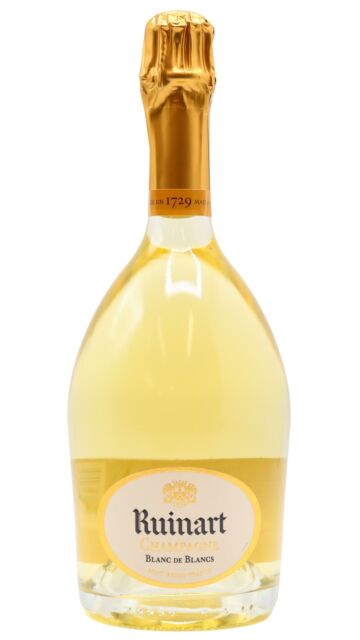





















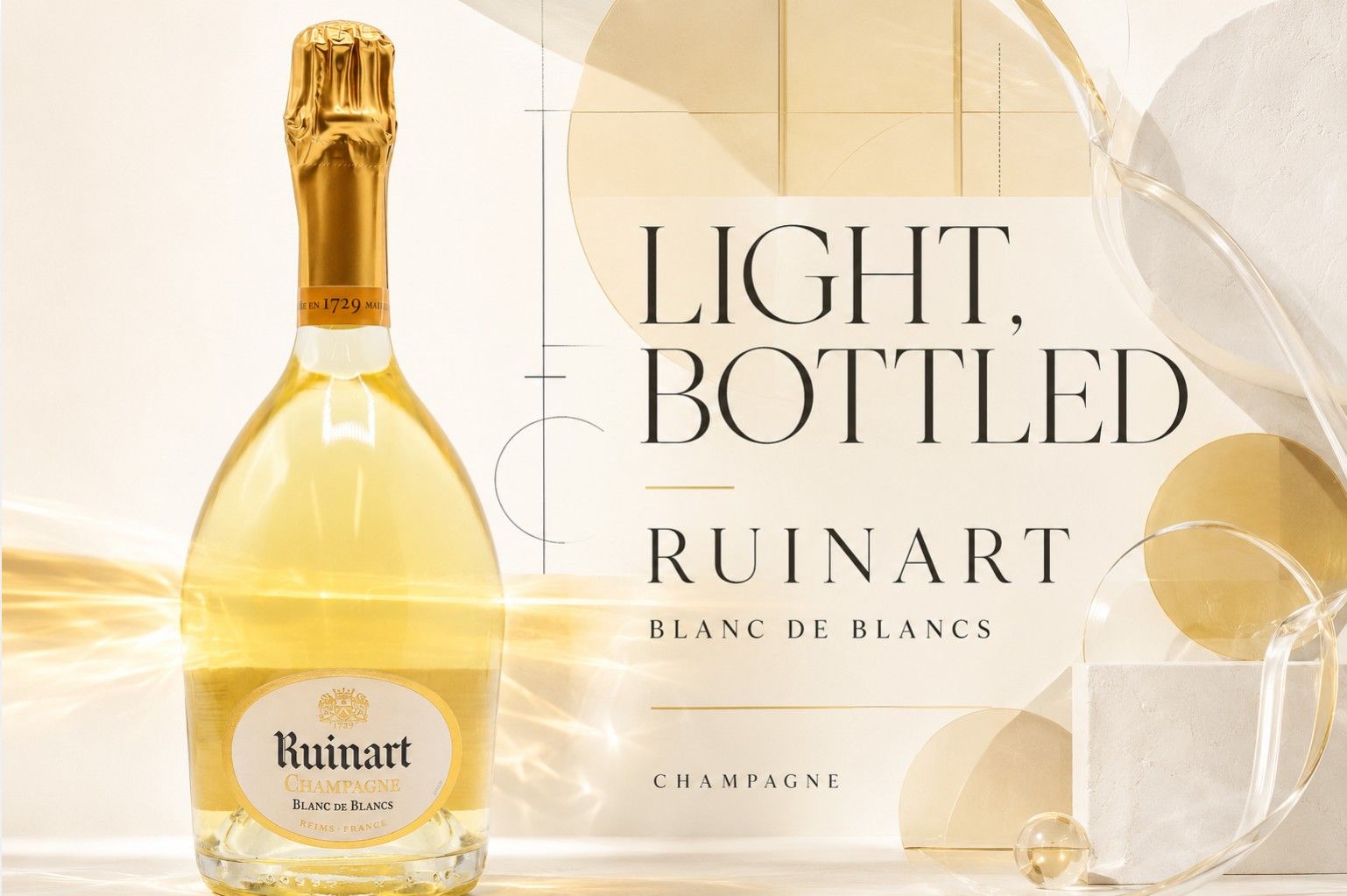
For Ruinart, Chardonnay is not simply one grape among several. It is the defining grape of the house.
The Ruinart Blanc de Blancs Champagne is made entirely from Chardonnay, bringing together fruit from around 25–30 different crus across Champagne. The current blend incorporates 20–30% reserve wines, spends two to three years ageing in Ruinart’s cellars and is bottled at 12.5% ABV with a dosage of 7g/L.
The result captures the style for which Ruinart has become particularly well known: ripe lemon, juicy pear and fresh peach, followed by white flowers, ginger and pink peppercorn before a rounded palate of citrus and tropical fruit.
It also comes from a remarkable Champagne house. Ruinart was established in Reims in 1729, making it the world's first established Champagne house. Chardonnay now sits at the centre of its modern identity, with Ruinart itself describing Blanc de Blancs as the emblematic expression of its signature taste.
For anyone searching for Ruinart Blanc de Blancs, Ruinart Champagne, Chardonnay Champagne, what Blanc de Blancs means or how Ruinart compares with other Champagnes, this is the natural place to begin.
Explore Ruinart Blanc de Blancs at Hard To Find Whisky or browse the wider Ruinart collection at HTFW.
Ruinart Blanc de Blancs at a Glance
- Producer: Ruinart
- Region: Champagne, France
- Style: Blanc de Blancs Champagne
- Grape: 100% Chardonnay
- Bottle size: 75cl
- ABV: 12.5%
- Vineyard sourcing: Approximately 25–30 crus
- Reserve wines: 20–30%
- Fermentation: Temperature-controlled stainless steel
- Malolactic fermentation: Yes
- Cellar ageing: 2–3 years
- Dosage: 7g/L
- Key flavours: Lemon, pear, peach, white flowers, ginger, pink peppercorn, ripe citrus and tropical fruit
- Recommended serving temperature: Around 8°C.
What Is Ruinart Blanc de Blancs?
Ruinart Blanc de Blancs is a multi-vintage Champagne made entirely from Chardonnay.
That sounds simple, but the blend itself is anything but.
Rather than relying on Chardonnay from one vineyard or village, Ruinart selects wines from around 25–30 crus across several areas of Champagne. The house then incorporates reserve wines from earlier harvests to create consistency and additional complexity.
The objective is not to make the sharpest or most austere Chardonnay Champagne possible.
Ruinart's former Cellar Master Frédéric Panaïotis described the cuvée as balancing freshness with roundness, with individual terroirs selected because their Chardonnays contribute different qualities to the finished blend.
That balance is the key to understanding the wine.
Ruinart Blanc de Blancs has the freshness people expect from Chardonnay, but it also has enough ripe fruit and texture to remain approachable.
What Does Blanc de Blancs Mean?
The phrase Blanc de Blancs literally means “white from whites.”
In the case of Ruinart Blanc de Blancs, it means the Champagne is made exclusively from Chardonnay. Ruinart repeatedly identifies Chardonnay as the signature grape of the house and uses it in every one of its cuvées.
That gives Blanc de Blancs a very different profile from a Champagne blending Chardonnay with Pinot Noir and Meunier.
Chardonnay tends to bring the qualities Ruinart wants to emphasise:
- Citrus
- White fruit
- Floral aromas
- Fresh acidity
- Elegance
- Precision
With Blanc de Blancs, those characteristics are allowed to define the entire wine.
Those wanting to explore the style more widely can also browse the Blanc de Blancs Champagne collection at HTFW.
Why Chardonnay Is So Important to Ruinart
Ruinart goes further than simply producing a Blanc de Blancs.
The house describes Chardonnay as the hallmark of Ruinart’s taste, responsible for the elegance and freshness running through its range.
That makes this bottle particularly important.
If R de Ruinart Brut introduces the complete house style through a blend of Chardonnay, Pinot Noir and Meunier, Blanc de Blancs isolates the grape Ruinart considers its signature. The current R de Ruinart composition uses approximately 40% Chardonnay alongside Pinot Noir and Meunier, whereas Blanc de Blancs removes the red varieties entirely.
The difference is immediately noticeable.
R de Ruinart moves towards apple, apricot, nuts, brioche and rounded golden fruit.
Blanc de Blancs is brighter, more citrus-led and floral.
For someone trying to understand what makes Ruinart distinct, Blanc de Blancs is arguably the clearest expression of the answer: Chardonnay.
Where Does the Chardonnay Come From?
Ruinart does not source all of the Chardonnay from one small area.
The house currently identifies four particularly important sources:
- Côte des Blancs
- Montagne de Reims
- Sézannais
- Vallée de la Vesle.
Around 25–30 different crus can be brought together in the finished wine.
That diversity matters.
A Blanc de Blancs can sometimes be thought of as a narrow style because only one grape variety is involved.
Ruinart takes the opposite approach.
One grape, many terroirs.
The complexity comes from blending different interpretations of Chardonnay rather than introducing other varieties.
That also separates the standard Ruinart Blanc de Blancs from prestige vintage releases such as Dom Ruinart Blanc de Blancs 2010, which was made entirely from Grand Cru Chardonnay, with 90% sourced from the Côte des Blancs and 10% from the Montagne de Reims.
Why Are Reserve Wines Used?
The current Ruinart Blanc de Blancs blend contains around 20–30% reserve wines from previous harvests.
Reserve wines are fundamental to multi-vintage Champagne.
Weather changes from one harvest to another.
One year may produce particularly ripe fruit.
Another may deliver greater acidity.
Another may favour certain vineyard areas.
Keeping wines from previous harvests gives the cellar team a broader palette when constructing a consistent house style.
For Ruinart Blanc de Blancs, reserve wines help preserve the balance between:
freshness, ripe fruit, roundness and aromatic complexity.
That is why the lack of a vintage year should not be mistaken for simplicity.
The finished Champagne can draw upon multiple harvests rather than being restricted to one.
How Is Ruinart Blanc de Blancs Made?
Ruinart's current production specification includes:
- Hand harvesting
- Blending Chardonnay from around 25–30 crus
- Incorporating 20–30% reserve wine
- Alcoholic fermentation in temperature-controlled stainless-steel vats
- Malolactic fermentation
- Two to three years of cellar ageing
- Dosage of 7g/L.
The use of stainless steel is significant.
The aim is to preserve the clean fruit and aromatic identity of Chardonnay rather than introducing an obvious layer of new-oak flavour.
Malolactic fermentation then helps moderate some of the sharper natural acidity, supporting the rounded texture Ruinart wants alongside Chardonnay's freshness.
The Champagne is then given two to three years in the cellar before release.
That maturation allows the components to integrate while retaining the bright, fruit-led character that defines the wine.
What Does Ruinart Blanc de Blancs Taste Like?
The official tasting profile is one of the strongest reasons this Champagne is so recognisable.
Rather than moving immediately towards toast, nuts and heavy autolytic character, it begins with fresh fruit and flowers.
Appearance
Ruinart describes the wine as brilliant pale yellow, with delicate almond-green and jade-green reflections.
Those green highlights suit the freshness of the wine particularly well.
Nose
The nose begins with:
- Ripe lemon
- Juicy pear
- Fresh peach
before becoming more floral, with:
- White flowers
- Ginger
- Pink peppercorn.
The ginger and pink peppercorn are particularly interesting.
They give the wine a subtle spicy dimension without moving away from its fundamentally fresh style.
Palate
The palate balances tension and roundness.
Expect:
- Ripe citrus
- Tropical fruit
- Fresh acidity
- Smooth texture
- Fine, persistent freshness.
The fruit becomes slightly broader than it appears on the nose.
Lemon and pear gradually move towards more generous tropical-fruit character.
Finish
The finish is long and delicate, retaining the Chardonnay freshness rather than becoming heavy or overtly sweet.
The overall progression is beautifully simple:
lemon and pear → peach and flowers → ginger and pepper → ripe citrus and tropical fruit.
Is Ruinart Blanc de Blancs Dry?
Yes.
The current blend has a dosage of 7g/L, giving it a dry, fresh profile while still allowing enough softness to balance the wine's Chardonnay-led acidity.
This is important because Blanc de Blancs does not necessarily mean extremely sharp or austere.
Ruinart deliberately emphasises both freshness and roundness.
There is ripe pear.
There is peach.
There is tropical fruit.
But the overall impression remains fresh rather than sweet.
Ruinart Blanc de Blancs vs R de Ruinart
The most useful comparison within the house is R de Ruinart Brut Champagne.
R de Ruinart currently combines approximately:
- 40–45% Pinot Noir
- 40% Chardonnay
- 10–15% Meunier.
It therefore gives a much broader three-grape interpretation of the house.
R de Ruinart
Expect:
- Reinette apple
- Apricot
- Almond
- Hazelnut
- Elderflower
- Brioche
- Biscuit
- Golden fruit.
Ruinart Blanc de Blancs
Expect:
- Lemon
- Pear
- Peach
- White flowers
- Ginger
- Pink peppercorn
- Tropical fruit.
R de Ruinart is rounder and more overtly blended in style.
Blanc de Blancs is brighter, more focused and more clearly Chardonnay-driven.
Ruinart Blanc de Blancs vs Ruinart Rosé
The Ruinart Second Skin Brut Rosé takes the house in another direction.
Ruinart Rosé currently uses 45% Chardonnay and 55% Pinot Noir, with 12% of the Pinot Noir vinified as red wine. It incorporates 20–30% reserve wines and also spends around two to three years in the cellars.
Its flavour profile moves towards:
- Pomegranate
- Lychee
- Guava
- Rose
- Red berries
- Tonka bean
- Nutmeg
- Pink grapefruit
- Peppermint.
The comparison demonstrates Chardonnay's role particularly clearly.
Blanc de Blancs
100% Chardonnay
Fresh, citrus-led, white-fruited and floral.
Ruinart Rosé
Chardonnay + Pinot Noir
More tropical, red-fruited, spicy and structured.
Both retain the elegance associated with Ruinart, but they express it very differently.
Ruinart Blanc de Blancs vs Dom Ruinart 2010
For a more serious comparison, look towards Dom Ruinart Blanc de Blancs Vintage 2010.
Both are 100% Chardonnay.
That is where the similarities begin to end.
Ruinart Blanc de Blancs
- Multi-vintage
- Chardonnay from around 25–30 crus
- 20–30% reserve wines
- Two to three years cellar ageing
- 7g/L dosage
- Fruit, flowers and freshness at the centre.
Dom Ruinart 2010
- Vintage 2010
- 100% Grand Cru Chardonnay
- 90% Côte des Blancs
- 10% Montagne de Reims
- At least nine years on lees
- 4g/L dosage
- A total production cycle of around 12 years
- Toasted nuts, floral and mineral notes, coffee, black tea, spice and elegant bitterness.
The standard Blanc de Blancs expresses Ruinart Chardonnay through freshness and accessibility.
Dom Ruinart asks what happens when the same house signature is pushed into prestige-vintage territory through Grand Cru fruit and dramatically longer ageing.
For anyone who enjoys the standard wine, Dom Ruinart is the logical destination further up the range.
Why Ruinart Is the Oldest Champagne House
Ruinart's history begins before Champagne had developed into the industry recognised today.
Dom Thierry Ruinart, a Benedictine monk born in 1657, spent time at the Abbey of Saint-Germain-des-Prés near Paris. There he became aware of the growing fashion among aristocrats for the new sparkling wines emerging from Champagne.
His observations influenced his nephew, Nicolas Ruinart.
On 1 September 1729, Nicolas drafted the founding charter of Maison Ruinart in Reims, establishing what Ruinart identifies as the world's first Champagne-producing company.
That gives the modern bottle an unusually deep historical connection.
Ruinart Blanc de Blancs may be a contemporary Champagne, but it comes from a house whose history extends almost to the beginning of Champagne as a commercial category.
The Ruinart Crayères
Another defining feature of the house sits underground.
During the mid-18th century, Ruinart began acquiring ancient chalk quarries beneath Reims – the famous crayères – for storing Champagne.
The underground network now extends for approximately eight kilometres, with Ruinart's chalk cellars reaching roughly 40 metres below the surface. Their naturally cool, dark and humid environment makes them particularly suitable for ageing Champagne.
Ruinart was the first Champagne house in Reims to establish cellars in these chalk caves during the 18th century.
Today the historic cellars form part of the UNESCO World Heritage-listed Champagne landscape.
That history is particularly relevant to Blanc de Blancs because every bottle spends two to three years ageing in Ruinart's cellars before release.
What Food Goes With Ruinart Blanc de Blancs?
Ruinart specifically recommends fish and seafood.
The house's own pairing example uses sea bass carpaccio with lime, fennel, Granny Smith apple and pink radish – flavours chosen to complement the wine's citrus, freshness and delicate spice.
That gives a useful guide to broader pairings:
- Oysters
- Langoustines
- Prawns
- Crab
- Scallops
- Sea bass
- Sushi and sashimi
- Lightly dressed seafood
- Fresh goat's cheese
- Citrus-led dishes
The key is freshness.
A very heavy sauce can easily overpower the qualities that make this wine attractive.
Ruinart Blanc de Blancs works best when the food allows the Chardonnay, citrus and mineral freshness to remain visible.
What Temperature Should Ruinart Blanc de Blancs Be Served At?
Ruinart recommends serving its non-vintage Champagnes at approximately 8°C. The house specifically warns that colder temperatures can suppress the wine.
The glass matters too.
Ruinart recommends a tulip-shaped glass with a sufficiently wide opening to allow both aromatic development and the evolution of the bubbles.
That is useful advice.
A very narrow flute may look traditional, but it can restrict the aromas of:
- Pear
- Peach
- White flowers
- Ginger
- Tropical fruit
that make the Champagne interesting.
Does Ruinart Blanc de Blancs Need Ageing?
It is designed to be enjoyed on release, after already spending two to three years in Ruinart's cellars.
The fresh style is a major part of its appeal.
Drinking it relatively young emphasises:
lemon, pear, peach, flowers and bright Chardonnay freshness.
Additional bottle age can gradually shift Champagne towards more developed flavours, but anyone specifically looking for mature Chardonnay complexity may be better served moving into Dom Ruinart Blanc de Blancs, which is deliberately given dramatically longer maturation before release.
Is There a Smaller Bottle of Ruinart Blanc de Blancs?
Yes.
HTFW also carries Ruinart Blanc de Blancs 37.5cl, offering the same broad Chardonnay-led style in a half-bottle format. The HTFW listing records it at 12.5% ABV.
That smaller format can be useful where a full 75cl bottle is unnecessary while still allowing the classic Ruinart Blanc de Blancs profile to be explored.
Frequently Asked Questions
What is Ruinart Blanc de Blancs?
It is a 100% Chardonnay Champagne from Ruinart, blended from around 25–30 crus and incorporating 20–30% reserve wines.
What percentage is Ruinart Blanc de Blancs?
The HTFW bottling is 12.5% ABV.
What does Blanc de Blancs mean?
For this Ruinart cuvée, it means the Champagne is made entirely from Chardonnay.
How many vineyards are used?
Ruinart currently blends Chardonnay from approximately 25–30 different crus across Champagne.
Does Ruinart use reserve wines?
Yes. The current blend includes 20–30% reserve wines from different vintages.
How long is Ruinart Blanc de Blancs aged?
It spends approximately two to three years ageing in Ruinart's cellars.
What is the dosage?
The current technical specification is 7g/L.
What does Ruinart Blanc de Blancs taste like?
Expect ripe lemon, juicy pear and peach, followed by white flowers, ginger and pink peppercorn, with ripe citrus and tropical fruit on the palate.
Is Ruinart Blanc de Blancs sweet?
It has a dosage of 7g/L and is built around freshness and ripe fruit rather than obvious sweetness.
What food goes with Ruinart Blanc de Blancs?
Ruinart recommends pairing it with fish or seafood.
What temperature should Ruinart Champagne be served at?
For its non-vintage Champagnes, Ruinart recommends around 8°C.
When was Ruinart founded?
Maison Ruinart was established in Reims in 1729 by Nicolas Ruinart, making it the first established Champagne house.
Is Dom Ruinart the same as Ruinart Blanc de Blancs?
No. Dom Ruinart Blanc de Blancs is the house's prestige vintage Chardonnay expression. The 2010 release uses exclusively Grand Cru Chardonnay and received at least nine years of lees ageing, compared with the multi-vintage standard Blanc de Blancs and its two-to-three-year cellar maturation.
Where can I buy Ruinart Blanc de Blancs?
You can view Ruinart Blanc de Blancs Champagne at Hard To Find Whisky or browse the wider Ruinart Champagne collection.
Final Thoughts
The Ruinart Blanc de Blancs Champagne is one of the clearest ways to understand the identity of Maison Ruinart.
The formula sounds remarkably focused:
100% Chardonnay.
But beneath that sits considerable blending complexity.
Around 25–30 different Chardonnay crus are brought together.
20–30% reserve wine adds depth and consistency.
Temperature-controlled fermentation preserves freshness.
Malolactic fermentation builds roundness.
Then the Champagne spends two to three years in Ruinart's cellars before release.
The flavours follow the same philosophy.
Ripe lemon.
Pear.
Fresh peach.
White flowers.
Ginger.
Pink peppercorn.
Then citrus and tropical fruit carry the wine through a long, delicate finish.
And behind the bottle is one of Champagne's most important historical houses: founded by Nicolas Ruinart in Reims in 1729, with ancient chalk cellars beneath the city that Ruinart pioneered as Champagne-ageing spaces during the 18th century.
For those wanting to explore the house further, R de Ruinart Brut introduces Pinot Noir and Meunier, Ruinart Second Skin Rosé adds red-fruit depth, while Dom Ruinart Blanc de Blancs 2010 takes Chardonnay into far longer-aged prestige-vintage territory.
But the standard Blanc de Blancs remains the most direct expression of the principle at the centre of the modern Ruinart style:
Chardonnay first.
Explore Ruinart Blanc de Blancs at HTFW or browse the complete Ruinart range at Hard To Find Whisky.