


















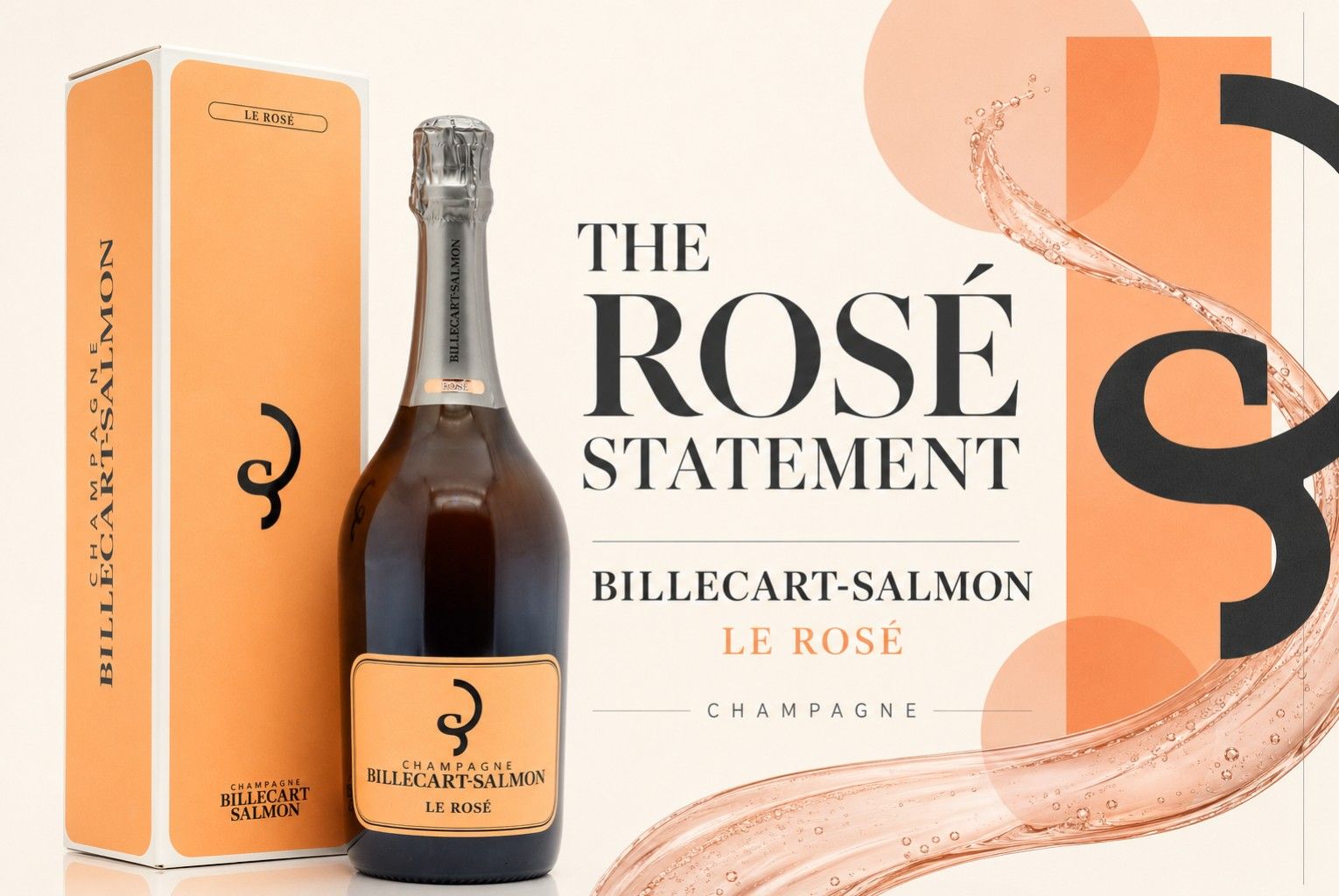
Some rosé Champagnes are extensions of a producer's main range. Billecart-Salmon Rosé has become one of the wines that defines the house itself.
The Billecart-Salmon Rosé Champagne Gift Box is the celebrated non-vintage rosé from the family-owned Champagne house founded in 1818. Today Billecart-Salmon presents the cuvée as Le Rosé, while it remains widely known as Billecart-Salmon Brut Rosé.
Its style is deliberately delicate: pale pink colour, fine bubbles, red berries, citrus zest and floral freshness leading into creamy wild strawberry and a lightly raspberry-led finish.
The current official technical information, based on the 2020 base vintage, gives a blend of 45% Chardonnay, 35% Pinot Noir and 20% Meunier, with part of the Pinot Noir vinified as red wine to create the distinctive rosé style. It undergoes low-temperature vinification in stainless steel, spends 36 months ageing on its lees and uses an Extra Brut dosage.
For anyone searching for Billecart-Salmon Rosé, Billecart Brut Rosé, Billecart-Salmon Champagne, best rosé Champagne or a premium Champagne gift box, this is the natural starting point in the wider Billecart-Salmon collection at HTFW.
Explore Billecart-Salmon Rosé Champagne at Hard To Find Whisky.
Billecart-Salmon Rosé at a Glance
- Producer: Billecart-Salmon
- Cuvée: Le Rosé / Brut Rosé
- Region: Champagne, France
- Bottle size: 75cl
- ABV: 12%
- Current reference blend: 45% Chardonnay, 35% Pinot Noir, 20% Meunier
- Rosé component: Pinot Noir vinified as red wine
- Vinification: Primarily low-temperature fermentation in stainless steel
- Lees ageing: 36 months
- Dosage: Extra Brut
- Serving temperature: 8–10°C
- Presentation: Gift box
- Style: Red berries, citrus, florals, wild strawberry, raspberry and creamy texture.
The grape percentages above are those currently published by Billecart-Salmon for the blend based on the 2020 vintage; as a multi-vintage Champagne, exact proportions can evolve between releases.
What Is Billecart-Salmon Rosé?
The Billecart-Salmon Rosé is the house's celebrated non-vintage rosé Champagne.
It is produced from Champagne's three principal varieties:
Chardonnay.
Pinot Noir.
Meunier.
Part of the Pinot Noir is vinified as red wine before blending, giving the finished Champagne its pale pink colour and red-fruit character without turning it into an excessively heavy or intensely coloured rosé.
That restraint is central to the Billecart-Salmon style.
The house's own description emphasises finesse, precision and freshness rather than power. The colour is deliberately pale, the bubbles fine and the fruit centred on wild strawberries, raspberries and citrus rather than darker jammy fruit.
Why Is Billecart-Salmon Rosé So Famous?
The answer is partly historical.
In the 1970s, Jean Roland-Billecart decided to revisit rosé Champagne at a time when the style had long been treated as secondary by parts of the Champagne industry. His objective was to create a particularly pale rosé characterised by freshness and subtle red-fruit notes.
It worked.
Billecart-Salmon's own history now describes Brut Rosé as the iconic cuvée of the house.
That is important because Billecart-Salmon produces a broad portfolio ranging from non-vintage Champagne through to prestigious vintage cuvées.
Yet it is the rosé that many drinkers immediately associate with the name.
Its reputation rests on a style that is recognisable without being extreme:
- Pale rather than deeply coloured
- Fresh rather than overtly sweet
- Red-fruited without becoming jammy
- Creamy without becoming heavy
- Fine and persistent rather than aggressively sparkling
That combination has given Billecart-Salmon Rosé a particularly strong following both as an aperitif and as a food Champagne.
How Is Billecart-Salmon Rosé Made?
The current official blend is based on 45% Chardonnay, 35% Pinot Noir and 20% Meunier.
Each grape contributes something different.
Chardonnay – 45%
Chardonnay currently forms the largest part of the blend and is sourced from leading crus across Champagne.
It provides much of the wine's:
- Citrus freshness
- Floral character
- Finesse
- Acidity
- Precision
That large Chardonnay component helps explain why Billecart-Salmon Rosé can feel so light and refined despite carrying clear red-fruit flavours.
Pinot Noir – 35%
Pinot Noir comes principally from the Montagne de Reims and Grande Vallée de la Marne.
Crucially, Pinot Noir vinified as red wine forms part of the assemblage.
This contributes:
- Colour
- Wild strawberry
- Raspberry
- Structure
- Vinous depth
It is the red-wine component that helps turn the base Champagne into rosé while preserving the house's preference for delicacy.
Meunier – 20%
The Meunier is sourced from the Vallée de la Marne and southern slopes around Épernay.
It adds:
- Fruit
- Roundness
- Approachability
- Softness through the mid-palate
Together, the three grapes provide the balance Billecart-Salmon is seeking:
Chardonnay for finesse. Pinot Noir for red fruit and structure. Meunier for generosity.
Why Is the Colour So Pale?
One of the most recognisable characteristics of Billecart-Salmon Rosé is its colour.
The house describes it as a radiant pale pink, with graceful effervescence rather than a dark or intensely salmon-coloured appearance.
That is deliberate.
When Jean Roland-Billecart developed the modern Brut Rosé style in the 1970s, one of his goals was specifically to produce a rosé with a very pale appearance and subtle red-fruit character.
The resulting wine demonstrates that rosé Champagne does not need deep colour to deliver significant flavour.
Instead, its identity comes from precision.
The red wine provides just enough:
colour, fruit and structure
without overwhelming the freshness supplied by Chardonnay and Meunier.
What Does Billecart-Salmon Rosé Taste Like?
The profile is elegant and fruit-driven rather than rich or oxidative.
Appearance
Expect a sparkling pale pink colour with fine, graceful bubbles.
The appearance itself gives a good indication of the style to follow.
This is not a dense, heavily extracted rosé.
Nose
The nose brings:
- Red berries
- Citrus zest
- Floral notes
- Fresh fruit
- Delicate aromatic freshness.
The citrus is particularly important because it keeps the red-fruit character lifted.
Rather than smelling simply of strawberry, there is an underlying brightness and freshness.
Palate
The palate is notably creamy and smooth, developing towards:
- Wild strawberry
- Red berries
- Fresh citrus
- Delicate fruit
- Fine acidity.
The texture is one of the defining features.
Billecart-Salmon's official description specifically emphasises the tactile sensation and creamy smoothness of the wine.
Finish
The finish moves towards raspberry, remaining fresh, precise and lightly fruity rather than sweet or heavy.
That makes the overall progression remarkably coherent:
citrus and berries → creamy strawberry → raspberry freshness.
Is Billecart-Salmon Rosé Sweet?
No.
The current technical specification identifies the wine as having an Extra Brut dosage.
That means the actual Champagne is quite dry despite its obvious strawberry and raspberry flavours.
This is an important distinction.
Fruitiness is not the same thing as sweetness.
Billecart-Salmon Rosé tastes fruit-forward because of the quality and composition of the grapes, particularly its red-wine Pinot Noir component.
The relatively restrained dosage allows:
- Citrus
- Acidity
- Mineral freshness
- Red berries
- Fine structure
to remain clearly defined.
Someone expecting a sweet pink sparkling wine will therefore find Billecart-Salmon much drier and more sophisticated.
Why Does It Spend 36 Months on the Lees?
Billecart-Salmon currently gives Le Rosé 36 months of ageing on its lees.
Lees are the spent yeast cells remaining inside the bottle following secondary fermentation.
Extended contact with them can help Champagne develop:
- Creamier texture
- Finer integration
- Greater complexity
- Subtle savoury or pastry-like dimensions
For Billecart Rosé, the aim is not to turn the wine into an overtly brioche-heavy style.
The fruit remains the focus.
Instead, the lees ageing helps explain the creamy smoothness and refined mousse that sit underneath the strawberry, raspberry and citrus flavours.
Why Low-Temperature Vinification Matters
Billecart-Salmon specifies low-temperature vinification in stainless steel tanks for its Rosé.
Lower-temperature fermentation is commonly used where a winemaker wants to preserve delicate aromatics and fruit purity.
In this case, that fits the house style particularly well.
The goal is not to create a massive, heavily oxidative wine.
The goal is:
- Fresh berries
- Citrus
- Flowers
- Fine acidity
- Precision
The stainless-steel approach also avoids adding obvious oak character at this stage.
The fruit remains clean and direct.
Billecart-Salmon Rosé vs Billecart-Salmon Brut Réserve
For someone exploring the house for the first time, the most useful comparison is with the Billecart-Salmon Brut Réserve Gift Box.
The two wines share the house's emphasis on finesse, but they express it differently.
Billecart-Salmon Rosé
- Chardonnay, Pinot Noir and Meunier
- Pinot Noir red wine included in the blend
- Pale pink
- Wild strawberry and raspberry
- Citrus and floral freshness
- Creamy texture
- 36 months on lees based on the current technical specification.
Billecart-Salmon Brut Réserve
The current Réserve blend is based on 28% Pinot Noir, 29% Chardonnay and 43% Meunier, with more than 50% reserve wines and around 50 months average lees ageing. Its profile leans towards apple, pear, citrus, white stone fruit, floral notes and subtle biscuit character.
The distinction is straightforward:
Le Réserve expresses the classic white Champagne style of Billecart-Salmon.
Le Rosé introduces red fruit and a creamier strawberry-led dimension.
Billecart Rosé vs Billecart Blanc de Blancs
The Billecart-Salmon Blanc de Blancs Champagne moves in almost the opposite direction.
Where Rosé uses all three principal Champagne varieties and adds red-wine Pinot Noir, Blanc de Blancs focuses entirely on Chardonnay.
HTFW describes the Blanc de Blancs with fine bubbles, luminous gold colour and a particularly delicate style.
That means:
Rosé
- Red berries
- Strawberry
- Raspberry
- Citrus
- Creamy texture
Blanc de Blancs
- Chardonnay purity
- Citrus
- Mineral freshness
- White fruit
- Greater linearity
The Rosé is the better choice for someone wanting fruit and texture.
The Blanc de Blancs places greater emphasis on precision and Chardonnay character.
Both can be explored through the wider Billecart-Salmon collection at HTFW.
Billecart Rosé vs Le Sous Bois
Another interesting comparison is the Billecart-Salmon Le Sous Bois Champagne.
Le Sous Bois is deliberately built around a more vinous, oak-influenced interpretation of Billecart-Salmon, with HTFW highlighting pastry, orchard fruit, citrus, malt, mocha and bergamot alongside a richer texture.
The difference is considerable.
Le Rosé
Fresh, pale, berry-led and precise.
Le Sous Bois
Broader, richer, more vinous and more obviously influenced by wood.
This shows that Billecart-Salmon's house style is not restricted to one formula.
Le Rosé represents one of its most delicate expressions.
Le Sous Bois demonstrates how much more structured the wines can become.
What About the Prestige Cuvées?
Drinkers wanting to move beyond the non-vintage collection can explore releases such as the Billecart-Salmon Nicolas François 2012 and Louis Salmon Blanc de Blancs 2013.
Nicolas François 2012 is a prestige vintage cuvée with orchard fruit, mirabelle plum, clementine, roasted almond, honeyed biscuit, vanilla and limestone freshness.
Louis Salmon, meanwhile, represents the house's prestige Chardonnay expression, with HTFW highlighting citrus zest, brioche, mirabelle plum and creamy pastry notes.
These are very different wines from Le Rosé.
That is precisely why Billecart-Salmon Rosé remains such a useful introduction to the producer.
It gives you the house's finesse and precision without moving immediately into a single-vintage prestige expression.
What About the Billecart-Salmon Rosé Magnum?
HTFW also carries the Billecart-Salmon Rosé 1.5 Litre Magnum Gift Box.
A magnum contains 150cl, equivalent to two standard 75cl bottles. HTFW lists the magnum at 12% ABV with the same pale pink, red-berry and citrus-led character.
Beyond simply providing more Champagne, larger formats are particularly appealing for:
- Larger celebrations
- Table presentation
- Gifting
- Champagne collectors
- Longer-term cellaring
Billecart-Salmon itself gives its rosé different recommended ageing windows depending on bottle size: approximately 2–4 years for a standard bottle, while magnums and jeroboams are suggested for around 4–8 years.
For an occasion where presentation matters, the Rosé Magnum is therefore a natural alternative to the standard gift-box bottle.
Is the Gift Box Worth Choosing?
The Billecart-Salmon Rosé Gift Box contains the familiar 75cl, 12% ABV rosé but adds the original presentation box.
That makes it particularly appropriate for:
- Birthdays
- Anniversaries
- Weddings
- Engagements
- Milestone celebrations
- Corporate gifting
- Champagne enthusiasts
The box does not change the wine.
What it changes is the presentation.
For a Champagne already associated with celebration and gifting, that matters.
What Food Goes With Billecart-Salmon Rosé?
Billecart-Salmon specifically recommends its Rosé with wild salmon and langoustine carpaccio.
It also recommends pairing the wine with red-fruit desserts provided they retain good acidity and are only lightly sweetened.
That gives a useful guide to the wider pairing possibilities.
Good options include:
- Wild salmon
- Smoked salmon
- Langoustines
- Prawns
- Lobster
- Tuna tartare
- Sushi
- Light poultry dishes
- Strawberry desserts
- Raspberry desserts
- Red-fruit tart
The key is delicacy.
This is not the rosé Champagne to put beside an extremely heavy or aggressively spiced dish.
The wine's strength is its balance of freshness, fine texture and subtle red fruit.
Can Billecart Rosé Be Served as an Aperitif?
Absolutely.
Billecart-Salmon describes Le Rosé as suitable for celebrations as well as food pairing.
Its combination of:
- Dryness
- Acidity
- Fine bubbles
- Citrus
- Red berries
makes it particularly effective before a meal.
Unlike a richer wine that demands food immediately, it can comfortably stand alone.
That versatility is another reason the cuvée has become such an important part of the house's range.
What Temperature Should Billecart-Salmon Rosé Be Served At?
Billecart-Salmon recommends 8–10°C.
That is cool enough to keep the Champagne crisp without suppressing its delicate fruit.
Serving it too cold can mask:
- Wild strawberry
- Raspberry
- Floral notes
- Citrus zest
A good approach is therefore to chill the bottle thoroughly and allow the wine to develop gradually in the glass.
A white-wine-shaped Champagne glass can be particularly useful because it gives the aromas more room to open than a very narrow flute.
Can You Age Billecart-Salmon Rosé?
Yes, although it is already designed to be enjoyable on release.
Billecart-Salmon currently recommends approximately:
- Half bottle: 1–2 years
- 75cl bottle: 2–4 years
- Magnum and jeroboam: 4–8 years.
This does not mean the wine must be aged.
Fresh bottles emphasise the bright berry, citrus and floral character.
Additional time can allow the wine to become more integrated and mature.
Anyone specifically interested in larger-format ageing can explore the Billecart-Salmon Rosé Magnum.
The History of Billecart-Salmon
Maison Billecart-Salmon was founded in 1818 following the marriage of Nicolas François Billecart and Elisabeth Salmon.
Together they established the Champagne house in Mareuil-sur-Aÿ, beginning a family business that has continued across generations.
HTFW describes Billecart-Salmon as one of the major Champagne houses that has remained family-run after more than seven generations.
The family connection extends into the names of some of the producer's most prestigious wines.
Nicolas François Billecart gives his name to the house's prestige vintage cuvée.
Elisabeth Salmon is commemorated through the prestige rosé cuvée bearing her name.
Louis Salmon, Elisabeth's brother and an important figure in the early winemaking history of the house, lends his name to the prestige Blanc de Blancs.
That makes the modern range unusually closely connected with the people who built the house.
Why Billecart-Salmon Rosé Matters Within the House
The importance of Le Rosé is greater than simply being the pink option in the range.
Billecart-Salmon's own history specifically identifies Brut Rosé as an iconic house cuvée following Jean Roland-Billecart's work on the style during the 1970s.
That makes it a particularly useful bottle for understanding the modern identity of Billecart-Salmon.
The wine expresses several qualities the producer repeatedly prioritises:
finesse.
Freshness.
Precision.
Texture.
Balance.
Its success also helped demonstrate that rosé Champagne could be taken seriously as a fine wine rather than treated purely as a novelty or sweeter alternative to white Champagne.
Frequently Asked Questions
What is Billecart-Salmon Rosé?
It is Billecart-Salmon's celebrated non-vintage rosé Champagne, currently presented by the house as Le Rosé and widely known as Brut Rosé.
What percentage is Billecart-Salmon Rosé?
The HTFW gift-box bottle is 12% ABV.
Which grapes are used?
The current official blend, based on the 2020 vintage, is:
- 45% Chardonnay
- 35% Pinot Noir
- 20% Meunier.
How does Billecart-Salmon make its Rosé?
The blend incorporates Pinot Noir vinified as red wine. It undergoes low-temperature vinification in stainless steel and currently spends around 36 months ageing on its lees.
Is Billecart-Salmon Rosé sweet?
No. The current technical information specifies an Extra Brut dosage, making it a distinctly dry rosé Champagne despite its ripe strawberry and raspberry flavours.
What does Billecart-Salmon Rosé taste like?
Expect red berries, citrus zest and delicate floral aromas, followed by a creamy palate of wild strawberry and a lightly raspberry-led finish.
How long is Billecart Rosé aged?
The current release spends approximately 36 months ageing on its lees.
What temperature should it be served at?
Billecart-Salmon recommends 8–10°C.
What food goes with Billecart-Salmon Rosé?
The house specifically recommends wild salmon and langoustine carpaccio, as well as lightly sweetened desserts built around fresh red fruit.
Is there a Billecart Rosé Magnum?
Yes. HTFW carries the Billecart-Salmon Rosé 1.5 Litre Magnum Gift Box.
When was Billecart-Salmon founded?
The house was founded in 1818 following the marriage of Nicolas François Billecart and Elisabeth Salmon.
Why is Billecart-Salmon Rosé famous?
The house developed its modern pale, fresh rosé style during the 1970s. Billecart-Salmon now describes Brut Rosé as one of its iconic cuvées.
Where can I buy Billecart-Salmon Rosé?
You can view Billecart-Salmon Rosé Champagne Gift Box at Hard To Find Whisky.
Final Thoughts
The Billecart-Salmon Rosé Champagne has become a benchmark not because it is the biggest, darkest or most intensely flavoured rosé.
Almost the opposite.
Its identity is built around restraint.
A pale pink colour.
Fine bubbles.
Fresh citrus.
Delicate red berries.
Wild strawberry.
A creamy texture.
And just enough raspberry on the finish to remind you that this is rosé.
The current blend uses 45% Chardonnay, 35% Pinot Noir and 20% Meunier, with Pinot Noir vinified as red wine providing colour and red-fruit character. Thirty-six months on the lees adds texture while Extra Brut dosage keeps the finished wine dry and precise.
Its history makes the bottle even more significant. Jean Roland-Billecart deliberately reinvented the house's approach to rosé Champagne in the 1970s, targeting precisely the pale colour, freshness and subtle red-fruit profile that still characterises the wine today.
That approach ultimately made Rosé one of Billecart-Salmon's defining wines.
For those exploring the house further, the Brut Réserve provides the classic white multi-vintage style, the Blanc de Blancs focuses on Chardonnay, Le Sous Bois moves towards a richer oak-influenced profile, while Nicolas François 2012 and Louis Salmon Blanc de Blancs 2013 take the range into prestige vintage territory.
But if one bottle has come to embody the modern Billecart-Salmon name, Le Rosé has perhaps the strongest claim.
Explore the Billecart-Salmon Rosé Champagne Gift Box at HTFW or browse the wider Billecart-Salmon Champagne collection.