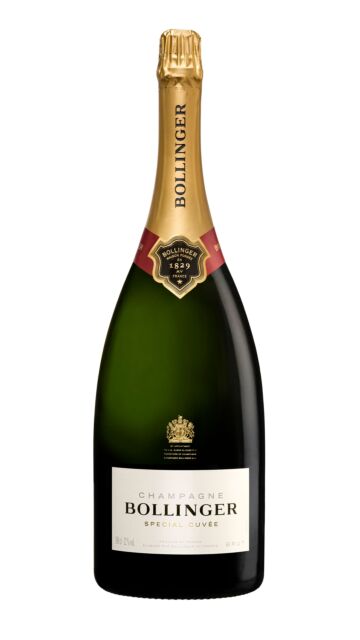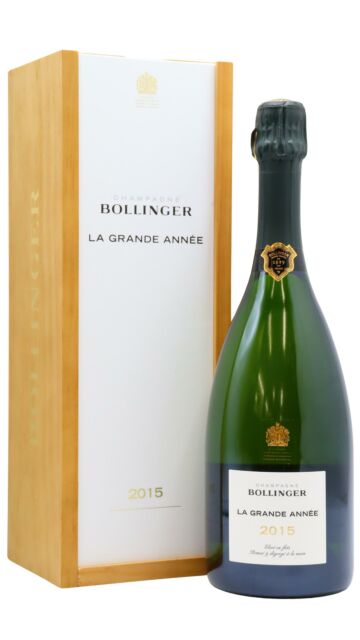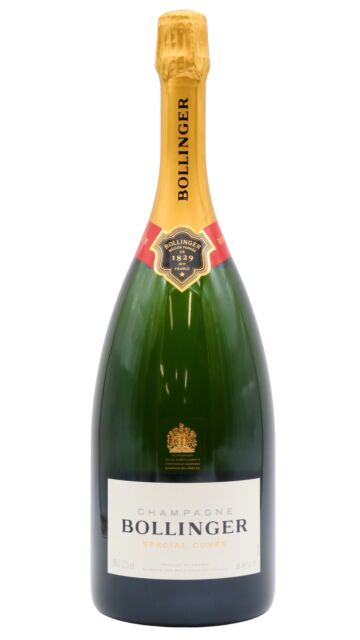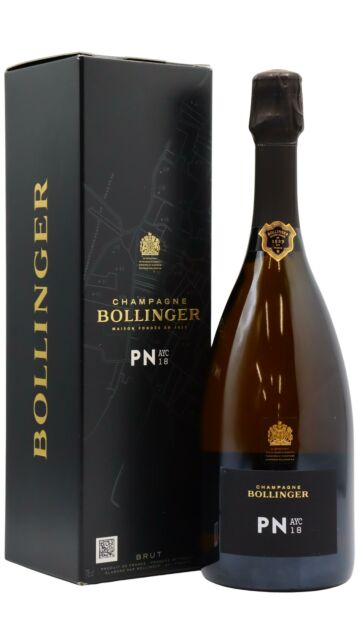
















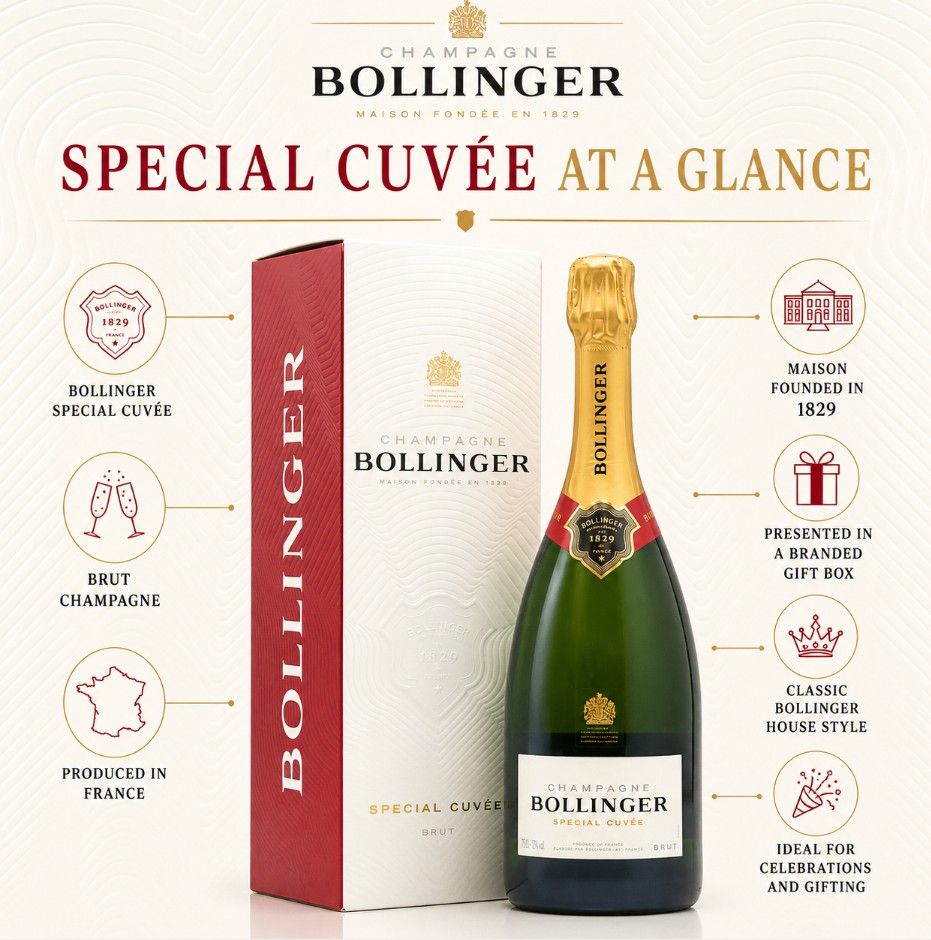
Bollinger Special Cuvée Champagne in a gift box is one of the most distinctive non-vintage Brut Champagnes produced by a major house.
Where some signature Champagnes focus primarily on citrus freshness and delicacy, Special Cuvée is recognised for its depth, structure and gastronomic character.
Pinot Noir forms 60% of the blend, giving the wine its broad shoulders and vinous texture. Chardonnay contributes freshness and finesse, while Meunier adds fruit and roundness.
The blend draws heavily on Bollinger’s reserve wines, including a remarkable collection preserved in magnum bottles for between seven and 15 years. Extended cellar ageing then develops the roasted fruit, brioche, fresh walnut and spice that define the finished Champagne.
The result is rich without becoming heavy, mature without losing freshness and structured enough to accompany a full meal.
Bottled at 12% ABV in a standard 75cl format, the current HTFW release is supplied in its original Bollinger gift box. It is an excellent choice for birthdays, weddings, anniversaries, Christmas, corporate gifting or any occasion requiring a Champagne with more weight and individuality than a typical aperitif style.
Customers can buy Bollinger Special Cuvée Champagne Gift Box, explore the complete Bollinger collection, or browse more bottles within HTFW’s extensive Champagne range.
Bollinger Special Cuvée: Key Details
The current bottle available through Hard To Find Whisky has the following specifications:
- Producer: Champagne Bollinger
- Expression: Special Cuvée
- Style: Non-vintage Brut Champagne
- Bottle size: 75cl
- Alcohol strength: 12% ABV
- Country of origin: France
- Region: Champagne
- House location: Aÿ
- Blend: 60% Pinot Noir, 25% Chardonnay and 15% Meunier
- Vineyard classification: More than 85% Grand and Premier Cru fruit
- Reserve wines: A majority of the final blend
- Reserve-magnum ageing: Selected wines preserved for seven to 15 years
- Dosage: Approximately 7–8g per litre
- Cellar ageing: Approximately twice the period required by Champagne regulations
- Recommended serving temperature: 8–10°C
- Packaging: Original gift box
- Primary flavours: Roasted apple, pear, peach, brioche, walnut and spice
- Best suited to: Gifting, celebrations, aperitif service and food pairing
Bollinger’s official specifications confirm the 60% Pinot Noir, 25% Chardonnay and 15% Meunier blend, the use of more than 85% Grand and Premier Cru fruit, extended ageing and moderate dosage.
What Is Bollinger Special Cuvée?
Special Cuvée is Bollinger’s signature non-vintage Champagne.
It is the bottle intended to express the House style consistently from one release to the next.
Rather than being produced from a single harvest, the finished wine combines:
- Wine from a principal base year
- Wines from several earlier harvests
- Chardonnay, Pinot Noir and Meunier
- Fruit from numerous Champagne villages
- Reserve wines matured through different methods
- Components selected for freshness, depth and structure
The emphasis on Pinot Noir separates Special Cuvée from lighter, Chardonnay-led Champagnes.
Its profile is broad and vinous, with enough body to work alongside food. Roasted and ripe fruit sit beside fresh acidity, while extended lees ageing adds brioche and a creamier texture.
It is still unmistakably Champagne, with fine bubbles and freshness, but the wine does not disappear after the first sip.
The name “Special Cuvée” has appeared for more than a century and reflects the belief that a simple description such as non-vintage Brut did not adequately communicate the quality or individuality of the wine.
Why Is It Called Special Cuvée?
The name dates back to 1911.
Georges Bollinger’s British agent believed that calling the wine “non-vintage Brut” was too ordinary for a Champagne of its character and subtlety.
He proposed the name “Special Cuvée”.
The English spelling of “Special” was retained, creating a name that also reflects Bollinger’s longstanding relationship with the British market.
More than a century later, Special Cuvée remains the House’s flagship expression.
The name is not intended to suggest that it is a one-off limited edition. It represents Bollinger’s continuing ability to reproduce its recognised style across different harvests.
Each release must balance:
- The character of the current harvest
- The maturity of reserve wines
- Pinot Noir structure
- Chardonnay freshness
- Meunier fruit
- Lees-aged complexity
- Consistency with previous releases
Bollinger confirms that the Special Cuvée name was suggested by the House’s British agent in 1911 because he believed “non-vintage Brut” did not suit a Champagne of such subtlety.
What Does Cuvée Mean?
The word “cuvée” can have several meanings in winemaking.
It may refer to:
- A particular wine or blend
- A producer’s named expression
- A selected portion of juice
- A wine assembled from multiple parcels or harvests
- The first and most highly valued juice obtained during pressing
For Bollinger, Special Cuvée is the name of the finished blend rather than an individual vineyard or vintage.
The wine is assembled to express the House style rather than one location or harvest year.
Why Is Pinot Noir So Important?
Pinot Noir represents 60% of the Special Cuvée blend.
This high proportion is central to Bollinger’s identity.
Pinot Noir gives Champagne:
- Structure
- Body
- Depth
- Red-fruit undertones
- Vinous texture
- Greater food-pairing versatility
- Ageing potential
- A broad and persistent finish
The grape is particularly important in Bollinger’s home village of Aÿ and across the Montagne de Reims.
Although the juice used for white Champagne is pressed away from the dark grape skins, Pinot Noir still contributes significant flavour and texture.
Its influence helps explain Special Cuvée’s golden colour, mature fruit and full-bodied palate.
Drinkers should not expect a strongly red-fruit-led wine in the manner of rosé Champagne. Instead, Pinot Noir provides the underlying strength on which the pear, roasted apple, brioche and spice can develop.
What Does Chardonnay Add?
Chardonnay accounts for 25% of the blend.
Its contribution includes:
- Fresh acidity
- Citrus
- Finesse
- Floral lift
- Mineral tension
- Elegance
- A cleaner finish
Without Chardonnay, Special Cuvée could become excessively broad or heavy.
The grape brings energy to the richer Pinot Noir foundation and helps preserve freshness through the finish.
This balance is particularly important because the wine contains a significant proportion of mature reserve components.
What Does Meunier Add?
Meunier forms the remaining 15% of the blend.
It contributes:
- Roundness
- Ripe fruit
- Softness
- Accessibility
- A smoother middle palate
- Immediate aromatic character
Meunier helps connect the structure of Pinot Noir with the freshness of Chardonnay.
Although it forms the smallest proportion, it prevents the final wine from feeling excessively firm or austere.
Grand Cru and Premier Cru Fruit
More than 85% of the fruit used for Special Cuvée comes from Grand Cru and Premier Cru villages.
Champagne’s traditional village classification recognises locations with particularly strong reputations for grape quality.
Grand Cru and Premier Cru status does not guarantee that every individual wine will be superior, but it indicates Bollinger’s reliance on established and highly regarded growing areas.
Important villages connected with the blend and wider House style include:
- Aÿ
- Verzenay
- Louvois
- Tauxières
- Avenay-Val-d’Or
- Cuis
These villages bring different expressions of Pinot Noir and Chardonnay.
The final wine is not intended to taste like one village alone. The blending team uses the variations between sites to create greater balance and consistency.
What Are Reserve Wines?
Reserve wines are wines retained from earlier harvests for future blending.
They are essential to non-vintage Champagne because weather conditions vary considerably from year to year.
A warmer harvest may provide ripe fruit and body, while a cooler year can contribute acidity and freshness.
By retaining wines from earlier seasons, the Cellar Master can balance these differences and preserve the recognised House style.
Reserve wines can contribute:
- Maturity
- Aromatic complexity
- Consistency
- Greater depth
- Developed fruit
- Nutty flavours
- Spice
- Lees-aged character
Special Cuvée contains a majority of reserve wines rather than depending almost entirely on one young harvest.
This gives the Champagne a more developed and layered character than its non-vintage designation might initially suggest.
Bollinger’s Reserve Magnums
One of the most distinctive aspects of Special Cuvée is Bollinger’s use of reserve wines stored in magnum bottles.
Selected wines are bottled in 1.5-litre magnums and sealed under cork for extended ageing.
Some of the reserve magnums used in Special Cuvée have been aged for between seven and 15 years.
Bollinger maintains approximately one million reserve magnums in its cellars, a collection described by the House as unique within Champagne.
At least 10% of the Special Cuvée blend can come from wines held in this format.
The reserve magnums are not the bottles eventually sold to customers. They are working components within the blending process.
When required, mature wine is removed from selected magnums and incorporated into the final Special Cuvée assembly.
These reserve wines can contribute:
- Dried and roasted fruit
- Walnut
- Spice
- Greater texture
- Aromatic depth
- Mature integration
- Consistency across different releases
Bollinger traces the use of reserve magnums in non-vintage blending back to 1892. The House states that Special Cuvée remains the principal beneficiary of this practice.
Why Store Reserve Wine in Magnums?
The magnum provides a particular environment for wine development.
It contains twice as much wine as a standard 75cl bottle while using a closure of a similar size.
This means the proportion of oxygen relative to the volume of wine is lower.
The wine can therefore develop gradually while retaining freshness.
Using natural cork also allows slow and controlled interaction over time.
The objective is not simply to make the reserve wine taste older.
It is to preserve:
- Fruit
- Acidity
- Aromatic complexity
- Texture
- Individual harvest character
When these components are added to Special Cuvée, they provide mature complexity without causing the finished Champagne to feel tired or excessively oxidative.
Why Is Bollinger Special Cuvée Aged for So Long?
Special Cuvée receives extended ageing in Bollinger’s cellars before release.
The House states that it is aged for approximately twice the period required by Champagne regulations, with a minimum cellar maturation of around three years.
During this period, the wine remains in contact with the yeast sediment created during secondary fermentation.
This lees ageing can contribute:
- Brioche
- Bread
- Pastry
- Greater creaminess
- Finer bubbles
- Additional texture
- Better integration
- A longer finish
Time also allows the fruit, reserve wines and dosage to settle into a more complete whole.
The result is not simply a young, fresh Champagne.
Special Cuvée combines vitality with flavours associated with longer maturation, including baked apple, compote, brioche and fresh walnut.
What Is Lees Ageing?
After the base wines are blended, the Champagne undergoes secondary fermentation inside the bottle.
Yeast consumes the added sugar and creates:
- Alcohol
- Carbon dioxide
- Sediment
The carbon dioxide becomes trapped inside the sealed bottle, producing Champagne’s bubbles.
The spent yeast gradually settles and forms the lees.
When wine remains in contact with the lees, the yeast cells slowly break down through a process called autolysis.
This can produce flavours and textures associated with:
- Brioche
- Bread dough
- Biscuit
- Pastry
- Cream
- Nuts
- A finer mousse
Lees ageing is one of the main reasons mature Champagne tastes different from simple sparkling wine intended for immediate drinking.
Is Special Cuvée a Vintage Champagne?
No. Special Cuvée is a non-vintage Champagne.
A vintage Champagne is made primarily or entirely from grapes harvested during one declared year.
Non-vintage Champagne combines wines from several harvests.
This allows Bollinger to:
- Maintain a consistent House style
- Use its extensive reserve-wine collection
- Balance warmer and cooler years
- Add mature complexity
- Preserve freshness
- Recreate the Special Cuvée profile over time
The lack of a vintage date does not mean that the wine is young or simple.
Some of the reserve components included in the blend may have been preserved for more than a decade before the final Champagne was assembled.
Customers wanting a vintage expression from the same House can explore Bollinger La Grande Année 2018 Champagne.
What Does Brut Mean?
Brut identifies the sweetness level of the finished Champagne.
Special Cuvée has a moderate dosage of approximately 7–8g of sugar per litre.
This places it within the Brut category and creates a dry overall profile.
The dosage is not intended to make the wine taste conventionally sweet. It balances Champagne’s naturally high acidity and helps integrate the different components.
In Special Cuvée, it supports:
- Ripe pear
- Peach
- Roasted apple
- Brioche
- Spice
- Walnut
The wine remains dry, structured and fresh through the finish.
Customers can explore more wines of this style within HTFW’s Brut Champagne collection.
Is Bollinger Special Cuvée Sweet?
No. Special Cuvée is a dry Brut Champagne.
Its ripe fruit, baked apple and brioche can create an impression of richness, but these characteristics should not be confused with high sugar.
The sweeter flavours include:
- Ripe pear
- Peach
- Apple compote
- Honey
- Brioche
These are balanced by:
- Fresh acidity
- Citrus
- Walnut
- Spice
- Pinot Noir structure
- A dry finish
Customers who normally find very lean Champagne too sharp may appreciate Special Cuvée’s greater body and fruit.
Those looking for an overtly sweet Champagne should consider a Demi-Sec rather than a Brut.
Bollinger Special Cuvée Tasting Notes
Appearance
Golden yellow with very fine, persistent bubbles.
The deeper golden colour reflects the high proportion of black grapes, extended ageing and mature reserve wines.
Nose
Aromatically complex.
Ripe fruit and warm spice appear first, followed by roasted apple, apple compote and peach.
With time in the glass, citrus, toasted brioche and hazelnut become more apparent.
Palate
Structured, long and lively.
Pear and baked apple sit alongside citrus zest, toasted nuts and a gentle touch of honey.
The bubbles feel fine and velvety rather than aggressively sharp.
Pinot Noir provides body, while Chardonnay maintains freshness through the centre of the palate.
Finish
Long, elegant and gently savoury.
Brioche, almond and fresh walnut remain alongside ripe fruit and restrained spice.
The wine finishes dry, with enough acidity to encourage another sip.
Bollinger’s official profile identifies ripe fruit, roasted apple, compote, peach, pear, brioche, spice and fresh walnut, while the HTFW tasting notes add citrus zest, hazelnut, honey and almond.
Is Bollinger Special Cuvée Full-Bodied?
Yes. It is one of the fuller and more structured signature non-vintage Champagnes.
Several factors contribute to this style:
- 60% Pinot Noir
- More than 85% Grand and Premier Cru fruit
- A majority of reserve wines
- Reserve components aged in magnums
- Extended lees ageing
- Moderate rather than high dosage
- Bollinger’s emphasis on vinous texture
Full-bodied does not mean heavy or lacking freshness.
Chardonnay, acidity and fine bubbles prevent the wine from becoming flat or tiring.
The style is better described as powerful and refined.
Is Bollinger Special Cuvée Toasty?
Special Cuvée contains noticeable brioche, toast and nutty flavours.
These develop through extended maturation and the use of older reserve wines.
Customers may notice:
- Toasted brioche
- Fresh bread
- Hazelnut
- Almond
- Walnut
- Baked apple
- Gentle spice
It is more developed and pastry-led than many youthful non-vintage Champagnes.
However, the wine retains fresh pear, peach and citrus, ensuring that it does not become completely dominated by toast.
The Bollinger House Style
Bollinger describes its Champagnes as powerful, refined and complex.
The style is based around several defining principles:
- A strong affinity with Pinot Noir
- Fruit sourced from highly regarded vineyards
- Extensive reserve-wine stocks
- Long cellar ageing
- Traditional craftsmanship
- Oak vinification for selected wines
- Patience in blending and maturation
- A family-led identity
Special Cuvée is the most accessible expression of those principles.
More specialised bottles such as PN, La Grande Année, R.D. and Vieilles Vignes Françaises take individual parts of the House style further.
The signature non-vintage wine must bring these characteristics together in a form that remains consistent and versatile.
Bollinger describes Pinot Noir, exceptional vineyards, inherited craftsmanship and a commitment to long-term quality as central to its powerful and complex House style.
The History of Bollinger
Champagne Bollinger was founded in Aÿ in 1829 by:
- Athanase de Villermont
- Joseph “Jacques” Bollinger
- Paul Renaudin
The original company was known as Renaudin-Bollinger.
Jacques Bollinger later married Louise-Charlotte de Villermont, strengthening the family connection at the heart of the House.
Bollinger developed a strong reputation in France and international markets, including Britain.
Queen Victoria granted the House its first Royal Warrant in 1884.
The company has remained closely associated with the Bollinger family and retains a distinctive position among the major Champagne Houses.
Its history is reflected not only in old cellars or packaging but in continuing production practices, including:
- Reserve wines preserved in magnums
- Oak-barrel vinification
- Long cellar ageing
- Hand riddling and disgorgement for selected prestige wines
- Careful vineyard management
- A continuing focus on Pinot Noir
Who Was Madame Bollinger?
Elisabeth Bollinger, often known as Lily Bollinger or Madame Jacques Bollinger, became one of the most important figures in the House’s history.
She took control after her husband, Jacques Bollinger, died in 1941.
At the time, France was occupied and Champagne production faced severe challenges, including shortages of labour, equipment and materials.
Madame Bollinger continued managing the vineyards and House through the war.
She was known for travelling around the vineyards by bicycle and maintaining close contact with the people working across the estate.
After the war, she expanded Bollinger’s international presence and became an important ambassador for Champagne.
Her influence included the creation of two particularly important Bollinger wines:
- R.D., introduced in 1967
- Vieilles Vignes Françaises, first produced from the 1969 vintage
R.D. demonstrated how extended lees ageing followed by recent disgorgement could combine mature complexity with freshness.
Vieilles Vignes Françaises preserved the character of rare ungrafted Pinot Noir vines that had survived phylloxera.
Bollinger’s official history records that Madame Bollinger took control in 1941, maintained the House through the Occupation and later introduced R.D. and Vieilles Vignes Françaises.
Bollinger and James Bond
Bollinger has a strong association with the James Bond film series.
This relationship has produced several special bottles and collectable presentations over the years.
The connection suits the Bollinger style particularly well.
Both brands are associated with:
- British cultural recognition
- Formal occasions
- Luxury
- Longstanding heritage
- Confident, distinctive presentation
Customers can explore the collaboration through the Bollinger James Bond 007 Limited Edition Special Cuvée.
The whisky-style collectability of a Bond bottle should be distinguished from the liquid itself. The release contains Special Cuvée, while the limited-edition value comes primarily from its 007 presentation.
How Should Bollinger Special Cuvée Be Served?
Bollinger recommends serving Special Cuvée between approximately 8°C and 10°C, with 10°C allowing its broader aromas to show clearly.
This is slightly warmer than some people serve inexpensive sparkling wine.
Serving it excessively cold can hide:
- Roasted apple
- Peach
- Brioche
- Walnut
- Spice
- Reserve-wine complexity
Serving it too warm can make the wine feel broad and reduce its refreshing character.
Chilling in a Refrigerator
Place the bottle in the refrigerator several hours before serving.
For an evening event, chilling it during the afternoon provides sufficient time for the wine to reach an even temperature.
Chilling in an Ice Bucket
Fill a Champagne bucket with roughly equal quantities of ice and water.
The water creates full contact around the bottle and chills more effectively than dry ice alone.
Bollinger recommends approximately 30 minutes in an ice-and-water bucket before service.
Do not place the bottle in a freezer. Extreme cold and forgotten bottles can damage the wine and create a safety risk.
Bollinger recommends serving Special Cuvée around 10°C and using a tulip or tall white-wine glass to concentrate its aromas.
Which Glass Is Best?
A tulip-shaped Champagne glass or tall white-wine glass is ideal.
The glass should provide:
- Enough height for the bubbles
- A broader bowl for aroma
- A slightly narrower rim
- Space for the wine to open
- A clear view of the mousse
A narrow flute can preserve bubbles, but it may restrict the richer fruit, brioche and walnut aromas.
A wide coupe loses bubbles and fragrance more quickly.
Because Special Cuvée has more body than many non-vintage Champagnes, a white-wine glass can work particularly well when it is served with food.
How to Open Bollinger Safely
Champagne bottles contain considerable internal pressure.
Open the bottle carefully:
- Chill the wine properly.
- Remove the foil.
- Keep a thumb over the cork.
- Loosen the wire cage without releasing your grip.
- Point the bottle away from people and fragile objects.
- Hold the cork firmly.
- Rotate the bottle slowly from the base.
- Allow the cork to emerge with a gentle sigh.
A controlled opening preserves more of the wine and reduces the risk of injury.
Bollinger advises against sabrage as a routine method of opening its Champagne.
How Should Champagne Be Poured?
Pour Special Cuvée slowly into a clean, dry glass.
A two-stage pour is useful:
- Add a small quantity and allow the initial foam to settle.
- Continue pouring until the glass is approximately two-thirds full.
This reduces overflowing and leaves sufficient room for the wine’s aroma to develop.
Avoid touching the rim of the glass with the bottle.
Do not use glasses carrying detergent residue, as this can interfere with the formation of bubbles.
What Food Goes with Bollinger Special Cuvée?
Special Cuvée is one of the more food-friendly non-vintage Champagnes.
Its Pinot Noir structure, mature reserve wines and nutty flavours allow it to accompany dishes that might overwhelm a lighter aperitif Champagne.
Scallops
Bollinger recommends truffled scallop carpaccio as a signature pairing.
The sweetness of scallop works with pear and peach, while truffle connects with the wine’s developed reserve character.
Oysters
Acidity and bubbles complement oysters, while the Champagne’s body prevents it from feeling too delicate beside their texture.
Lobster and Crab
The wine works particularly well with shellfish served in butter, cream or a light bisque.
Pinot Noir gives it enough structure for richer sauces.
Smoked Salmon
Brioche and gentle nuttiness complement the fish, while acidity refreshes the palate.
Sushi and Sashimi
Special Cuvée works with fatty fish, clean rice and restrained seasoning.
Avoid excessive sweet soy sauce, which can make a dry Champagne appear sharper.
Roast Chicken
Roast poultry is one of the best pairings.
Golden skin reflects the roasted and brioche flavours, while the meat works with the Champagne’s broad texture.
Turkey
Special Cuvée is suitable for Christmas dinner, particularly alongside turkey, stuffing and roasted vegetables.
Its bubbles and acidity prevent the meal from feeling too heavy.
Duck
The Pinot Noir structure supports duck, especially when served with apple, cherry or a restrained fruit sauce.
Pork
Roast pork and pork belly work with roasted apple, spice and fresh walnut.
The Champagne’s acidity cuts through fat while its fruit complements apple-based accompaniments.
Mushroom and Truffle Dishes
Mushroom risotto, truffled pasta and savoury pastries connect with the wine’s mature, earthy and nutty dimensions.
Parmesan and Comté
Hard cheeses bring salt and umami, balancing the fruit and brioche.
Fresh walnut notes create a natural connection with aged Comté.
Fried Chicken
Champagne and fried chicken create an excellent contrast.
Acidity and bubbles cut through the crisp coating, while brioche and roasted flavours echo the browned crust.
Fish and Chips
The bubbles refresh the palate after fried batter, while citrus and acidity work with the fish.
This deliberately informal pairing demonstrates that high-quality Champagne does not need to be reserved exclusively for fine dining.
Is Bollinger Special Cuvée a Good Aperitif?
Yes, although it is fuller than many aperitif Champagnes.
It works particularly well before a meal when served with:
- Oysters
- Smoked salmon
- Gougères
- Parmesan
- Charcuterie
- Truffle canapés
- Shellfish
- Light pastry dishes
Its structure also allows the same bottle to continue through the first course and main meal.
This makes it useful when hosts prefer to serve one Champagne throughout an occasion rather than changing wine after the reception.
Is It a Good Wedding Champagne?
Yes. The gift-boxed 75cl bottle is suitable both as a wedding present and for serving at smaller celebrations.
One 75cl bottle provides approximately:
- Six 125ml servings
- Five 150ml servings
For a larger reception, calculate bottle requirements according to whether Champagne will be served:
- Only for the toast
- Throughout the reception
- Alongside canapés
- With the meal
- In addition to other wines
The original box makes the bottle especially suitable as:
- A gift for the couple
- An engagement present
- A wedding-party thank-you
- A bottle for the main table
- A first-anniversary bottle
For a more dramatic sharing format, consider the Bollinger Special Cuvée 1.5-Litre Magnum Gift Box.
Is It a Good Birthday or Anniversary Gift?
Special Cuvée works well for a broad range of occasions:
- 18th birthdays
- 21st birthdays
- 30th birthdays
- 40th birthdays
- 50th birthdays
- Engagements
- Weddings
- Anniversaries
- Retirements
- Promotions
- Graduations
- Christmas
- Corporate gifts
- New homes
The original box provides a polished presentation and protects the bottle during gifting and storage.
The wine itself is also widely recognisable without feeling generic.
Its fuller profile makes it particularly suitable for recipients who already enjoy wine, food and mature Champagne styles.
How Should an Unopened Bottle Be Stored?
Bollinger recommends stable storage between approximately 10°C and 15°C.
The bottle should be kept:
- Away from sunlight
- Away from ultraviolet light
- At a consistent temperature
- Free from excessive vibration
- In an environment with suitable humidity
- Protected from sudden heat or cold
Bollinger states that its bottles may be stored upright or on their side.
For short-term domestic storage, keeping the bottle in its original box in a cool, dark cupboard is normally sufficient.
A temperature-controlled wine cabinet is preferable for longer ageing.
Can Special Cuvée Be Aged?
Yes. Special Cuvée can be enjoyed immediately or retained under suitable cellar conditions.
Additional bottle ageing may develop:
- Toast
- Nuts
- Honey
- Dried fruit
- Greater integration
- Softer bubbles
- More savoury complexity
At the same time, fresh pear, peach and citrus may gradually become less prominent.
Whether ageing improves the wine depends on personal taste.
Customers who prefer freshness and lively fruit should drink it closer to purchase.
Those who enjoy mature, nutty and developed Champagne may choose to keep it for several years in a suitable cellar.
Bollinger states that its non-vintage Champagnes can continue developing for several years after leaving the House’s cellars.
How Long Does It Keep After Opening?
Use a purpose-made Champagne stopper and return the bottle to the refrigerator immediately.
Bollinger advises that an opened bottle can remain in good condition for up to approximately 48 hours when properly sealed and refrigerated.
The exact result will depend on:
- How much wine remains
- How quickly it was sealed
- Refrigerator temperature
- The quality of the stopper
- How often the bottle is reopened
The spoon-in-the-neck method does not create an airtight seal and should not replace a proper stopper.
Special Cuvée vs Bollinger Rosé
Bollinger Rosé Brut NV Champagne offers a red-fruit-led interpretation of the House style.
Special Cuvée
- Golden non-vintage Brut
- 60% Pinot Noir
- Roasted apple and pear
- Peach
- Brioche
- Walnut
- Spice
- Broad gastronomic style
Bollinger Rosé
- Pink Champagne
- Pinot Noir-led
- Strawberry
- Raspberry
- Redcurrant
- Black cherry
- Brioche
- Greater berry-fruit intensity
Special Cuvée is the more traditional and versatile choice.
Bollinger Rosé offers greater colour, red-fruit character and visual impact.
Special Cuvée vs La Grande Année 2018
Bollinger La Grande Année 2018 is a vintage Champagne produced from one exceptional harvest.
Special Cuvée
- Non-vintage
- Multiple harvest years
- Significant reserve-wine content
- 60% Pinot Noir
- Designed for House-style consistency
- Accessible immediately
- Original gift box
La Grande Année 2018
- Vintage Champagne
- One declared harvest
- Pinot Noir and Chardonnay
- Vinified in oak
- Extended ageing
- Greater vintage specificity
- Wooden-box presentation
- More suitable for collecting and fine dining
Special Cuvée is the better everyday expression of Bollinger.
La Grande Année offers greater concentration, individuality and vintage character.
Special Cuvée vs Bollinger PN TX20
Bollinger PN TX20 Champagne explores Pinot Noir more directly.
Special Cuvée
- 60% Pinot Noir
- Includes Chardonnay and Meunier
- Multi-village blend
- Reserve-wine complexity
- Balanced House expression
- 12% ABV
Bollinger PN TX20
- 100% Pinot Noir
- Focused on a principal cru and base year
- Greater emphasis on terroir
- More specialised release
- 12.5% ABV
- Designed for Pinot Noir enthusiasts
Special Cuvée shows how Pinot Noir works within the complete Bollinger blend.
PN TX20 isolates the grape more clearly and provides a more focused reading of individual terroir.
Special Cuvée vs the James Bond 007 Edition
Bollinger James Bond 007 Limited Edition Special Cuvée contains the familiar Special Cuvée style in collectable Bond-themed packaging.
Standard Gift Box
- Classic Bollinger presentation
- Special Cuvée liquid
- Suitable for general gifting
- Timeless House design
- More accessible presentation
James Bond Edition
- Special Cuvée liquid
- 007-themed design
- Limited-edition packaging
- Greater memorabilia appeal
- Suited to Bond and Champagne collectors
Choose the standard gift box when the wine and classic Bollinger identity are the priority.
Choose the James Bond edition for collectability and film-related presentation.
Special Cuvée 75cl vs Magnum
The Bollinger Special Cuvée Magnum contains 1.5 litres, equivalent to two standard bottles.
Special Cuvée 75cl
- Five to six glasses
- Easier to chill
- Easier to carry
- Suitable for couples and small groups
- Lower purchase cost
- Convenient gift format
Special Cuvée Magnum
- Ten to twelve glasses
- Greater visual impact
- Suitable for larger celebrations
- Slower bottle development
- More ceremonial presentation
- Gift-boxed large format
The standard bottle is practical for most gifts and dinners.
The magnum is better for weddings, major anniversaries and group celebrations.
Larger Bollinger Special Cuvée Bottles
HTFW also offers larger formats for major occasions.
Three-Litre Jeroboam
The Bollinger Special Cuvée Three-Litre Jeroboam contains the equivalent of four standard bottles.
It is particularly suitable for:
- Large dinner parties
- Weddings
- Corporate celebrations
- Restaurant service
- Major anniversaries
- Centrepiece presentation
Six-Litre Methuselah
The Bollinger Special Cuvée Six-Litre Methuselah contains the equivalent of eight standard bottles.
This is a genuine event format intended for a substantial group.
Large bottles require:
- Extended chilling time
- A sufficiently large ice bucket
- Careful handling
- More than one person for controlled pouring
- Appropriate storage space
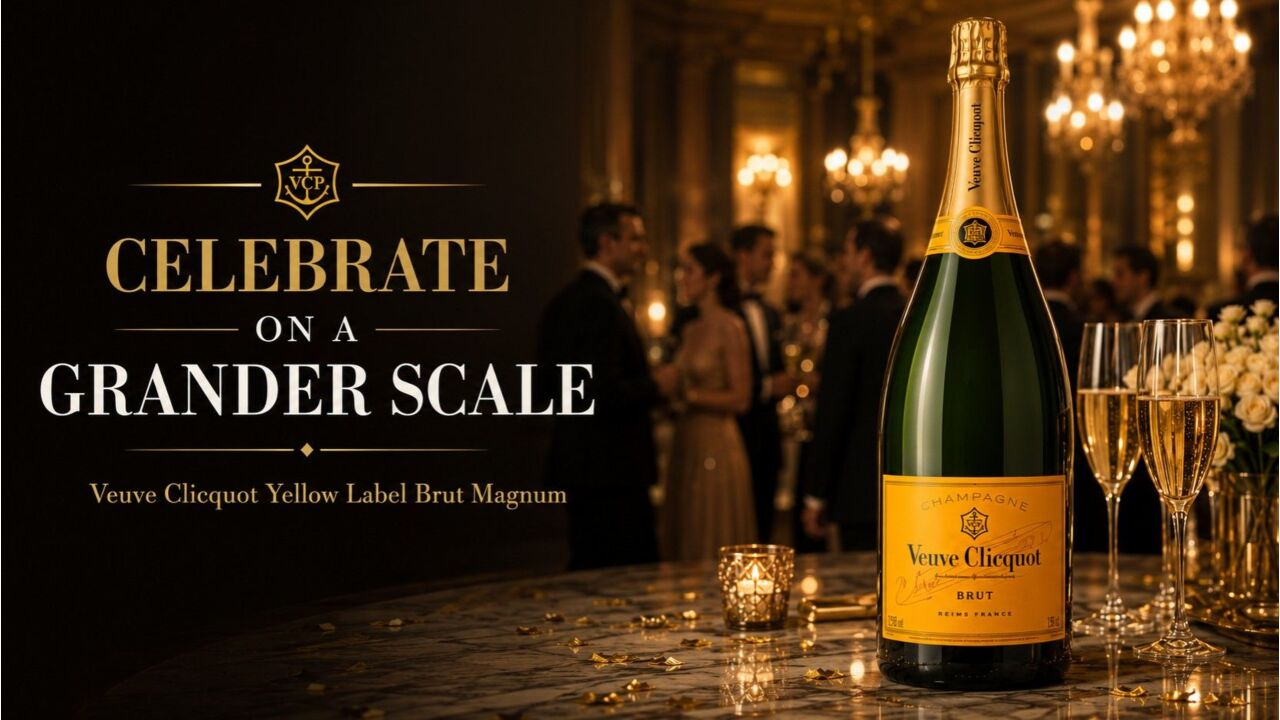
Bollinger Special Cuvée vs Veuve Clicquot Yellow Label
Veuve Clicquot Yellow Label Brut Champagne is another Pinot Noir-led non-vintage Champagne.
Bollinger Special Cuvée
- 60% Pinot Noir
- Majority reserve wines
- Reserve wines aged in magnum
- Roasted apple
- Brioche
- Walnut
- More vinous and full-bodied
- 12% ABV
Veuve Clicquot Yellow Label
- Approximately 50% Pinot Noir
- Pear, peach and citrus
- Brioche and dried fruit
- Structured but more fruit-forward
- Brighter and more immediately accessible
- 12.5% ABV
Bollinger generally feels richer, nuttier and more mature.
Veuve Clicquot offers a slightly brighter balance of fruit, freshness and structure.
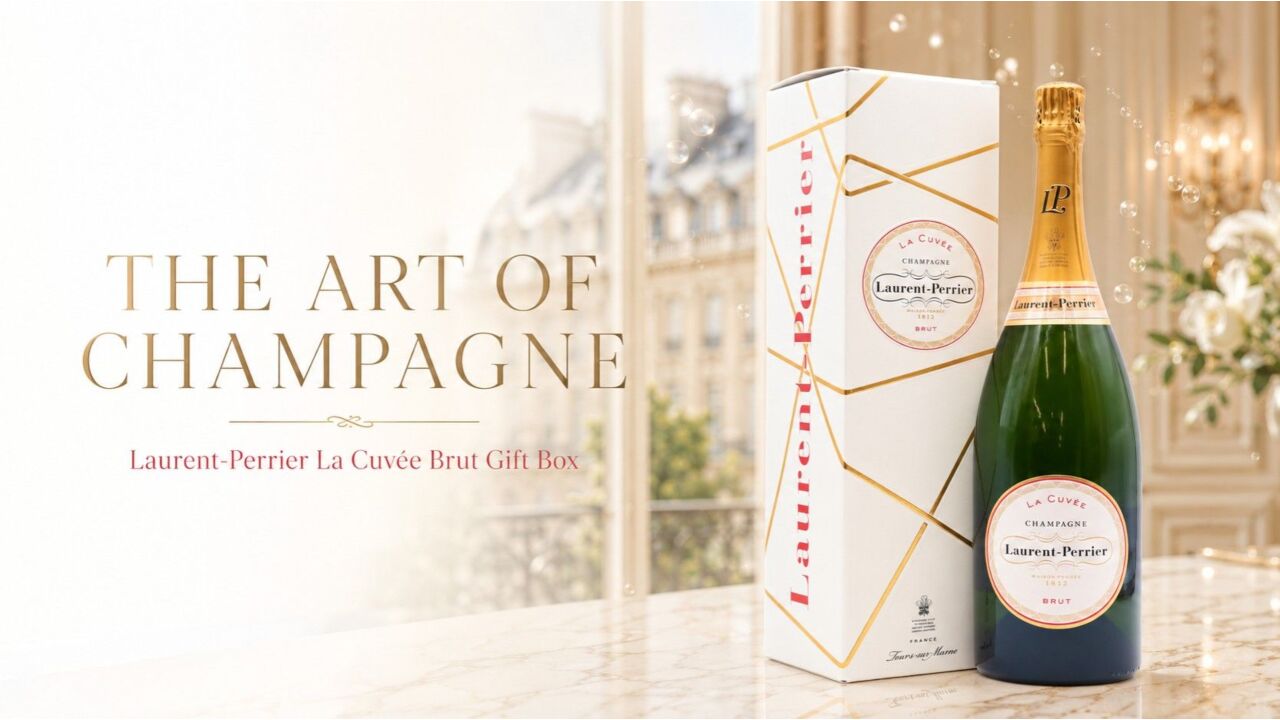
Bollinger Special Cuvée vs Laurent-Perrier La Cuvée
Laurent-Perrier La Cuvée Brut takes a contrasting Chardonnay-led approach.
Bollinger Special Cuvée
- 60% Pinot Noir
- Golden and full-bodied
- Roasted apple
- Brioche
- Walnut
- Spice
- Strong food-pairing profile
Laurent-Perrier La Cuvée
- More than 50% Chardonnay
- Paler and more delicate
- Citrus
- White flowers
- Vine peach
- White fruit
- Fresher aperitif style
Choose Bollinger for depth, richness and mature complexity.
Choose Laurent-Perrier for citrus freshness, floral elegance and a lighter texture.
Bollinger Special Cuvée vs Moët & Chandon Brut Impérial
Moët & Chandon Brut Impérial is a fruit-forward alternative.
Bollinger Special Cuvée
- Pinot Noir-led
- Greater reserve-wine maturity
- Roasted apple and brioche
- Fresh walnut
- Fuller body
- More savoury complexity
Moët & Chandon Brut Impérial
- Balanced three-grape blend
- Green apple
- Citrus
- White flowers
- Lively fruit
- Broad international recognition
- Lighter and more immediately refreshing
Moët is an accessible choice for large celebrations.
Bollinger offers more depth and is better suited to customers who want a richer Champagne for food.
Frequently Asked Questions
What is Bollinger Special Cuvée?
It is Bollinger’s signature non-vintage Brut Champagne, made predominantly from Pinot Noir and incorporating a substantial proportion of reserve wines.
How large is the bottle?
The current HTFW gift-boxed bottle contains 75cl.
What is the alcohol strength?
It is bottled at 12% ABV.
Does it come in a gift box?
Yes. The current HTFW bottle is supplied in its original Bollinger box.
Is it a vintage Champagne?
No. It combines wine from several harvest years.
Which grapes are used?
The blend contains 60% Pinot Noir, 25% Chardonnay and 15% Meunier.
Is it Pinot Noir-led?
Yes. Pinot Noir forms the majority and provides much of the structure and body.
How much Grand and Premier Cru fruit is used?
More than 85% of the blend comes from Grand and Premier Cru villages.
What are reserve wines?
They are wines retained from earlier harvests and used to create consistency and mature complexity.
Are reserve wines aged in magnums?
Some are. Bollinger preserves selected reserve wines in magnums for seven to 15 years.
How many reserve magnums does Bollinger hold?
The House states that its collection contains approximately one million reserve magnums.
How long is Special Cuvée aged?
It is aged in Bollinger’s cellars for approximately twice the minimum period required by the Champagne appellation, with a minimum of around three years.
What is the dosage?
It is moderately dosed at approximately 7–8g per litre.
Is it dry?
Yes. Special Cuvée is a dry Brut Champagne.
Is it sweet?
It has ripe fruit and brioche flavours but remains dry and structured.
What does it taste like?
Expect roasted apple, apple compote, pear, peach, citrus, brioche, walnut, hazelnut and spice.
Is it full-bodied?
Yes. Its Pinot Noir dominance and mature reserve wines create a fuller style than many non-vintage Champagnes.
Is it toasty?
Yes. Extended lees ageing develops brioche, toast and nutty flavours.
What colour is it?
It has a rich golden colour with very fine bubbles.
What is the best serving temperature?
Serve it at approximately 8–10°C, with around 10°C allowing the full aroma to develop.
Which glass should be used?
A tulip-shaped Champagne glass or tall white-wine glass is ideal.
Can it be served as an aperitif?
Yes. It works particularly well with oysters, smoked salmon, cheese gougères and shellfish.
Can it accompany a full meal?
Yes. Its structure makes it suitable for scallops, lobster, chicken, pork, duck, mushroom dishes and hard cheese.
Does it pair with fried chicken?
Yes. Acidity and bubbles cut through the crisp coating, while brioche complements the browned crust.
Is it good for weddings?
Yes. The gift box and recognisable Champagne House make it suitable for wedding presents and smaller celebrations.
How many glasses are in a bottle?
A 75cl bottle provides approximately five to six normal Champagne servings.
Can it be aged after purchase?
Yes. It can continue developing for several years under suitable cellar conditions.
How should it be stored?
Keep it in a cool, dark and stable location, ideally between 10°C and 15°C.
How long does it keep after opening?
Use a proper Champagne stopper, refrigerate immediately and consume within approximately 48 hours.
Is there a magnum?
Yes. HTFW offers a gift-boxed 1.5-litre magnum.
Are larger formats available?
Yes. Three-litre Jeroboam and six-litre Methuselah editions are also available.
Is there a Bollinger Rosé?
Yes. Bollinger Rosé adds a more pronounced strawberry, raspberry and redcurrant profile.
What is the James Bond edition?
It is a limited 007-themed presentation containing Bollinger Special Cuvée.
Is Special Cuvée better than Veuve Clicquot?
Neither is objectively better. Bollinger is generally richer, nuttier and more mature, while Veuve Clicquot is brighter and more fruit-forward.
Is it a good gift?
Yes. The original box, established House name and food-friendly style make it suitable for celebrations and formal gifting.
Why Bollinger Special Cuvée Stands Out
Special Cuvée stands out because its complexity is created through time and blending rather than an attention-grabbing novelty.
Its character comes from:
- 60% Pinot Noir
- More than 85% Grand and Premier Cru fruit
- A majority of reserve wines
- Reserve wines preserved in magnums
- Extended lees ageing
- A moderate dosage
- Bollinger’s long-established House style
These elements produce a Champagne with genuine depth.
The fruit ranges from fresh pear and peach to roasted apple and compote. Brioche and fine bubbles provide texture, while walnut and spice create a more savoury finish.
It works as an aperitif, but it becomes particularly impressive at the dining table.
For customers who find some non-vintage Champagnes too light or sharply acidic, Special Cuvée offers a richer alternative without losing freshness or elegance.
Buy Bollinger Special Cuvée Champagne Gift Box
Bollinger Special Cuvée Champagne Gift Box contains 75cl of the House’s signature Pinot Noir-led non-vintage Brut.
The blend combines 60% Pinot Noir, 25% Chardonnay and 15% Meunier, with more than 85% of the fruit sourced from Grand and Premier Cru villages.
Reserve wines provide depth and consistency, including selected components preserved in magnums for between seven and 15 years.
Bottled at 12% ABV, Special Cuvée delivers roasted apple, pear, peach and citrus alongside brioche, toasted nuts, honey and gentle spice.
Serve it at approximately 8–10°C as an aperitif or pair it with scallops, shellfish, roast chicken, pork, mushroom dishes and mature cheese.
Presented in its original Bollinger box, it is an excellent choice for birthdays, weddings, anniversaries, Christmas, corporate gifting or an impressive dinner.
Shop Bollinger Special Cuvée Champagne Gift Box, compare it with Bollinger Rosé, or choose the larger Bollinger Special Cuvée Magnum.
Browse the complete Bollinger collection, discover more Brut Champagne, or explore the complete Champagne range at Hard To Find Whisky.