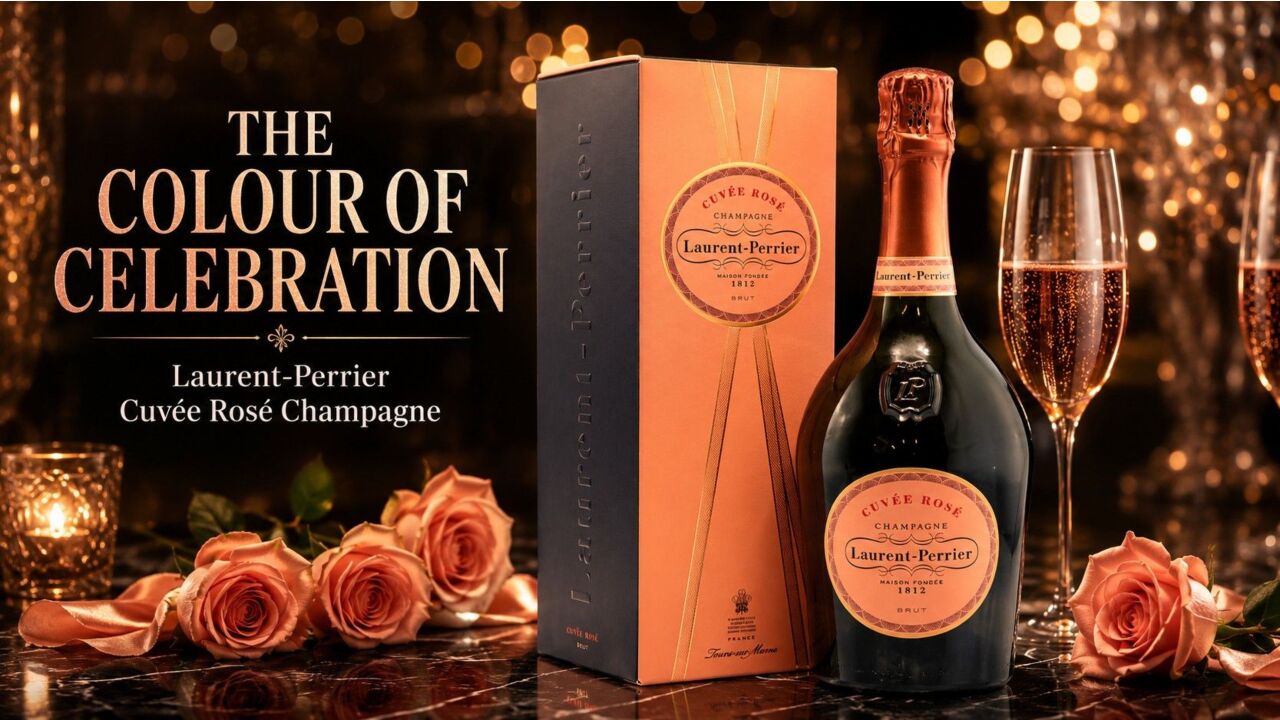

















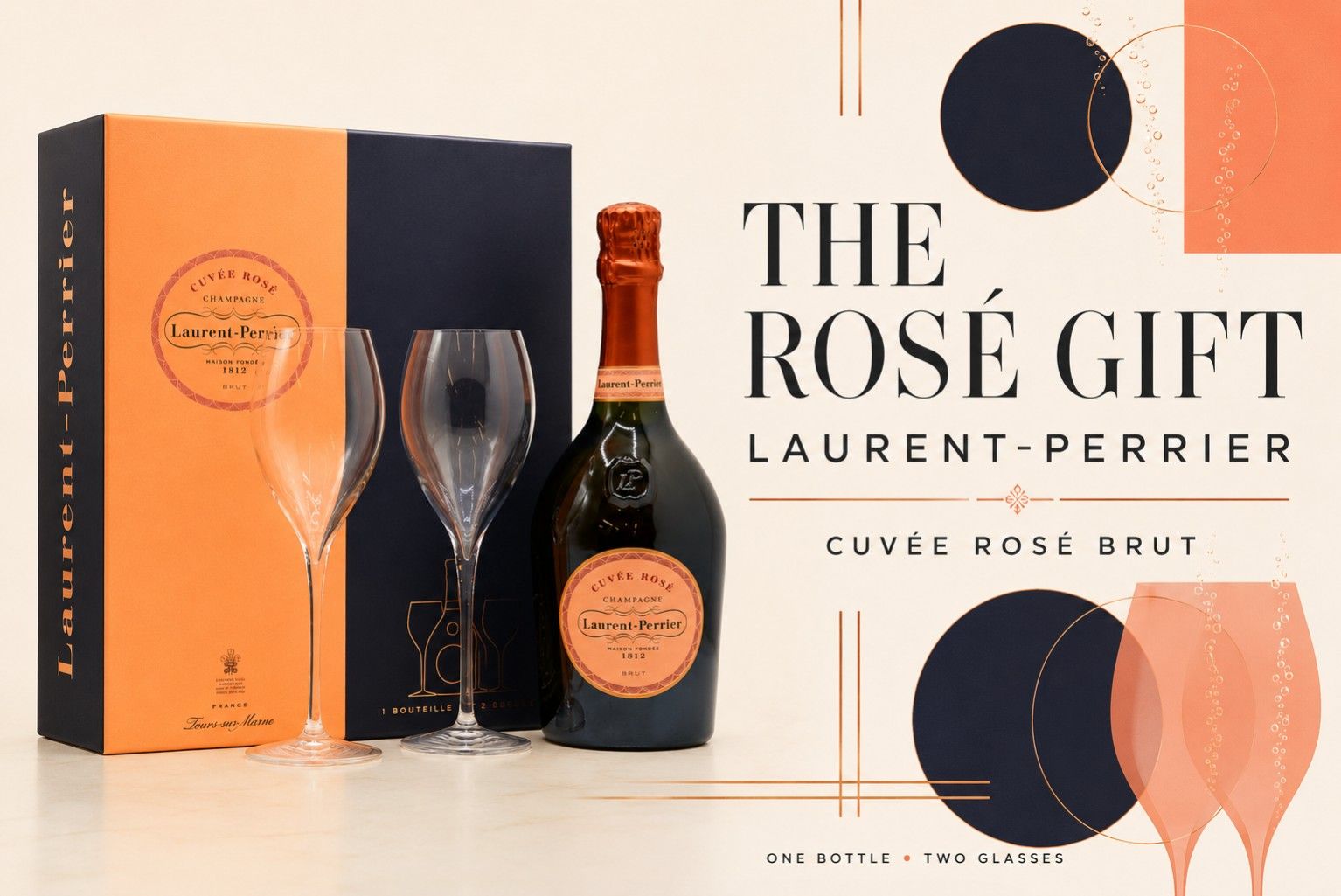
Laurent-Perrier Cuvée Rosé is distinctive before the cork has even been pulled.
Its sculpted shield-shaped bottle, vivid salmon-pink Champagne and long association with 100% Pinot Noir maceration have made it one of Laurent-Perrier’s defining wines. The Laurent-Perrier Cuvée Rosé Brut Champagne Glass Pack takes that familiar bottle and turns it into a complete presentation set, pairing a 75cl bottle of Cuvée Rosé with two Champagne glasses.
The Champagne itself was created in 1968 by Bernard de Nonancourt, at a time when rosé Champagne was considerably less fashionable than it is today. Instead of producing a rosé simply by blending red and white wines, Laurent-Perrier developed a carefully controlled Pinot Noir maceration technique, giving Cuvée Rosé its naturally derived colour and particularly intense red-fruit character.
Today it is produced entirely from Pinot Noir sourced from ten crus in the Montagne de Reims, with the grapes macerated for approximately 48–72 hours before the wine receives around five years of ageing.
The result is unmistakably fruit-driven: raspberry, redcurrant, strawberry and black cherry, balanced by lively freshness and a supple, rounded palate.
For a gift, dinner for two or anyone wanting the glassware to serve the Champagne alongside the bottle, the Cuvée Rosé Glass Pack adds something the standard bottle does not: a ready-made serving set built around one of the best-known rosé Champagnes.
You can also explore the wider Laurent-Perrier collection at HTFW.
Laurent-Perrier Cuvée Rosé Glass Pack at a Glance
- Producer: Laurent-Perrier
- Style: Brut Rosé Champagne
- Pack: One 75cl bottle with two Champagne glasses
- ABV: 12.5% on the current HTFW glass-pack listing
- Grape: 100% Pinot Noir
- Origin of fruit: Ten crus in the Montagne de Reims
- Production: Maceration rosé
- Maceration: Approximately 48–72 hours
- Ageing: Approximately five years
- Cuvée created: 1968
- Key flavours: Raspberry, redcurrant, strawberry and black cherry
- House style: Freshness, elegance and purity.
What Is Included in the Laurent-Perrier Cuvée Rosé Glass Pack?
The Laurent-Perrier Cuvée Rosé Glass Pack centres on a 75cl bottle of Cuvée Rosé Brut Champagne, with the presentation set also including two Champagne glasses.
That makes the pack different from the standard Laurent-Perrier Cuvée Rosé Gift Box.
The wine is the attraction in both formats, but the glass pack is designed around serving as well as presentation.
That makes it particularly well suited to occasions where the bottle will actually be opened rather than simply presented.
Two glasses also make the concept particularly natural for:
- Anniversaries
- Engagements
- Birthdays
- Dinner for two
- Housewarming gifts
- Champagne lovers
- Celebratory meals
The pack does not alter the Champagne itself. What it changes is the way it is presented and enjoyed.
What Is Laurent-Perrier Cuvée Rosé?
Cuvée Rosé is Laurent-Perrier's signature non-vintage rosé Champagne.
It is made from 100% Pinot Noir, using fruit from ten crus located in the Montagne de Reims. Rather than adding still red wine to a white Champagne blend, Laurent-Perrier uses a controlled period of skin contact to create both the wine's colour and its aromatic character.
That process is known as maceration.
The idea sounds straightforward, but the timing is critical.
Too little skin contact and the desired colour and fruit character may not develop.
Too much can introduce excessive extraction.
Laurent-Perrier therefore adjusts the maceration period according to the harvest, typically allowing approximately 48 to 72 hours.
The Champagne then receives around five years of ageing, allowing the bright Pinot Noir fruit to develop while retaining the freshness that Laurent-Perrier considers central to its house style.
Why 1968 Was Such an Important Year
Cuvée Rosé was launched in 1968.
That date matters because Laurent-Perrier was moving against the prevailing market rather than following an established rosé Champagne trend.
The house itself notes that rosé Champagne was not especially fashionable at the time. Bernard de Nonancourt nevertheless decided to develop a dedicated maceration rosé, presented in the distinctive shield-shaped bottle that remains associated with Cuvée Rosé today.
Its creation grew out of work that Laurent-Perrier had already begun earlier in the decade.
From around 1960, the house had developed still Champagne-region wines that helped its winemaking team gain greater knowledge of extracting Pinot Noir fruit and colour through skin contact. That experience eventually helped make Cuvée Rosé possible.
Rather than adapting an existing white Champagne, Laurent-Perrier effectively developed a distinct rosé identity.
More than half a century later, Cuvée Rosé remains one of the house's most recognisable bottles.
What Does 100% Pinot Noir Bring to Cuvée Rosé?
Pinot Noir defines this Champagne.
Laurent-Perrier selects fruit from ten different crus within the Montagne de Reims, an area particularly associated with high-quality Pinot Noir.
Using Pinot Noir exclusively gives the wine greater emphasis on:
- Red berries
- Structure
- Body
- Freshness
- Aromatic intensity
The most obvious difference becomes apparent when Cuvée Rosé is compared with Laurent-Perrier La Cuvée.
La Cuvée contains more than 50% Chardonnay, with Pinot Noir and Meunier making up the balance. Its profile therefore leans towards citrus, white flowers, vine peach and white fruit.
Cuvée Rosé heads in almost the opposite direction.
Raspberry.
Redcurrant.
Strawberry.
Black cherry.
The difference demonstrates just how much grape selection shapes Champagne before ageing or dosage are even considered.
How Laurent-Perrier Makes Its Maceration Rosé
Laurent-Perrier treats maceration as a specialist area of expertise rather than simply another production step.
The Pinot Noir is first selected in the vineyard. After harvest, a second selection takes place on sorting tables before the grapes are destemmed and moved into dedicated stainless-steel maceration vats.
The maceration is conducted separately by cru.
During the 48–72 hour period, the vats receive pump-overs twice daily, helping extract colour and aromatic compounds from the grape skins. The juice is then separated from the solid material before fermentation begins.
This process explains why the colour and flavour of Cuvée Rosé are so closely connected.
The wine is not coloured pink as an afterthought.
The same Pinot Noir skins responsible for its colour also help shape its red-fruit character.
Maceration Rosé vs Blended Rosé Champagne
Champagne permits two principal approaches to rosé.
The more widespread method is assemblage, or blended rosé.
A relatively small quantity of still red Pinot Noir or Meunier wine is incorporated into white base wine before the Champagne undergoes its secondary fermentation. Laurent-Perrier confirms that this is the more commonly used approach in Champagne.
The second approach is maceration.
Here, black grape skins remain in contact with their juice long enough for colour and aromatic compounds to be extracted directly.
Laurent-Perrier Cuvée Rosé belongs firmly to the latter camp.
Neither method automatically determines quality. Exceptional Champagne can be produced using either.
What matters here is that Laurent-Perrier has turned maceration into part of the identity of the wine.
What Does Laurent-Perrier Cuvée Rosé Taste Like?
The official profile is remarkably consistent in its emphasis on fresh red fruit.
Appearance
Cuvée Rosé's colour naturally develops from raspberry pink towards salmon pink.
This is one of the visually distinctive aspects of the wine, particularly in Laurent-Perrier's clear shield bottle.
Nose
The nose is particularly fresh and precise, dominated by:
- Raspberry
- Redcurrant
- Strawberry
- Black cherry.
It is an immediately recognisable profile.
There is no need to search through layers of flavour before discovering what the wine is trying to express.
Red fruit is the centre of the experience.
Palate
The palate begins with lively freshness before becoming supple and rounded.
Laurent-Perrier describes the experience as resembling a basket of freshly picked red berries.
The important point is the balance.
Despite all that ripe fruit, the Champagne avoids becoming heavy.
Fresh acidity and effervescence maintain energy throughout.
Finish
The red berries continue through the finish, with raspberry, strawberry and darker fruit remaining alongside the refreshing structure of the wine.
It is expressive without losing precision.
Is Laurent-Perrier Cuvée Rosé Sweet?
No. Cuvée Rosé is a Brut Champagne.
Its intense raspberry, strawberry and cherry aromas can create an impression of sweetness, particularly for anyone accustomed to much leaner Blanc de Blancs styles.
But fruity does not necessarily mean sweet.
The wine remains built around freshness and balance.
This distinction is important because the naturally ripe character of Pinot Noir is one of Cuvée Rosé's greatest strengths.
Why Does Laurent-Perrier Age Cuvée Rosé for Five Years?
The house gives the wine around five years of ageing before release.
That is longer than the basic minimum required for non-vintage Champagne.
The extended maturation gives the components time to integrate while retaining the bright fruit that defines the wine.
For comparison, Laurent-Perrier gives La Cuvée around four years of ageing, while prestige expressions such as Alexandra Rosé Millésimé receive around ten years.
That positions Cuvée Rosé neatly between the house's standard white Brut and its prestige rosé.
It has enough time to develop depth without losing the immediacy of its berry-led style.
Why the Shield-Shaped Bottle?
The bottle is part of Cuvée Rosé's identity.
Laurent-Perrier launched the Champagne in its distinctive shield-shaped bottle in 1968, deliberately giving the new rosé its own appearance rather than simply placing pink Champagne inside conventional house packaging.
The design has become so closely associated with the wine that Cuvée Rosé can often be recognised before the label can be read.
In the glass pack, that visual identity becomes even more important.
The bottle is already unusually decorative, while the accompanying glasses turn it from a single-bottle purchase into a more complete presentation.
Why Choose the Glass Pack?
There are now several ways to buy Laurent-Perrier Cuvée Rosé.
HTFW carries the standard Cuvée Rosé Gift Box, larger formats including the 1.5 Litre Magnum, and special presentations alongside the Glass Pack.
The glass pack makes most sense when presentation and immediate use matter equally.
A gift box primarily protects and presents the bottle.
A glass pack adds something functional.
You can open the pack, pour the Champagne and use the accompanying glasses straight away.
That simplicity makes it particularly suited to gifting between two people.
Laurent-Perrier Cuvée Rosé Glass Pack vs Gift Box
Both formats contain the same core Cuvée Rosé style.
The distinction is presentation.
Cuvée Rosé Gift Box
The Laurent-Perrier Cuvée Rosé Gift Box presents the bottle in dedicated packaging.
It is the cleaner option if the bottle itself is the sole focus.
Cuvée Rosé Glass Pack
The Glass Pack combines the 75cl Champagne with two glasses, creating a ready-to-serve set.
For someone who already owns suitable Champagne glassware, the gift box may be enough.
For a recipient who will appreciate an entire serving set, the glass pack adds more to the experience.
Glass Pack vs Laurent-Perrier Cuvée Rosé Magnum
Another alternative is the Laurent-Perrier Cuvée Rosé 1.5 Litre Magnum.
These formats serve very different purposes.
The glass pack is built around two-person presentation and serving.
The magnum is designed to make an impression at a larger table or gathering.
A 75cl bottle generally offers several glasses of Champagne, making it practical for a smaller celebration.
A 1.5-litre magnum doubles that volume and creates considerably greater visual impact.
For an intimate gift, the glass pack makes more sense.
For a larger celebration, the magnum has the advantage.
What Food Goes With Laurent-Perrier Cuvée Rosé?
This is one of the more food-friendly rosé Champagnes.
Laurent-Perrier officially recommends it with:
- Exotic cuisine
- Asian dishes
- Marinated fish
- Parma ham
- Chaource cheese
- Red-fruit desserts.
The variety of those pairings demonstrates the usefulness of Pinot Noir.
There is enough structure for savoury food, but sufficient freshness for fish and lighter dishes.
With Fish
Marinated fish works particularly well because the Champagne's acidity and red-fruit freshness can complement citrus, herbs and delicate seasoning.
With Charcuterie
Parma ham introduces salt and fat, both of which contrast nicely with the wine's freshness.
With Asian Food
Aromatic spices, ginger and mild chilli can work with the ripe berry profile better than they would with some very lean Champagnes.
With Dessert
Strawberry, raspberry and other red-fruit desserts naturally echo the flavours already present in the wine.
The dessert should not be excessively sweet, however, as a very sugary dish can make Brut Champagne appear unusually dry.
Cuvée Rosé vs Laurent-Perrier La Cuvée
For anyone deciding between pink and white Laurent-Perrier, this is the most useful comparison.
The Laurent-Perrier La Cuvée uses more than 50% Chardonnay, alongside 30–35% Pinot Noir and 10–15% Meunier. It draws from more than 100 crus and includes 15–30% reserve wines.
Its style is delicate and bright:
citrus, white flowers, vine peach and white fruit.
Cuvée Rosé is 100% Pinot Noir from ten crus, giving a dramatically more red-fruit-led profile.
In simple terms:
La Cuvée = citrus, white fruit and delicacy.
Cuvée Rosé = red berries, Pinot Noir and greater fruit intensity.
Cuvée Rosé vs Alexandra Rosé 2012
Those looking beyond the standard rosé can move towards Laurent-Perrier Alexandra Rosé Millésimé 2012.
Alexandra Rosé is Laurent-Perrier's prestige vintage interpretation.
The 2012 release uses 80% Pinot Noir and 20% Chardonnay, sourced entirely from Grand Cru villages, and receives around ten years of ageing.
Its profile is correspondingly more complex, combining crushed red fruit with a richer, warmer palate and bitter-orange character.
Cuvée Rosé remains fresher and more immediate.
Alexandra is deeper, rarer and deliberately more serious.
For most drinkers, Cuvée Rosé is the bottle that defines Laurent-Perrier's rosé identity.
The History of Laurent-Perrier
Maison Laurent-Perrier traces its origins to 1812, when André-Michel Pierlot settled in Tours-sur-Marne and established the Champagne business that would eventually become Laurent-Perrier.
The current name developed later.
After the company passed to Eugène Laurent, his widow Mathilde-Emilie Perrier took control following his death in 1887. She combined her surname with his, creating the Laurent-Perrier identity.
A major turning point arrived in 1939, when Marie-Louise de Nonancourt acquired the estate.
Her son Bernard de Nonancourt subsequently became CEO in 1948 at just 28 years old. At the time, the company employed around 20 people and was selling about 80,000 bottles.
Bernard transformed the house.
Laurent-Perrier credits him with establishing the modern philosophy of:
freshness, elegance and purity.
Cuvée Rosé is one of the clearest expressions of his willingness to innovate.
Laurent-Perrier's Modern Cellar Master
Laurent-Perrier's history continues to evolve.
In 2025, Olivier Vigneron became Cellar Master, having joined Laurent-Perrier in 2004 after earlier experience in Bordeaux and Champagne. The house describes his role as ensuring continuity of Laurent-Perrier's established winemaking style and savoir-faire.
That continuity matters for a non-vintage Champagne.
Cuvée Rosé does not rely on one particular harvest year.
The challenge is maintaining its familiar Pinot Noir, berry-fruit and freshness profile as vineyard conditions change from one year to another.
Frequently Asked Questions
What comes in the Laurent-Perrier Cuvée Rosé Glass Pack?
The pack combines a 75cl bottle of Laurent-Perrier Cuvée Rosé Brut Champagne with two Champagne glasses.
What percentage is the glass-pack Champagne?
The current HTFW Cuvée Rosé Glass Pack is listed at 12.5% ABV.
What grape is Laurent-Perrier Cuvée Rosé made from?
It is made entirely from 100% Pinot Noir.
Where does the Pinot Noir come from?
Laurent-Perrier uses Pinot Noir from ten crus in the Montagne de Reims.
Is Laurent-Perrier Rosé made by blending red and white wine?
No. Cuvée Rosé is a maceration rosé, where Pinot Noir juice remains in contact with the grape skins to extract colour and flavour.
How long are the grapes macerated?
Approximately 48–72 hours, depending on the harvest.
How long is Laurent-Perrier Cuvée Rosé aged?
Approximately five years.
When was Cuvée Rosé created?
It was launched in 1968 under Bernard de Nonancourt.
What does Laurent-Perrier Cuvée Rosé taste like?
Its official profile centres on raspberry, redcurrant, strawberry and black cherry, with a fresh attack and supple, rounded palate.
Is Laurent-Perrier Rosé sweet?
It is a Brut rosé Champagne. Its ripe berry flavours can seem generous and sweet-fruited, but the overall style remains fresh rather than dessert-like.
What food goes with Laurent-Perrier Cuvée Rosé?
Laurent-Perrier suggests Asian and exotic cuisine, marinated fish, Parma ham, Chaource cheese and red-fruit desserts.
Where can I find other Laurent-Perrier Champagnes?
The wider range can be explored through the Laurent-Perrier collection at Hard To Find Whisky, including La Cuvée, Blanc de Blancs, vintage releases, Grand Siècle and Alexandra Rosé.
Final Thoughts
The Laurent-Perrier Cuvée Rosé Brut Champagne Glass Pack takes one of Laurent-Perrier's most recognisable Champagnes and gives it a particularly useful presentation.
At its centre is the classic 75cl Cuvée Rosé, accompanied by two Champagne glasses.
The wine itself remains the real reason for the pack's appeal.
It is 100% Pinot Noir from ten crus in the Montagne de Reims.
The grapes undergo 48–72 hours of carefully managed maceration.
The Champagne then ages for approximately five years before release.
That process produces the character that has defined Cuvée Rosé since 1968: raspberry, redcurrant, strawberry and black cherry, delivered with freshness and a supple, rounded texture.
There is also a strong historical story behind it. Cuvée Rosé emerged from Bernard de Nonancourt's determination to innovate at a time when rosé Champagne was far from fashionable, helping make Pinot Noir maceration one of Laurent-Perrier's specialist areas of expertise.
For a conventional single-bottle presentation, there is the Laurent-Perrier Cuvée Rosé Gift Box. For larger occasions, the Cuvée Rosé 1.5 Litre Magnum provides the same distinctive Champagne in a more imposing format. At the prestige end of the house's rosé range, Alexandra Rosé Millésimé 2012 takes the idea into vintage Grand Cru territory.
The glass pack, however, has a simpler appeal:
an iconic bottle of Laurent-Perrier Cuvée Rosé, two glasses, and everything needed to pour the first serving.
Explore the Laurent-Perrier Cuvée Rosé Glass Pack at HTFW or browse the wider Laurent-Perrier collection.