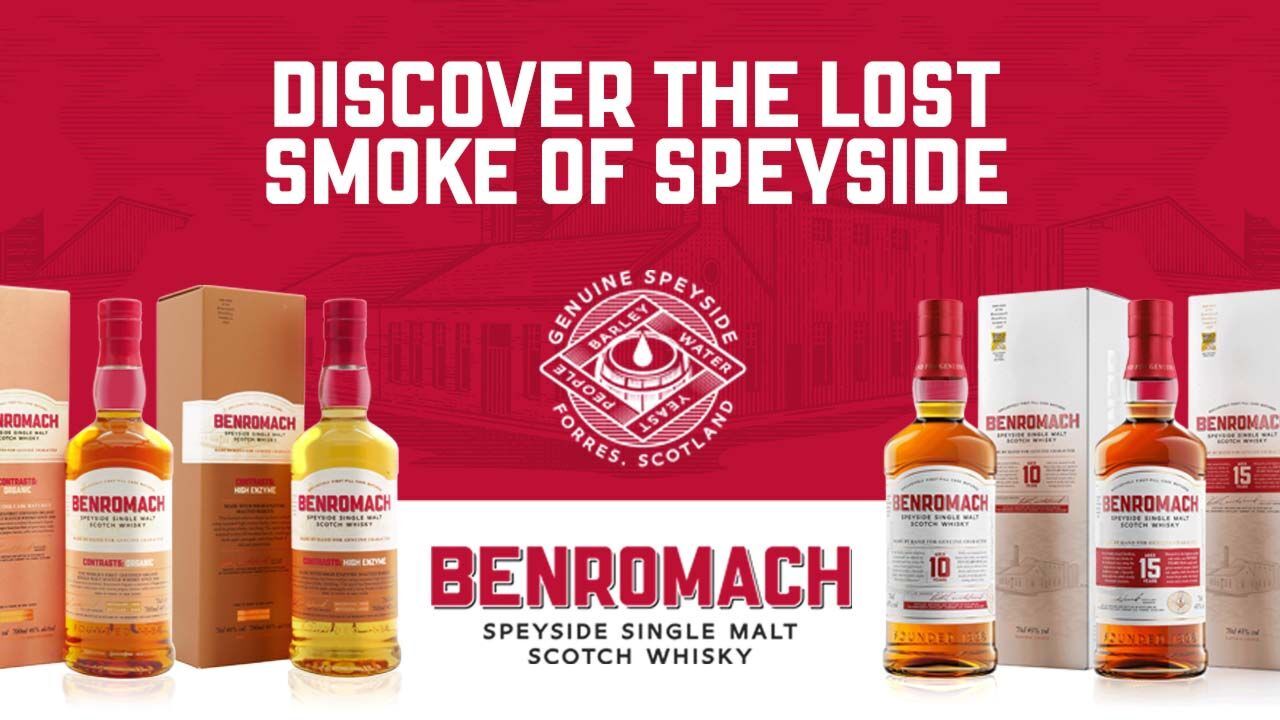














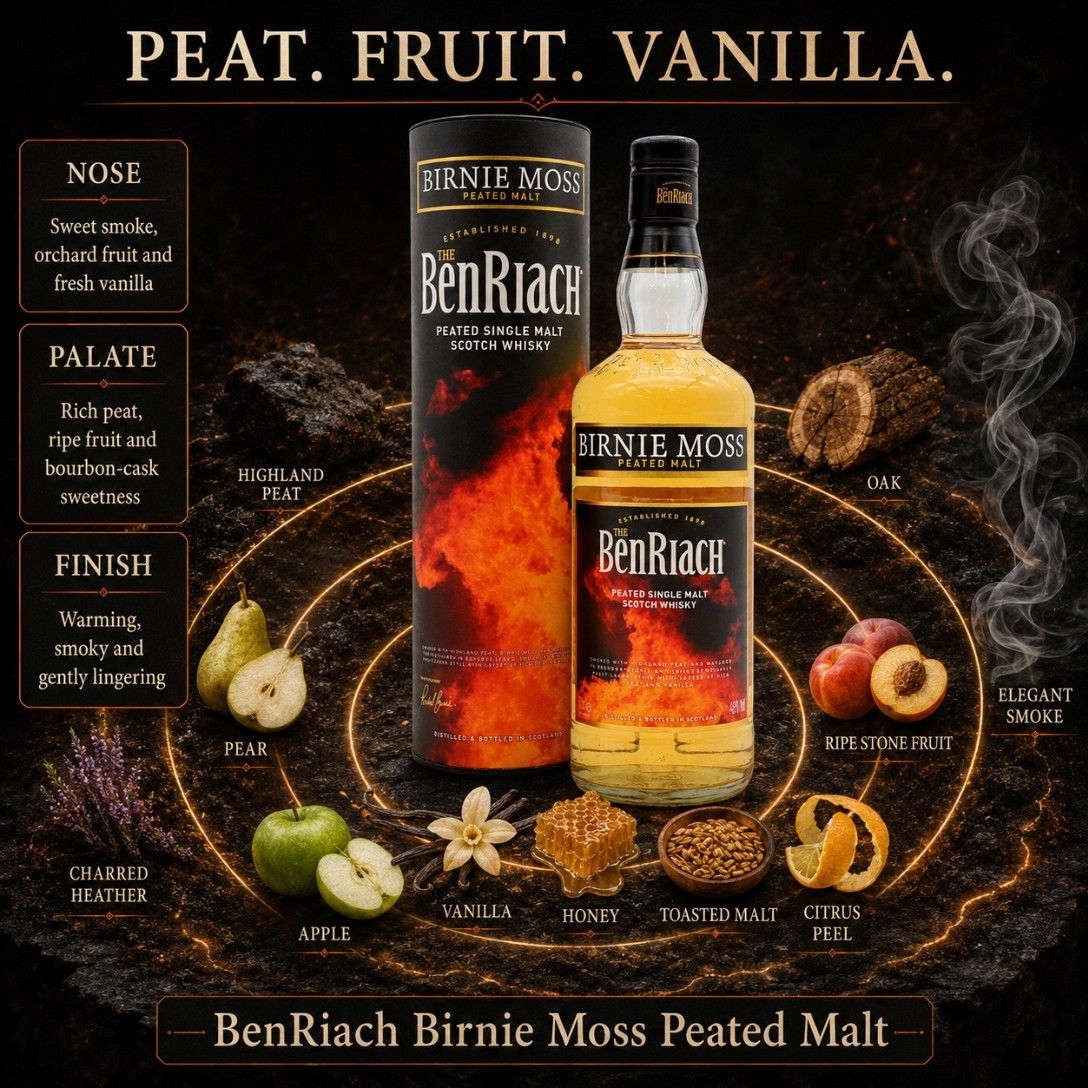
Speyside single malt is usually associated with orchard fruit, honey, malt and gentle oak. Benriach has never been content to remain within those familiar boundaries.
Benriach Birnie Moss Peated Speyside Single Malt Scotch Whisky takes the distillery’s naturally fruit-forward spirit and surrounds it with dense Highland peat smoke.
Matured in ex-bourbon casks and bottled at a substantial 48% ABV, Birnie Moss combines sweet vanilla, citrus and ripe stone fruit with barbecued pineapple, aromatic spice, crunchy malt and a lingering bonfire character.
It is heavily peated, but it does not attempt to imitate the maritime and medicinal style most closely associated with Islay.
Benriach uses peat sourced from the Scottish Highlands, creating a sweeter and more woodland-like smoke. The peat feels earthy, aromatic and occasionally meaty, while the ex-bourbon barrels preserve enough vanilla, fruit and creamy sweetness to keep the whisky balanced.
Birnie Moss belongs to an earlier generation of Benriach bottlings and is no longer part of the distillery’s current official range. Surviving bottles therefore offer more than a forceful smoky dram: they capture an important stage in the development of peated Speyside whisky before expressions such as The Smoky Ten, The Smoky Twelve and Smoke Season became central to the modern Benriach collection.
Benriach Birnie Moss at a Glance
- Distillery: Benriach
- Expression: Birnie Moss
- Whisky type: Peated Speyside Single Malt Scotch Whisky
- Bottle size: 70cl
- Strength: 48% ABV
- Age statement: None
- Primary maturation: Ex-bourbon casks
- Peat style: Highland peat
- Region: Speyside
- Country: Scotland
- Packaging: Cardboard presentation tube
- Release status: Previous-generation Benriach bottling
- Key flavours: Vanilla custard, citrus, stone fruit, barbecued pineapple, malt, aromatic spice, walnut and bonfire smoke
No numerical age statement or official bottle outturn is attached to the release. Its identity is built around peat intensity, bourbon-cask sweetness and a robust bottling strength rather than a declared age or individually numbered production total.
What Is Benriach Birnie Moss?
Benriach Birnie Moss is an age-unstated, heavily peated single malt produced at Benriach Distillery in northern Speyside.
The whisky was made with malted barley dried over Highland peat, giving the spirit an intense smoky character before maturation.
It was then matured in ex-bourbon casks, which added:
- Sweet vanilla
- Caramel
- Citrus
- Ripe fruit
- Creamy texture
- Light oak spice
The interaction between those casks and Benriach’s fruit-driven spirit is central to the finished whisky.
Birnie Moss does not present peat as a dry or entirely savoury flavour. Its smoke is wrapped around vanilla custard, juicy stone fruit and grilled pineapple, producing a combination that is rich, sweet and smoky.
The whisky is bottled at 48% ABV, giving it greater weight than many standard-strength Speyside malts. The higher strength preserves its oily mouthfeel, keeps the smoke clear and allows the sweeter fruit to remain visible beneath the peat.
Why Birnie Moss Is an Unusual Speyside Whisky
Peated Scotch whisky is most strongly associated with Islay and Scotland’s western islands.
Speyside built its modern reputation through a different style. Many of its best-known distilleries produce unpeated whisky centred on fruit, malt, honey and cask maturation.
Birnie Moss deliberately challenges that expectation.
The whisky combines:
- Speyside orchard and stone fruit
- Bourbon-cask vanilla
- Highland peat smoke
- Toasted malt
- Savoury barbecue notes
- Nutty spice
This makes it useful for two different audiences.
Drinkers who already enjoy peat gain an opportunity to explore smoke without the seaweed, iodine and medicinal character often found in coastal malt.
Speyside drinkers receive a recognisable fruit-led spirit transformed by intense smoke.
Birnie Moss is therefore not simply a novelty created by adding peat to an otherwise conventional recipe. It represents a longstanding part of Benriach’s distilling heritage.
The distillery returned to peated production during the early 1970s, reviving a 19th-century approach at a time when unpeated whisky had become the Speyside norm. Benriach continues that tradition through an annual period known as Smoke Season.
What Does Birnie Moss Mean?
Birnie Moss is named after a windswept area of moorland close to Benriach Distillery.
The name creates an appropriately wild image for a whisky built around dense, earthy smoke.
“Moss” immediately suggests:
- Damp earth
- Heather
- Peat
- Woodland
- Vegetation
- Smoke drifting across open ground
These associations fit the character of the whisky more naturally than a maritime or coastal name would.
Benriach sits inland in northern Speyside, and its peated whisky is shaped by Highland peat rather than the seaweed-rich coastal peat most closely associated with Islay.
Birnie Moss therefore reflects both geography and flavour. It presents peat as part of a rugged Highland landscape rather than an island shoreline.
Highland Peat Versus Islay Peat
Not all peat creates the same flavour.
Peat is formed from compressed plant material accumulated over thousands of years. Its composition depends on the vegetation and environment in which it developed.
Coastal peat may contain material associated with maritime plants and salt-rich environments. Inland Highland peat is more closely connected with woodland, heather, grasses and other terrestrial vegetation.
When burned during the drying of malted barley, those differences can influence the aroma of the smoke and the resulting whisky.
Benriach describes its Highland peat as creating a sweet, smoky woodland profile. The distillery contrasts this with the more medicinal style associated with many West Coast and Islay whiskies.
Typical Highland-Peat Characteristics
- Bonfire smoke
- Smouldering wood
- Heather
- Earth
- Charred herbs
- Sweet smoke
- Toasted malt
- Barbecue
- Forest floor
Typical Islay-Peat Characteristics
- Iodine
- Seaweed
- Brine
- Medicinal smoke
- Tar
- Antiseptic notes
- Coastal minerals
- Maritime ash
These are broad tendencies rather than strict rules.
Cask selection, fermentation, still shape, maturation and blending all affect the final whisky. Some Islay malts can be sweet and fruity, while some mainland peated whiskies can become intensely earthy or medicinal.
Birnie Moss nevertheless provides a particularly clear example of the distinction. Its smoke feels rich, aromatic and woodland-led, while vanilla and ripe fruit soften the peat.
Benriach’s Fruit-Laden Spirit
Peat is only one side of Birnie Moss.
The underlying new make is produced through Benriach’s slow distillation process, designed to capture a high level of fruity esters.
The distillery allows a long central heart of the spirit run to be collected, preserving compounds that develop into orchard fruit and citrus aromas.
Benriach identifies this fruit-laden spirit as one of the defining qualities across its three production styles:
- Classic unpeated
- Highland peated
- Triple distilled
The peated spirit used for Birnie Moss therefore begins with many of the same fruit-producing qualities found in Benriach’s unpeated whisky.
Smoke is layered onto the fruit rather than replacing it.
That explains why the whisky can offer intense peat while still presenting:
- Stone fruit
- Citrus
- Pineapple
- Overripe fruit
- Vanilla
- Sweet malt
This combination separates Birnie Moss from peated whiskies built primarily around ash, minerals or dry smoke.
Ex-Bourbon Cask Maturation
Birnie Moss is matured in ex-bourbon casks.
American bourbon must be matured in new charred oak containers. Once emptied, those casks retain substantial flavour and are widely used by Scotch whisky producers.
Ex-bourbon barrels commonly bring:
- Vanilla
- Caramel
- Coconut
- Honey
- Citrus
- Sweet oak
- Toasted sugar
- Gentle spice
These qualities are particularly useful with peated spirit.
Vanilla softens smoke, while caramel and fruit keep the whisky from becoming excessively dry. The charred interior of the original bourbon barrel also creates a natural connection with bonfire and barbecue flavours.
In Birnie Moss, the cask influence appears most clearly through vanilla custard, citrus, sweet malt and a creamy texture.
The whisky is not heavily wine-finished or built around dried fruit. The relatively direct bourbon maturation allows the interaction between Benriach spirit and Highland peat to remain at the centre.
Why Bourbon Casks Work with Peated Whisky
Bourbon and peat create several complementary flavour combinations.
Vanilla and Smoke
Vanilla gives the smoke a sweeter and creamier setting.
Rather than tasting only of burnt wood or ash, the whisky begins to suggest smoked custard, toasted marshmallow or vanilla cream near a bonfire.
Caramel and Barbecue
Caramelised wood sugars connect naturally with grilled and charred flavours.
This helps explain the barbecue-meat and barbecued-pineapple qualities in Birnie Moss.
Citrus and Peat
Citrus adds freshness and keeps the whisky from feeling too heavy.
Orange or lemon peel can make dense smoke feel more aromatic, particularly on the nose.
Tropical Fruit and Char
Pineapple becomes richer when combined with heat and smoke.
Birnie Moss’s barbecued-pineapple note provides one of the clearest examples of the whisky’s sweet-and-savoury balance.
Why Birnie Moss Has No Age Statement
Birnie Moss does not display a numerical age.
In Scotch whisky, any age statement must refer to the youngest whisky used in the bottle. A producer may combine several ages, but the label can show only the age of the youngest component.
An age-unstated release gives the whisky maker greater freedom to select casks for flavour rather than working towards one declared number.
For Birnie Moss, the important qualities are:
- Peat intensity
- Fruit freshness
- Bourbon-cask vanilla
- Creamy texture
- Aromatic spice
- Full-bodied smoke
Younger peated spirit can display smoke more directly because extended maturation has not yet softened or integrated it completely.
The absence of an age statement therefore suits a whisky designed to deliver intense peat and energetic fruit.
It should not be assumed that the bottle contains only the legal minimum age, nor should an unsupported age range be assigned to it. Benriach did not make a numerical age the focus of the release.
Why 48% ABV Matters
Birnie Moss is bottled at 48% ABV.
This strength gives it considerably more body than whisky presented at the legal minimum of 40%.
At 48%, the whisky retains:
- A creamy and oily mouthfeel
- Concentrated fruit
- Firm malt character
- Clear peat smoke
- A longer finish
- Enough structure for water or ice
The strength is particularly effective because Birnie Moss must balance two powerful elements: dense peat and sweet bourbon oak.
A lower bottling strength could make the fruit feel thin or allow the smoke to become detached from the rest of the palate.
At 48%, vanilla custard, crunchy malt and stone fruit have enough weight to stand alongside the peat.
The whisky remains approachable neat but can also accept a few drops of water without losing its essential character.
Benriach Birnie Moss Tasting Notes
The following profile expands on the tasting notes supplied for the exact HTFW bottle.
Colour
Bright gold with warm straw and light amber highlights.
The bourbon-cask maturation gives the whisky a lighter appearance than heavily sherried or wine-finished peated malts.
Nose
The nose is bold, aromatic and immediately smoky.
Dense bonfire smoke arrives first, joined by charred wood, earthy peat and barbecued meat.
Sweet vanilla begins to emerge beneath the smoke, followed by citrus peel and ripe fruit. Stone fruit brings peach and apricot, while grilled pineapple introduces a richer tropical note.
Aromatic spice and toasted malt add structure.
With time in the glass, the whisky reveals:
- Vanilla cream
- Lemon zest
- Ripe peach
- Grilled pineapple
- Toasted cereal
- Barbecue smoke
- Walnuts
- Sweet earth
The smoke remains substantial, but the nose does not become entirely dry or ashy.
Palate
The palate is rich, full-bodied and satisfyingly creamy.
Vanilla custard creates the opening sweetness, followed by juicy peach, apricot and other ripe stone fruits.
Crunchy malt provides a cereal-led middle, while aromatic spices build around the fruit.
Peat smoke then expands across the palate.
The smoke feels thick and enveloping, with flavours of:
- Smouldering wood
- Charred herbs
- Barbecued fruit
- Roasted malt
- Earth
- Gentle ash
The bourbon casks continue to supply sweetness, preventing the peat from becoming excessively bitter.
At 48% ABV, the texture is substantial enough to carry both the smoke and fruit through the entire sip.
Finish
The finish is long, warming and increasingly savoury.
Sweet fruit lingers initially, particularly pineapple and overripe stone fruit.
Delicate smoke gradually overtakes the sweetness, followed by walnut, malt and drying spice.
The final impression combines:
- Bonfire embers
- Nutty oak
- Warm spice
- Sweet malt
- Overripe fruit
- A final trace of vanilla
The smoke remains after the fruit has faded, but the finish is more aromatic than medicinal.
Is Birnie Moss Very Smoky?
Yes. Birnie Moss was created as an intensely peated expression.
The smoke is not a faint background detail or a subtle seasoning. It is one of the whisky’s defining characteristics.
Expect:
- Bonfire smoke
- Barbecued food
- Charred wood
- Earthy peat
- Toasted malt
- Lingering embers
However, intensity should not be confused with an Islay flavour profile.
Birnie Moss does not centre on iodine, seaweed or antiseptic notes. Its Highland peat is sweeter and more woodland-like, supported by vanilla and fruit.
This makes the whisky powerful without becoming entirely austere.
Is Birnie Moss Sweet?
The whisky has substantial sweetness beneath the smoke.
Its sweeter flavours include:
- Vanilla custard
- Ripe stone fruit
- Pineapple
- Citrus
- Overripe fruit
- Sweet malt
- Bourbon-cask caramel
The drier and more savoury flavours include:
- Bonfire smoke
- Barbecued meat
- Earth
- Walnut
- Oak spice
- Charred grain
The palate begins sweeter than it finishes.
Vanilla and fruit lead the arrival, while smoke, nuts and spice gradually take control through the finish.
This progression makes Birnie Moss more layered than a whisky designed only around peat intensity.
Is Birnie Moss Medicinal?
Birnie Moss may contain earthy and slightly savoury peat, but medicinal character is not its main style.
Drinkers may find:
- A touch of smoke-related sharpness
- Charred herbs
- Earth
- Burnt grain
- Barbecue
- Dry ash
They are less likely to find the strong iodine, antiseptic and seaweed characteristics associated with heavily maritime Islay whisky.
Benriach specifically distinguishes its Highland peat from the medicinal peat associated with the West Coast.
Is Birnie Moss Suitable for Islay Drinkers?
Yes, particularly for drinkers who enjoy heavy peat but want a different expression of smoke.
An Islay enthusiast may find the peat familiar in intensity but different in flavour.
Instead of seaweed and iodine, Birnie Moss offers:
- Woodland smoke
- Vanilla
- Peach
- Pineapple
- Malt
- Barbecue
- Nuts
The whisky can therefore act as a useful comparison rather than a direct substitute.
It shows how heavily peated malt can change when produced from fruit-driven Speyside spirit and matured in sweet ex-bourbon casks.
Is Birnie Moss Suitable for Peat Beginners?
Birnie Moss is heavily peated, so it is not the gentlest possible introduction to smoky whisky.
However, several qualities make it more approachable than its intensity might suggest:
- Sweet vanilla
- Juicy fruit
- Creamy texture
- Bourbon-cask caramel
- Limited medicinal character
- A controlled 48% ABV
Drinkers who enjoy sweet bourbon, grilled fruit or barbecue flavours may find the whisky easier to approach than a very dry, briny or medicinal malt.
Those seeking a milder introduction to Benriach smoke may prefer Benriach The Smoky Ten, which combines peated and unpeated spirit at 46% ABV.
How to Drink Benriach Birnie Moss
Birnie Moss can be enjoyed neat, with water or over ice.
Neat
Pour a moderate measure into a tulip-shaped whisky glass.
Allow it to rest for five to ten minutes before tasting. This gives the initial smoke time to settle and allows the vanilla and fruit to become clearer.
Begin by nosing above the rim rather than placing the nose deeply into the glass.
Take a small first sip, then return to the aroma. The second taste should reveal more custard, fruit and malt beneath the peat.
With Water
A few drops of water can reveal:
- More vanilla custard
- Brighter citrus
- Softer stone fruit
- Sweeter malt
- Reduced alcohol warmth
- A clearer pineapple note
Water may also make the smoke feel more aromatic and less dense.
Add it gradually. Excessive dilution can reduce the creamy texture and shorten the finish.
Over Ice
One large cube provides controlled cooling and dilution.
As the whisky chills:
- Vanilla becomes more prominent.
- Peat feels softer.
- Pineapple becomes sweeter.
- Spice recedes.
- The texture becomes easier to approach.
Some of the finer citrus and malt aromas may become less visible at lower temperatures.
In a Highball
Birnie Moss has enough strength and smoke to create a bold highball.
Use a smaller measure, clear ice and highly carbonated soda water.
A strip of orange peel complements the citrus and stone fruit without overwhelming the peat.
Cocktails with Birnie Moss
The whisky’s intense smoke and 48% strength make it suitable for cocktails that require a clearly recognisable peated component.
Smoky Old Fashioned
Use Birnie Moss with a small quantity of sugar syrup and aromatic bitters.
Orange peel highlights the citrus, while the sugar reinforces the bourbon-cask vanilla.
Penicillin
Birnie Moss can be used as a smoky float over blended Scotch, lemon, honey and ginger.
Its sweet Highland peat works particularly well with honey, while the barbecued-fruit character adds depth.
Smoky Rob Roy
Sweet vermouth introduces herbs and dark fruit.
Use it sparingly so the vanilla, malt and peat remain the focus.
Peated Whisky Sour
Fresh lemon juice contrasts with the creamy vanilla and smoke.
The 48% ABV strength ensures the whisky remains visible after shaking and dilution.
Food Pairings for Benriach Birnie Moss
The whisky works particularly well with grilled, smoked and fruit-led foods.
Recommended pairings include:
- Barbecued pork
- Smoked brisket
- Grilled pineapple
- Smoked ham
- Charred sausages
- Mature cheddar
- Smoked cheese
- Toasted walnuts
- Roast peaches
- Apricot tart
- Vanilla custard
- Dark chocolate
- Smoked almonds
- Caramelised nuts
Grilled pineapple is the most direct pairing, reflecting the whisky’s tropical fruit and barbecue smoke.
Smoked meat amplifies the savoury peat, while vanilla-led desserts reveal the sweeter bourbon-cask side.
Mature cheddar adds enough salt and richness to withstand the smoke without covering the fruit.
Benriach’s Peated Speyside Tradition
Benriach’s smoky identity began long before Birnie Moss.
The distillery resumed production in 1965 after an exceptionally long silent period. During the early 1970s, it began producing batches of peated spirit using malted barley smoked with Highland peat.
This was highly unconventional.
Speyside had become known primarily for unpeated, fruit-led whisky. Producing smoky malt revived an older 19th-century approach that had largely disappeared from the region.
Benriach’s historical research indicates that its oldest remaining peated inventory dates to 1975, giving the distillery access to some of the oldest peated Speyside whisky in existence.
That tradition continues through Smoke Season, an annual production period during which peated malt returns to the distillery.
Birnie Moss belongs within that history.
It helped show a broader audience that Benriach peat was not limited to old archive casks or occasional single-cask releases. It could also form the foundation of a bold, accessible distillery bottling.
The Three Styles of Benriach Spirit
Benriach is unusual in producing three separate styles of spirit.
Classic Unpeated Spirit
This is the fruit-driven foundation of expressions such as Benriach The Original Ten.
It centres on:
- Orchard fruit
- Honey
- Malt
- Citrus
- Vanilla
- Toasted oak
Highland-Peated Spirit
This style adds sweet woodland smoke to Benriach’s fruit-laden character.
Birnie Moss, The Smoky Ten, The Smoky Twelve and Smoke Season all explore this side of the distillery.
Triple-Distilled Spirit
Benriach also produces a small quantity of triple-distilled whisky.
A third distillation creates a lighter and particularly smooth spirit, providing another foundation for the distillery’s varied cask programme.
Benriach began exploring triple distillation during the 1990s and continues to produce all three styles.
The History of Benriach Distillery
Benriach was founded by John Duff in 1898 on the site of the former Riach farm, close to Longmorn Distillery and south of Elgin.
The timing was unfortunate.
The late Victorian whisky boom ended shortly after the distillery opened, and the Pattison Crash created severe pressure across the Scotch industry.
Benriach stopped distilling in 1900, only a short time after production began.
The site did not become entirely inactive. Its floor maltings continued operating and supplied neighbouring Longmorn, preserving part of the distillery infrastructure through decades of silence.
As demand for Scotch recovered during the mid-20th century, Glenlivet Distillers renovated Benriach and restarted its stills in 1965.
Peated distillation followed in the early 1970s, while the first Benriach single malt was released in 1994.
The distillery was mothballed again in 2002 before an independent consortium led by Billy Walker acquired it in 2004. The new owners quickly developed a broad portfolio of peated, unpeated and unusually matured Benriach whiskies.
The Billy Walker Era and Birnie Moss
Billy Walker’s period at Benriach was particularly important to the modern reputation of the distillery.
The warehouses contained a remarkable variety of stock:
- Unpeated spirit
- Heavily peated spirit
- Triple-distilled whisky
- Bourbon barrels
- Sherry casks
- Wine finishes
- Old and rare peated casks
Rather than narrowing the range to one permanent Speyside style, the independent owners used this diversity as a defining strength.
Birnie Moss reflects that approach.
It is direct, heavily peated and bourbon-cask-led, with no age statement distracting from the flavour profile.
The bottle also comes from the earlier BenRiach presentation, before the current range was redesigned around The Original Ten, The Smoky Ten and the wider modern collection.
It therefore captures both the distillery’s peated heritage and the creative range-building associated with the independent Billy Walker era.
Birnie Moss and the Modern Benriach Range
Birnie Moss is not currently listed among Benriach’s official core or special-edition whiskies.
The modern range presents smoky Speyside through age-stated multi-cask expressions and the more powerful Smoke Season release.
This makes Birnie Moss an interesting bridge between two periods.
Earlier Peated Range
- Birnie Moss
- Curiositas
- Septendecim
- Solstice
- Albariza
- Peated Quarter Casks
- Peated Cask Strength releases
Modern Smoky Range
- The Smoky Ten
- The Smoky Twelve
- Smoke Season
- Older peated components within The Twenty One, The Twenty Five and The Thirty
Birnie Moss is not identical to any one modern expression.
Its no-age-statement format, bourbon maturation and direct peat intensity give it a simpler and more forceful style than Benriach’s current three-cask Smoky bottlings.
Birnie Moss Versus Benriach The Smoky Ten
Benriach The Smoky Ten is the natural modern comparison.
The Smoky Ten combines unpeated and peated spirit matured for at least ten years in bourbon barrels, Jamaican rum casks and toasted virgin oak.
It is bottled at 46% ABV and offers orchard fruit syrup, smoked honey, spiced pear, maple and smoked applewood.
Birnie Moss
- No age statement
- 48% ABV
- Heavily peated
- Ex-bourbon cask maturation
- Vanilla custard
- Barbecued pineapple
- Stone fruit
- Dense bonfire smoke
The Smoky Ten
- 10-year age statement
- 46% ABV
- Combination of peated and unpeated spirit
- Bourbon, rum and virgin oak
- Orchard fruit
- Smoked honey
- Spiced pear
- More layered cask profile
Birnie Moss is the more direct and peat-forward whisky.
The Smoky Ten is smoother and more complex in its cask construction, with rum and virgin oak adding sweetness and spice.
Birnie Moss Versus Benriach The Smoky Twelve
Benriach The Smoky Twelve combines peated and unpeated spirit matured in bourbon barrels, sherry casks and Marsala wine casks.
Bottled at 46% ABV, it offers smoked vanilla, charred orange, toasted almond, dark chocolate, fruit peel and brown sugar.
Birnie Moss
- Younger and more energetic in style
- Bourbon-cask-led
- Higher 48% ABV
- Vanilla custard and stone fruit
- Barbecue and bonfire smoke
- Nutty, spicy finish
The Smoky Twelve
- 12-year age statement
- Bourbon, sherry and Marsala casks
- 46% ABV
- Dark chocolate and brown sugar
- Charred orange
- More integrated and wine-influenced smoke
The Smoky Twelve is darker, richer and more polished.
Birnie Moss is brighter, more direct and more obviously built around peat intensity.
Birnie Moss Versus Benriach Smoke Season
Benriach Smoke Season is one of the strongest current descendants of the style explored by Birnie Moss.
Smoke Season is bottled at 52.8% ABV and matured in bourbon barrels and toasted virgin oak. HTFW describes it as Benriach’s most heavily peated and smokiest release at the time of its introduction, with caramel, smoke, oak spice, citrus peel, vanilla, cinnamon and apple.
Birnie Moss
- 48% ABV
- Ex-bourbon casks
- Sweet fruit and creamy vanilla
- Dense peat smoke
- Simpler cask structure
- Earlier-generation bottling
Smoke Season
- 52.8% ABV
- Bourbon and toasted virgin oak
- Greater oak intensity
- More caramel and cinnamon
- Higher alcohol strength
- Modern special-edition presentation
Smoke Season is more powerful and oak-driven.
Birnie Moss places greater emphasis on juicy fruit, custard and straightforward bourbon-cask peat.
Birnie Moss Versus Benriach Curiositas
Benriach Curiositas 10 Year Old is another important earlier peated Benriach.
The HTFW bottle is presented at 40% ABV and combines medicinal peat, tarmac, honey, fruit, oak, iodine, nuts, dried fruit and spice.
Birnie Moss
- No age statement
- 48% ABV
- Bourbon-cask fruit and vanilla
- Barbecued pineapple
- Creamier and more powerful
- Dense but sweet smoke
Curiositas
- 10-year age statement
- 40% ABV on the HTFW listing
- More medicinal and iodine-led
- Dried fruit and nuts
- Lighter body
- More conventional age-stated presentation
Curiositas provides a closer connection with medicinal peat.
Birnie Moss is fuller, sweeter and more tropical, with its higher strength producing a significantly richer texture.
Birnie Moss Versus Peated Quarter Casks
Benriach Peated Quarter Casks is bottled at 46% ABV and uses smaller oak casks to increase the interaction between wood and spirit.
Its profile combines orchard and stone fruit with nuts, spice, malt, caramel and substantial peat smoke.
Birnie Moss
- Standard ex-bourbon maturation
- 48% ABV
- Vanilla custard
- Pineapple
- Barbecue smoke
- Fruit-led peat
Peated Quarter Casks
- Smaller quarter-cask maturation
- 46% ABV
- Greater caramel and oak extraction
- Ripe fruit and nuts
- Youthful malt
- Strong wood-and-smoke interaction
Quarter Casks is more oak-intensive.
Birnie Moss offers a cleaner view of Benriach peated spirit shaped by conventional bourbon wood.
Birnie Moss Versus Peated Cask Strength Batch 1
Benriach Peated Cask Strength Batch 1 is bottled at 56% ABV and presents Benriach smoke at a much higher natural strength.
Birnie Moss
- 48% ABV
- Ready to drink neat
- Bourbon-cask sweetness
- Creamy vanilla and fruit
- Strong but controlled peat
Peated Cask Strength Batch 1
- 56% ABV
- Greater concentration
- More alcohol intensity
- Designed for gradual dilution
- A more demanding high-proof experience
Birnie Moss is the more accessible of the two.
Peated Cask Strength is better suited to experienced drinkers who want maximum control over dilution and flavour intensity.
Birnie Moss Versus Benriach The Thirty
Benriach The Thirty demonstrates what the distillery’s peated spirit can become after extended maturation.
It combines peated whisky matured in sherry casks, bourbon barrels, virgin oak and port casks, bottled at 46% ABV.
Its profile centres on honeyed smoke, dark fruit, nuanced oak, spice and a long smoked-honey finish.
Birnie Moss
- No age statement
- 48% ABV
- Energetic and intensely smoky
- Vanilla, citrus and stone fruit
- Bonfire and barbecue
- Accessible peated Speyside style
The Thirty
- 30-year age statement
- 46% ABV
- Four-cask maturation
- Mature honeyed smoke
- Dark fruit and refined oak
- Greatly softened and integrated peat
The Thirty shows how age can transform Benriach peat from a direct bonfire into a polished layer of smoked honey and mature fruit.
Birnie Moss preserves the more youthful and forceful side of the distillery’s smoke.
Birnie Moss Versus The Original Ten
Benriach The Original Ten provides the clearest comparison with Benriach’s classic fruit-led style.
It is matured in bourbon barrels, sherry casks and virgin oak and bottled at 43% ABV. Pear, nectarine, honeyed malt, almond and spiced vanilla define the profile.
The Original Ten
- Orchard fruit
- Honeyed malt
- Toasted oak
- Pear and nectarine
- Subtle smoke
- 43% ABV
Birnie Moss
- Dense Highland peat
- Barbecued pineapple
- Vanilla custard
- Stone fruit
- Nutty spice
- 48% ABV
Tasting the two side by side reveals how much of Benriach’s fruit remains present after peat is introduced.
Birnie Moss is not a completely different distillery style. It is the same fruit-led foundation transformed by smoke.
More Benriach Whiskies to Explore
The Benriach collection at HTFW includes 175 listings spanning core expressions, previous-generation bottlings, single casks, independent releases and rare aged whisky.
Benriach The Smoky Ten
The Smoky Ten is the best modern starting point for Benriach’s peated style.
Its combination of bourbon, rum and virgin oak creates a sweeter and more layered alternative to Birnie Moss.
Benriach The Smoky Twelve
The Smoky Twelve adds sherry and Marsala influence, producing darker chocolate, orange and brown-sugar flavours.
Benriach Smoke Season
Smoke Season provides greater strength, toasted virgin oak and an even more concentrated modern smoky profile.
Benriach Curiositas
Curiositas 10 Year Old is one of the closest historical companions to Birnie Moss.
It offers a more medicinal, age-stated interpretation of earlier Benriach peat.
Benriach Peated Quarter Casks
Peated Quarter Casks explores the accelerated oak interaction created by smaller barrels.
Benriach Peated Cask Strength Batch 1
Peated Cask Strength Batch 1 presents the distillery’s smoke at 56% ABV for a much more powerful experience.
Benriach The Original Ten
The Original Ten is the natural introduction to Benriach’s orchard-fruit, honey and toasted-oak character.
Benriach The Smoky Twelve Gift Set
The Smoky Twelve with Branded Glass offers the current age-stated smoky style in a gift presentation.
Benriach The Thirty
The Thirty shows the exceptional longevity of peated Benriach through three decades and four cask types.
Customers can also explore the wider peated Scotch whisky collection and Speyside whisky range.
Is Birnie Moss Discontinued?
Birnie Moss is no longer part of Benriach’s current official whisky range and is widely recorded as a discontinued expression.
HTFW currently holds surviving bottles, but this should not be interpreted as evidence that the expression remains in active production.
Its place has effectively been taken by newer smoky releases, particularly:
- The Smoky Ten
- The Smoky Twelve
- Smoke Season
The modern whiskies are not direct replacements in recipe.
Birnie Moss remains distinctive through its combination of:
- No age statement
- Ex-bourbon maturation
- 48% ABV
- Heavy peat
- Vanilla custard
- Barbecued pineapple
- Earlier BenRiach packaging
Once remaining retail stock has been sold, availability is likely to depend increasingly on the secondary market.
Is Birnie Moss Collectable?
Birnie Moss has several qualities that support collector interest:
- It belongs to an earlier BenRiach range.
- It is no longer part of the current official collection.
- It represents the distillery’s longstanding peated tradition.
- It uses the previous BenRiach branding and presentation.
- It predates The Smoky Ten and The Smoky Twelve.
- It is bottled at a robust 48% ABV.
- It captures the Billy Walker-era approach to heavily peated Speyside whisky.
It is not a numbered single cask or a release with a confirmed limited outturn.
Its collectability therefore comes from discontinuation, historical position and flavour style rather than a declared bottle total.
Future financial value cannot be guaranteed.
The strongest reason to purchase Birnie Moss remains the opportunity to taste a distinctive previous-generation Benriach that cannot be replaced exactly by the current range.
How to Store Benriach Birnie Moss
Store the bottle upright.
Whisky should not be laid on its side for long periods because prolonged exposure to high-strength alcohol may damage the cork.
Keep the bottle:
- Away from direct sunlight
- At a stable temperature
- Inside its tube where practical
- Away from radiators and other heat sources
- Upright
- Protected from repeated temperature changes
Whisky does not continue maturing once bottled.
A sealed bottle of Birnie Moss may become older as an object, but the spirit inside remains the same age and composition as it was on the day of bottling.
Who Will Enjoy Benriach Birnie Moss?
Birnie Moss is particularly well suited to drinkers who enjoy:
- Heavily peated whisky
- Sweet Highland smoke
- Peated Speyside single malt
- Bourbon-cask maturation
- Vanilla and stone fruit
- Barbecue flavours
- Full-bodied whisky at 46–50% ABV
- Previous-generation distillery bottlings
- Benriach’s Billy Walker-era range
- Comparing mainland and Islay peat
- Discontinued Scotch whisky
It may be less suitable for someone seeking a very gentle, unpeated or heavily sherried whisky.
Drinkers who dislike all forms of peat are unlikely to find the vanilla and fruit sufficient to disguise its smoky character.
Is Benriach Birnie Moss Worth Buying?
Benriach Birnie Moss succeeds because its peat and fruit feel equally important.
The whisky is smoky enough to satisfy experienced peat drinkers, but it is not built only around ash and intensity.
Benriach’s underlying fruit-laden spirit remains visible through:
- Ripe stone fruit
- Citrus
- Barbecued pineapple
- Overripe fruit
- Sweet malt
Ex-bourbon casks add vanilla custard and a creamy texture, while Highland peat supplies dense bonfire smoke, earthy warmth and savoury barbecue character.
The 48% ABV strength gives every part of the whisky enough weight.
Its discontinued status also adds historical interest.
Birnie Moss represents a period when Benriach’s peated range was expressed through highly individual names and direct flavour concepts. The modern Smoky collection is more structured and age-led, but Birnie Moss remains one of the clearest examples of straightforward, intensely peated Speyside whisky.
For established Benriach drinkers, it provides an opportunity to revisit an earlier style.
For peat enthusiasts, it demonstrates how mainland smoke differs from an Islay profile.
For newcomers willing to begin with something bold, its vanilla, fruit and creamy bourbon-cask sweetness make the intensity more approachable than the name might suggest.
Frequently Asked Questions
What is Benriach Birnie Moss?
Birnie Moss is a heavily peated Speyside single malt produced by Benriach and matured in ex-bourbon casks.
What strength is Birnie Moss?
It is bottled at 48% ABV.
What size is the bottle?
The HTFW release contains 70cl.
Does Birnie Moss have an age statement?
No. It is a no-age-statement single malt.
What casks were used?
The whisky was matured in ex-bourbon casks.
Is Birnie Moss heavily peated?
Yes. It was created as an intensely peated expression of Benriach.
What type of peat does Benriach use?
Benriach uses peat sourced from the Scottish Highlands.
It creates a sweet and smoky woodland character rather than the strongly medicinal profile associated with many Islay whiskies.
What does Birnie Moss taste like?
Its main flavours include vanilla custard, citrus, juicy stone fruit, barbecued pineapple, aromatic spice, crunchy malt, walnut and bonfire smoke.
Is Birnie Moss smoky?
Yes. Dense peat and bonfire smoke are central to the whisky.
Is it medicinal?
It is less medicinal than many heavily peated Islay whiskies, focusing more on woodland smoke, earth, barbecue and sweet fruit.
Is Birnie Moss sweet?
It has substantial sweetness from vanilla, bourbon oak, citrus and stone fruit, balanced by peat, nuts and spice.
Is Birnie Moss peated with Islay peat?
No. Benriach describes its peat as Highland peat.
Is Birnie Moss an Islay whisky?
No. It is a Speyside single malt made at Benriach.
Where is Benriach Distillery?
Benriach is located in northern Speyside, south of Elgin and close to Longmorn Distillery.
When was Benriach founded?
The distillery was founded by John Duff in 1898.
Why did Benriach close?
It stopped distilling in 1900 following the severe downturn connected with the Pattison Crash.
When did Benriach reopen?
Production resumed in 1965.
When did Benriach begin making peated spirit?
The distillery returned to peated production during the early 1970s.
Does Benriach still make peated whisky?
Yes. Peated spirit is distilled during an annual period known as Smoke Season.
Is Birnie Moss still produced?
It is no longer part of Benriach’s current official range and is widely recorded as discontinued.
What replaced Birnie Moss?
There is no exact replacement, but The Smoky Ten, The Smoky Twelve and Smoke Season now represent the main modern Benriach smoky styles.
What is the difference between Birnie Moss and The Smoky Ten?
Birnie Moss is a no-age-statement, bourbon-cask whisky bottled at 48% ABV with a more direct and heavily peated profile.
The Smoky Ten is a 10-year-old combination of peated and unpeated spirit matured in bourbon, rum and virgin-oak casks at 46% ABV.
What is the difference between Birnie Moss and The Smoky Twelve?
The Smoky Twelve carries a 12-year age statement and uses bourbon, sherry and Marsala casks, producing more chocolate, orange and dark-fruit character.
Birnie Moss is brighter, more bourbon-led and more directly smoky.
What is the difference between Birnie Moss and Smoke Season?
Smoke Season is stronger at 52.8% ABV and uses bourbon and toasted virgin oak.
Birnie Moss is bottled at 48% ABV and places greater emphasis on vanilla custard, stone fruit and barbecued pineapple.
Is Birnie Moss suitable for beginners?
It is heavily peated, but its vanilla, fruit and creamy texture make it more approachable than some intensely dry or medicinal smoky whiskies.
Should water be added?
Water is optional. A few drops can reveal additional vanilla, citrus and stone fruit while softening the densest smoke.
Can Birnie Moss be served over ice?
Yes. One large cube provides gradual dilution and makes the vanilla and fruit more prominent.
Is Birnie Moss suitable for cocktails?
Yes. It works well in a Penicillin, smoky Old Fashioned, Rob Roy or peated Whisky Sour.
Is Birnie Moss collectable?
Its discontinued status, earlier packaging and place within Benriach’s peated history give it collector interest, although no confirmed bottle outturn was published.
Where can I buy Benriach Birnie Moss?
Benriach Birnie Moss Peated Speyside Single Malt Scotch Whisky is available from Hard To Find Whisky while stocks remain.
Smoke from the Other Side of Speyside
Benriach Birnie Moss challenges a simple assumption: that heavily peated whisky must taste coastal, medicinal or unmistakably Islay.
Its smoke comes from a different landscape.
Highland peat creates bonfire, earth, woodland and barbecue. Benriach’s fruit-laden spirit brings peach, citrus and pineapple, while ex-bourbon casks provide vanilla custard and creamy sweetness.
The result is unmistakably smoky but equally recognisable as Speyside single malt.
Benriach Birnie Moss is bold enough for experienced peat drinkers, yet sweet and fruit-driven enough to demonstrate why Benriach’s smoky whisky has developed such a dedicated following.
It also preserves an important stage in the distillery’s recent history.
Before The Smoky Ten, The Smoky Twelve and Smoke Season established the modern range, Birnie Moss presented peated Benriach in a particularly direct form: bourbon casks, no age statement, 48% ABV and a dense fog of Highland smoke.
The bottle may belong to a previous range, but its flavour remains entirely relevant.
It is smoky Speyside without compromise.