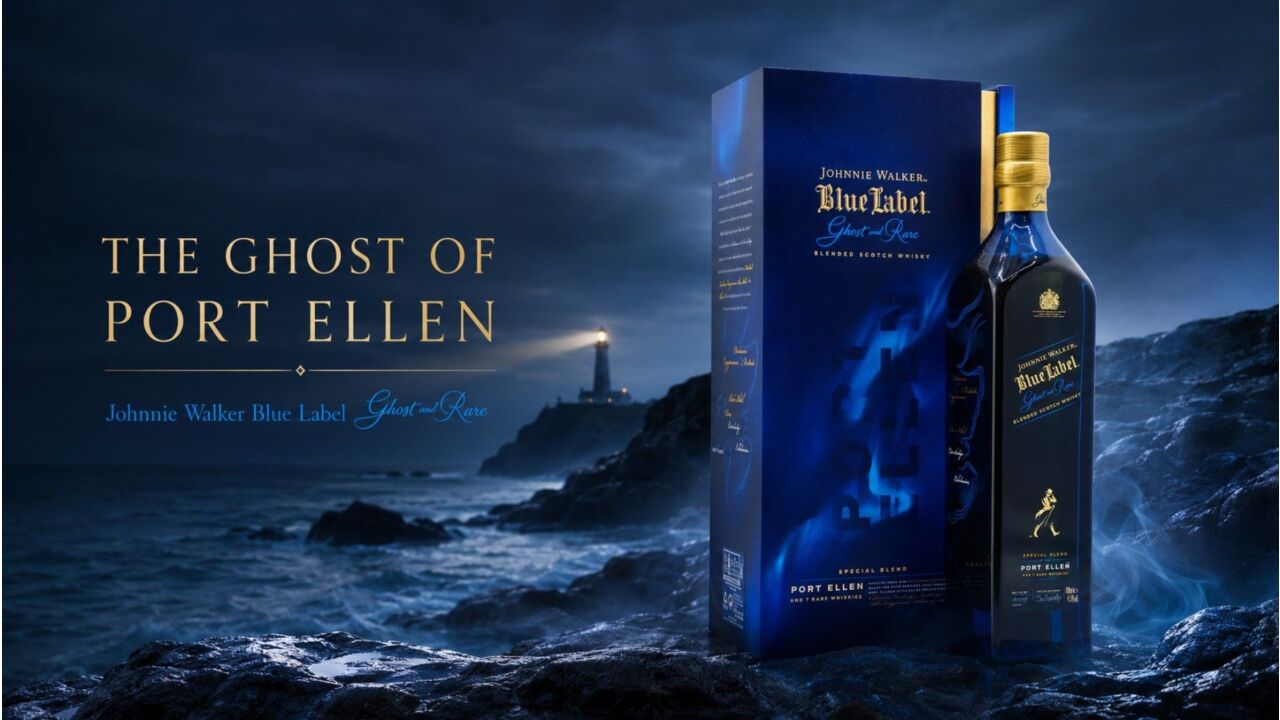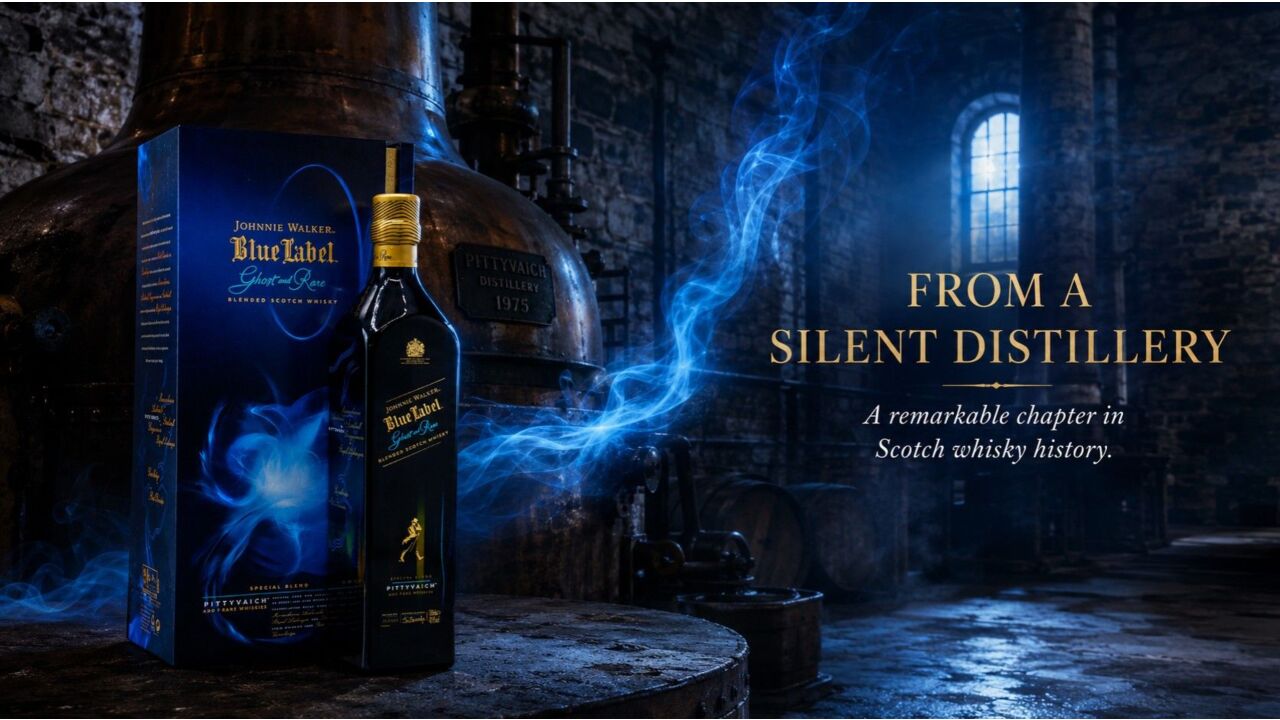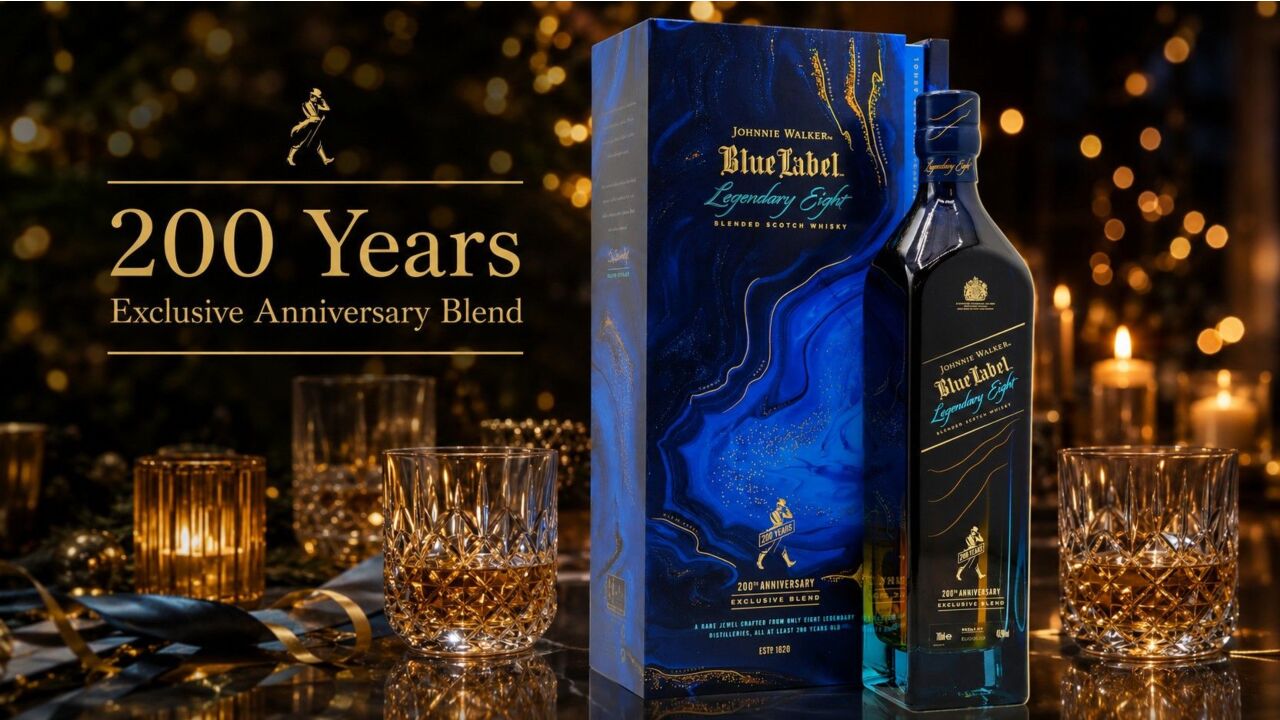
























Some limited-edition whiskies are distinguished by unusual packaging. Others commemorate an anniversary, artist or cultural event.
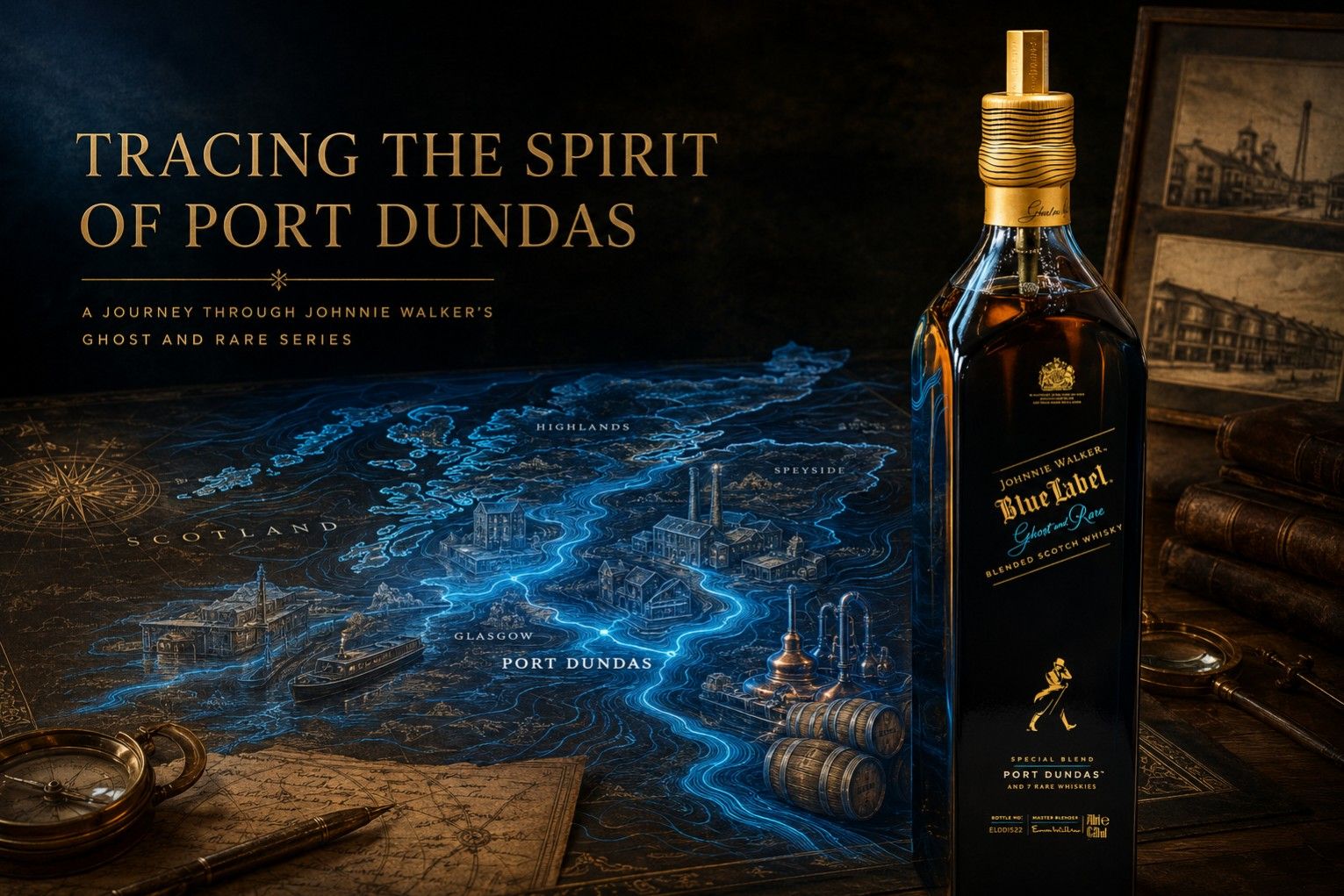
Johnnie Walker Blue Label Ghost & Rare Port Dundas is built around something far more difficult to replace: mature whisky from a distillery that no longer exists.
Port Dundas stood beside the Forth and Clyde Canal in Glasgow and spent almost two centuries producing grain whisky for some of Scotland’s most important blends. The distillery closed permanently in 2010, leaving only the whisky already resting in casks.
Every bottle drawn from those stocks reduces the amount that remains.
Released in 2022 as the fifth expression in the Johnnie Walker Blue Label Ghost & Rare series, Port Dundas places rare grain whisky from the lost Glasgow distillery at the centre of an eight-distillery blend.
The Port Dundas component contributes creamy vanilla, polished wood and delicate sweetness. Historic whiskies from Cambus and Brora introduce further vanilla and restrained smoke, while Cameronbridge and Glenkinchie bring spiced apple. Clynelish, Dailuaine and Auchroisk complete the blend with peach, berries, malt, wax and additional depth.
Bottled at 43.8% ABV and supplied in its original presentation box, this is a whisky created for drinking as much as collecting.
It also offers a valuable reminder that grain whisky is not merely a neutral background component. When selected from exceptional casks and given sufficient time to mature, it can provide extraordinary silkiness, sweetness and complexity.
Johnnie Walker Ghost & Rare Port Dundas at a Glance
- Full name: Johnnie Walker Blue Label Ghost & Rare Port Dundas
- Producer: John Walker & Sons
- Series: Blue Label Ghost & Rare
- Release number: Fifth expression
- Whisky type: Blended Scotch whisky
- Country of origin: Scotland
- Bottle size: 70cl
- Alcohol strength: 43.8% ABV
- Year bottled: 2022
- Central distillery: Port Dundas
- Other ghost whiskies: Cambus and original historic stocks from Brora
- Additional distilleries: Cameronbridge, Glenkinchie, Clynelish, Dailuaine and Auchroisk
- Total distilleries represented: Eight
- Cask influence: Includes second-fill American oak and highly charred first-fill American oak
- Packaging: Original presentation box
- Bottle details: Individually numbered release
- Character: Creamy, fruity, polished and gently smoky
- Key flavours: Vanilla, oak, spiced apple, peach, berries and soft smoke
- Best suited to: Blue Label drinkers, collectors and enthusiasts of closed-distillery whisky
What Is Johnnie Walker Blue Label Ghost & Rare Port Dundas?
Ghost & Rare Port Dundas is a limited-edition blended Scotch whisky created from exceptionally scarce malt and grain whiskies held within the Johnnie Walker reserves.
The blend contains whisky from eight distilleries:
- Port Dundas
- Cambus
- Brora
- Cameronbridge
- Glenkinchie
- Clynelish
- Dailuaine
- Auchroisk
Port Dundas provides the central character.
The other seven whiskies were selected to reveal, complement and extend the creamy grain-whisky style rather than cover it.
This gives the release a different purpose from standard Johnnie Walker Blue Label.
Traditional Blue Label aims to produce a complete expression of the Johnnie Walker house style, balancing mature fruit, chocolate, malt, oak, honey, spice and gentle smoke.
Ghost & Rare Port Dundas places greater emphasis on one particular distillery. The entire blend is constructed to present the qualities of rare Port Dundas grain whisky while preserving the refinement associated with Blue Label.
It is not a single grain whisky, despite the importance of Port Dundas.
It is a blended Scotch whisky combining both grain and single malt components from multiple Scottish distilleries.
What Does “Ghost and Rare” Mean?
The Ghost & Rare name describes the two types of whisky used within the collection.
Ghost Whisky
A ghost distillery is a distillery that has ceased production while stocks of its whisky remain in maturation or storage.
Once those surviving casks have been emptied, the original whisky cannot simply be produced again.
Even when a distillery is later rebuilt or reopened, whisky from the earlier operation remains historically distinct. Different equipment, production methods, ingredients and maturation conditions can prevent new spirit from recreating the old whisky precisely.
Port Dundas closed in 2010 and remains silent.
Cambus closed in 1993.
Brora closed in 1983 and reopened in 2021, but the Brora included in Port Dundas Ghost & Rare comes from original stocks produced before the historic closure.
Rare Whisky
Not every whisky included in the blend comes from a closed distillery.
The term “Rare” also covers exceptional casks from active distilleries that meet the quality and character required for the release.
These include whisky from:
- Cameronbridge
- Glenkinchie
- Clynelish
- Dailuaine
- Auchroisk
The rarity therefore comes from a combination of discontinued spirit, long maturation, restricted cask availability and highly selective blending.
The History of Port Dundas Distillery
Port Dundas was established in Glasgow in 1811.
Its location beside the Forth and Clyde Canal gave the distillery access to an important industrial transport route. Raw materials could reach the site efficiently, while finished spirit could be moved through Glasgow and onwards to markets around the world.
Port Dundas developed during a period when Glasgow was becoming one of Britain’s major industrial cities.
The distillery expanded considerably and eventually became one of Scotland’s most important grain-whisky producers.
By the later nineteenth century, the Port Dundas operation had developed from neighbouring distillery businesses into an enormous production complex. Historical accounts described it as one of the most extensive distilleries in Scotland.
The site became closely associated with blended Scotch whisky.
Its grain spirit provided sweetness, texture and balance to blends that required dependable quality on a very large scale.
Port Dundas survived:
- Changes in ownership
- Fires
- Rebuilding
- Shifts in production technology
- Two world wars
- Periods of changing whisky demand
- Major consolidation across the Scotch industry
The distillery underwent extensive modernisation during the twentieth century and remained a major Glasgow landmark.
Diageo announced plans to close Port Dundas in 2009, and production ended in 2010.
The closure brought almost 200 years of distilling history to an end.
Why Did Port Dundas Close?
Port Dundas did not close because grain whisky had ceased to be important.
Grain whisky remains essential to blended Scotch, which accounts for a considerable proportion of Scotland’s whisky production and international sales.
The closure formed part of a wider consolidation of grain-whisky production.
Diageo transferred demand towards other facilities, particularly the much larger Cameronbridge Distillery in Fife. The decision concentrated production within fewer modern sites rather than maintaining both operations.
Once Port Dundas stopped distilling, its remaining mature whisky became finite.
No additional Port Dundas spirit has been produced since 2010, and the original distillery equipment is no longer operating.
This is what gives releases such as Ghost & Rare Port Dundas their historical significance.
The whisky is not simply inspired by a closed distillery. It contains genuine spirit produced there before the doors closed.
Why Was Port Dundas Important to Johnnie Walker?
Blended Scotch relies on the relationship between malt and grain whisky.
Single malt can provide:
- Orchard and tropical fruit
- Malt sweetness
- Smoke
- Wax
- Nuts
- Floral character
- Maritime flavours
- Rich oak and spice
Grain whisky can contribute:
- Creamy vanilla
- Toffee
- Soft sweetness
- Silky texture
- Polished oak
- Integration
- Length
- Space for malt flavours to develop
Port Dundas was particularly valued for its sweet and delicate grain character.
It could provide the creamy foundation needed to connect more forceful malt components without allowing the blend to feel disjointed.
This role was especially important for Johnnie Walker.
The purpose of blending is not merely to place several whiskies in the same bottle. Each component must support a larger structure.
Port Dundas could soften smoke, carry fruit and bring texture while remaining complex enough to contribute its own flavour.
Ghost & Rare Port Dundas brings that normally supporting role into the foreground.
What Is Grain Whisky?
Grain whisky is frequently misunderstood.
The term does not mean the spirit is young, cheap or lacking in quality.
Single grain Scotch whisky is whisky produced at one distillery using a grain recipe that may include wheat or maize alongside malted barley. It is generally distilled in continuous column stills rather than the copper pot stills used for single malt.
Column distillation is highly efficient and can create a lighter spirit.
When young, that spirit may appear relatively delicate. After extended maturation in good-quality oak, however, grain whisky can develop considerable richness.
Mature grain whisky may display:
- Vanilla
- Coconut
- Caramel
- Toffee
- Honey
- Custard
- Polished wood
- Tropical fruit
- Soft spice
- A silky texture
Its lighter original spirit allows the character of the cask to become particularly influential over time.
The Port Dundas whisky selected for this release demonstrates how grain spirit can develop depth without losing elegance.
Is Port Dundas a Single Malt Distillery?
Port Dundas is remembered primarily as a grain-whisky distillery.
The early history of the site involved malt-whisky production, but the operation ultimately became one of Scotland’s major grain distilleries.
The whisky at the centre of Johnnie Walker Ghost & Rare Port Dundas is grain whisky rather than single malt.
This is one of the qualities that makes the release so interesting within the series.
Earlier Ghost & Rare editions centred on lost single malt distilleries such as:
- Brora
- Port Ellen
- Glenury Royal
- Pittyvaich
The fifth release shifts attention towards grain whisky and its essential place within the history of Johnnie Walker.
How Was Ghost & Rare Port Dundas Created?
The Johnnie Walker blending team selected mature Port Dundas whiskies from two forms of American oak.
Second-Fill American Oak
A second-fill cask has already been used to mature Scotch whisky once after its original use.
Its oak influence is generally gentler than that of a first-fill cask.
For the Port Dundas component, second-fill American oak contributes:
- Creamy vanilla
- Soft sweetness
- Rounded grain character
- Integrated oak
- A smooth texture
The reduced intensity allows the delicate character of the mature grain whisky to remain visible.
First-Fill Highly Charred American Oak
A first-fill Scotch cask is being used for Scotch whisky for the first time after holding its previous contents.
Highly charred American oak can provide:
- Stronger vanilla
- Toasted wood
- Caramel
- Baking spice
- Greater structure
- Charred sweetness
The combination of the two cask styles creates contrast.
Second-fill oak protects delicacy and creaminess, while highly charred first-fill oak adds depth and spice.
The blending team then layered the Port Dundas whisky with seven additional components selected to amplify particular characteristics.
The Eight Distilleries in Ghost & Rare Port Dundas
Each distillery performs a different role within the final whisky.
Port Dundas
Port Dundas forms the heart of the blend.
Its mature grain whisky supplies:
- Creamy vanilla
- Polished wood
- Delicate sweetness
- Silky texture
- Structural balance
Rather than disappearing behind the malts, Port Dundas determines the direction of the whisky.
Cambus
Cambus was another important Lowland grain distillery.
It closed in 1993, and its remaining stocks have become increasingly scarce.
Within the blend, Cambus reinforces:
- Vanilla
- Sweet grain
- Soft oak
- Creaminess
- Mellow maturity
Using Port Dundas and Cambus together gives the release a particularly strong foundation of historic grain whisky.
Brora
Brora provides a contrasting Highland character.
The historic stocks selected for the blend contribute:
- Restrained smoke
- Waxy texture
- Highland depth
- Mineral character
- Mature complexity
Brora’s soft smoke prevents the grain sweetness from becoming overly gentle.
Cameronbridge
Cameronbridge is an active grain distillery in Fife and one of the most important grain-whisky producers in Scotland.
Its role includes:
- Additional smoothness
- Sweet grain character
- Vanilla
- Spiced apple
- Texture
Cameronbridge also creates a link between historic grain whisky and continuing modern production.
Glenkinchie
Glenkinchie is a Lowland single malt distillery known for a light, floral and orchard-fruit style.
It contributes:
- Spiced apple
- Fresh malt
- Light flowers
- Gentle cereal
- Elegant sweetness
These qualities lift the creamier grain components.
Clynelish
Clynelish is known for its distinctive waxy texture and coastal Highland character.
Its whisky can bring:
- Waxy fruit
- Citrus
- Peach
- Mineral notes
- Subtle maritime freshness
The texture of Clynelish works naturally with mature grain whisky.
Dailuaine
Dailuaine produces a weightier Speyside malt often used within high-quality blends.
Its contribution can include:
- Rich malt
- Orchard fruit
- Berries
- Spice
- Body
Dailuaine helps give the middle of the palate greater weight.
Auchroisk
Auchroisk is a Speyside distillery associated with clean fruit, cereal and gentle spice.
It contributes:
- Peach
- Soft berries
- Fresh malt
- Nutty character
- Light spice
Together, the eight distilleries create a progression from cream and vanilla into apple, peach, berries, smoke and mature oak.
The official release identifies Port Dundas, Cambus and historic Brora as the ghost components, supported by rare whisky from Cameronbridge, Glenkinchie, Clynelish, Dailuaine and Auchroisk.
Who Created Johnnie Walker Ghost & Rare Port Dundas?
The whisky was created under Johnnie Walker Master Blender Dr Emma Walker.
It was the first Ghost & Rare release launched after she became Master Blender, succeeding Dr Jim Beveridge.
The surname is coincidental; Emma Walker is not a descendant of John Walker.
Her role involves overseeing the blending team and working with the extensive reserves available to Johnnie Walker.
For Port Dundas, the challenge was to show how much depth mature grain whisky could bring to Blue Label.
Rather than using Port Dundas only as a smooth base, the blend was designed to present its creamy sweetness and wood character clearly.
The supporting whiskies were then chosen around that central profile.
This makes the release both a tribute to the Port Dundas workforce and a demonstration of the creative potential of grain whisky.
Johnnie Walker Ghost & Rare Port Dundas Tasting Notes
Colour
Glowing honey-gold with deeper caramel and amber tones.
Copper-bronze reflections create a warm appearance that suggests mature American oak, vanilla and polished wood.
Nose
Creamy wood and vanilla appear first.
The Port Dundas grain whisky creates a soft and rounded opening, followed by a restrained smoky note from the historic Brora stocks.
Spiced apple develops through the influence of Cameronbridge and Glenkinchie. Peach and berry aromas then bring greater brightness and complexity.
Further impressions may include:
- Vanilla custard
- Caramel
- Polished oak
- Baked apple
- Cinnamon
- Ripe peach
- Red berries
- Light smoke
- Toasted cereal
The nose is refined rather than forceful, with each aroma emerging gradually.
Palate
Silky and creamy in texture.
Vanilla and toasted oak form the foundation before spiced apple begins to develop. Peach, berries and sweet malt add freshness, while gentle smoke brings contrast.
The palate may suggest:
- Vanilla cream
- Toffee
- Toasted oak
- Apple pie
- Peach
- Raspberry
- Redcurrant
- Malted cereal
- Cinnamon
- Soft Highland smoke
At 43.8% ABV, the whisky has enough strength to maintain definition without losing the smoothness associated with Blue Label.
Finish
Long, creamy and controlled.
Vanilla and polished Port Dundas wood remain central as gentle smoke develops behind them. Spiced apple gradually gives way to peach, berries and warming oak.
The finish avoids excessive sweetness.
Soft spice and mature wood provide balance, leaving a final impression of fruit, cream and restrained smoke.
What Does Ghost & Rare Port Dundas Taste Like?
The simplest description is creamy, fruity and gently smoky.
Its character begins with mature grain whisky rather than peat smoke or heavy sherry-cask richness.
The flavour develops through several stages:
- Creamy vanilla and soft grain sweetness appear first.
- Polished oak adds depth and structure.
- Spiced apple introduces freshness.
- Peach and red berries broaden the fruit.
- Gentle smoke develops behind the sweetness.
- Vanilla, wood and spice remain through the finish.
This progression distinguishes Port Dundas from standard Blue Label.
The whisky is not designed to be heavily smoky, intensely sweet or dominated by one cask type.
Its appeal lies in the way mature grain whisky creates a smooth platform on which the fruit, malt and smoke can develop.
Is Ghost & Rare Port Dundas Smoky?
The whisky contains smoke, but it is not a heavily peated blend.
The smoky character comes particularly from historic Brora whisky.
Expect something closer to:
- Distant Highland smoke
- Lightly charred wood
- Soft ash
- A fading fireplace
- Gentle mineral smoke
It does not deliver the intense medicinal, maritime or tarry peat associated with some Islay single malts.
Drinkers who enjoy the restrained smoke of standard Blue Label should find Port Dundas approachable.
Those seeking a more forceful Ghost & Rare release may prefer the Port Ellen edition.
Is Ghost & Rare Port Dundas Sweet?
Port Dundas has a pronounced sweetness, but it is balanced by oak, spice and smoke.
The sweet character may suggest:
- Vanilla
- Custard
- Caramel
- Toffee
- Baked apple
- Peach
- Berries
- Sweet cereal
This sweetness comes from the mature grain whiskies, American oak and fruit-led malt components.
No syrupy or liqueur-like character is required to create the effect.
The whisky remains structured and dry enough to retain the identity of a premium blended Scotch.
Ghost & Rare Port Dundas Versus Standard Blue Label
Both whiskies share the refinement and balance associated with the Blue Label range.
Their emphasis is different.
Johnnie Walker Blue Label
- Bottled at 40% ABV
- Designed around the complete Blue Label house style
- Dark chocolate
- Dried fruit
- Honey
- Nuts
- Oak spice
- Gentle smoke
- Ongoing core-range expression
Ghost & Rare Port Dundas
- Bottled at 43.8% ABV
- Limited-edition release
- Built around one closed grain distillery
- Creamy vanilla
- Polished wood
- Spiced apple
- Peach and berries
- Restrained smoke
- Individually numbered bottles
Standard Blue Label is broader and more familiar.
Port Dundas is more focused, with a clearer grain-whisky identity and brighter fruit.
Someone discovering Blue Label for the first time may begin with the standard release.
An established Blue Label drinker seeking a rarer and more historically specific expression will find Port Dundas particularly rewarding.
Port Dundas Versus Ghost & Rare Brora
Ghost & Rare Brora was the first release in the series.
Brora Edition
- Released in 2017
- Centred on Highland single malt
- Waxy fruit
- Mineral character
- Coastal influence
- Smoke
- Richer malt-led texture
- Bottled at 46% ABV
Port Dundas Edition
- Released in 2022
- Fifth series release
- Centred on Glasgow grain whisky
- Creamy vanilla
- Polished wood
- Spiced apple
- Peach and berries
- Bottled at 43.8% ABV
Brora is more malt-driven, smoky and coastal.
Port Dundas is creamier, sweeter and more directly focused on mature oak and grain-whisky texture.
Port Dundas Versus Ghost & Rare Port Ellen
Ghost & Rare Port Ellen places rare Islay single malt at its heart.
Port Ellen Edition
- Stronger maritime identity
- Peat smoke
- Dried fruit
- Tropical fruit
- Salt
- Rich malt
- More obvious Islay character
Port Dundas Edition
- Creamier grain-whisky foundation
- Vanilla
- Polished wood
- Spiced apple
- Peach
- Berries
- Gentler smoke
Port Ellen is the more overtly smoky and maritime whisky.
Port Dundas is softer, creamier and more fruit-led.
The two releases demonstrate how the Ghost & Rare concept can move from powerful lost single malt to delicate mature grain whisky without abandoning the Blue Label style.
Port Dundas Versus Ghost & Rare Glenury Royal
Ghost & Rare Glenury Royal celebrates a lost Highland single malt distillery.
Glenury Royal Edition
- Rich Highland fruit
- Nuts
- Toffee
- Dried fruit
- Gentle smoke
- Malt-led depth
Port Dundas Edition
- Creamy grain whisky
- Vanilla
- Wood
- Spiced apple
- Peach and berries
- Softer, silkier structure
Glenury Royal feels darker and more malt-driven.
Port Dundas is brighter, creamier and more polished.
Port Dundas Versus Ghost & Rare Pittyvaich
Ghost & Rare Pittyvaich was the fourth release in the collection.
Pittyvaich Edition
- Centred on lost Speyside malt
- Fresh apple
- Stewed orchard fruit
- Berries
- Honeycomb
- Butterscotch
- Cinnamon
Port Dundas Edition
- Centred on closed Lowland grain whisky
- Creamy vanilla
- Polished oak
- Spiced apple
- Peach
- Red berries
- Soft smoke
Both releases contain orchard and berry notes.
Pittyvaich places greater emphasis on autumn fruit, honeycomb and cinnamon. Port Dundas offers a silkier texture with more vanilla and wood.
The existing HTFW guide to Ghost & Rare Pittyvaich explores the fourth release in greater detail.
The Complete Johnnie Walker Ghost & Rare Sequence
The main Ghost & Rare releases were created to highlight a different rare distillery within each blend.
1. Ghost & Rare Brora
Released in 2017.
The inaugural edition centred on rare Highland whisky from Brora.
2. Ghost & Rare Port Ellen
Released in 2018.
The second expression explored the smoky, maritime character of the celebrated Islay distillery.
3. Ghost & Rare Glenury Royal
Released in 2019.
The third release focused on rich Highland whisky from the lost Glenury Royal distillery.
4. Ghost & Rare Pittyvaich
The fourth expression centred on one of Scotland’s shortest-lived modern malt distilleries.
Its profile emphasised orchard fruit, berries, honeycomb and cinnamon.
5. Ghost & Rare Port Dundas
Released in 2022.
The fifth edition brought grain whisky to the centre of the series through Port Dundas, supported by Cambus, historic Brora stocks and five additional rare whiskies.
Collectors can explore further special editions through the Johnnie Walker brand page.
How to Drink Johnnie Walker Ghost & Rare Port Dundas
This whisky is best approached slowly.
Its rarity does not prevent experimentation, but neat service provides the clearest view of its grain, fruit and oak character.
Neat
Pour approximately 25ml into a tulip-shaped whisky glass.
Allow the whisky to rest for several minutes before tasting.
The pause gives the vanilla, wood, apple and peach aromas time to expand.
Take a small first sip and allow the texture to coat the palate before returning to the glass.
With Chilled Water Beside It
Johnnie Walker recommends enjoying Blue Label-style releases neat with chilled water served separately.
A sip of cold water cleanses and cools the palate between tastes without immediately diluting the whisky.
This allows each sip to begin from a relatively neutral starting point.
With a Few Drops of Water
After tasting the whisky neat, add several drops of still water.
Water may reveal:
- Softer vanilla
- Sweeter grain
- Additional peach
- Brighter berries
- More visible malt
- Gentler smoke
Avoid adding a large quantity at once.
At 43.8% ABV, the whisky does not require significant dilution.
Over a Large Ice Cube
One large cube creates a cooler and softer serve.
The lower temperature may emphasise vanilla, cream and oak while reducing some of the fruit and delicate smoke.
Neat service remains preferable for a detailed tasting, but ice can suit relaxed drinking.
In a Highball
A highball is possible, although the rarity and price of the whisky make it less obvious for regular mixing.
A restrained serve uses:
- 40ml Ghost & Rare Port Dundas
- Chilled soda water
- Clear ice
- Thin apple peel
The soda lengthens the creamy and fruity character without introducing additional sweetness.
Food Pairings for Ghost & Rare Port Dundas
The whisky’s vanilla, orchard fruit, berries and gentle smoke allow it to accompany several foods.
Suitable pairings include:
- Roast pork
- Glazed ham
- Smoked salmon
- Roast chicken
- Mild blue cheese
- Mature cheddar
- Roasted almonds
- Apple tart
- Peach tart
- Vanilla panna cotta
- Crème brûlée
- Dark chocolate
- Berry desserts
Roast Pork
Pork works naturally with spiced apple.
The whisky’s creamy texture supports the richness of the meat, while gentle smoke adds contrast.
Smoked Salmon
Smoked salmon connects with the restrained Brora smoke.
The whisky’s vanilla and peach prevent the pairing from becoming overly savoury.
Apple Tart
Apple tart mirrors the spiced orchard fruit found in the blend.
Vanilla custard reinforces the Port Dundas grain-whisky character.
Peach Dessert
Fresh peach, peach tart or peach melba highlights the softer stone-fruit aromas brought by the malt components.
Avoid desserts with excessive sugar, which may make the whisky appear drier and more heavily oaked.
Crème Brûlée
Vanilla custard and caramelised sugar create a direct connection with the creamy grain whisky and charred American oak.
Dark Chocolate
A moderately dark chocolate introduces bitterness and roasted depth.
It works particularly well with the polished wood, berries and gentle smoke.
Is Ghost & Rare Port Dundas a Good Gift?
Yes, particularly for someone who already appreciates premium Scotch whisky.
The bottle is suitable for:
- Johnnie Walker collectors
- Blue Label drinkers
- Closed-distillery enthusiasts
- Grain-whisky enthusiasts
- Blended Scotch collectors
- Glasgow whisky enthusiasts
- Milestone birthdays
- Retirement gifts
- Anniversaries
- Christmas gifts
- Corporate presentations
- Major celebrations
Its story gives it more individuality than a standard luxury whisky.
The recipient receives not only a premium blend but also a portion of whisky history connected with one of Glasgow’s most important lost distilleries.
The original box and individually numbered presentation strengthen its suitability as a gift.
Is Ghost & Rare Port Dundas Collectable?
The bottle has strong collector appeal.
Several factors support that interest:
- It is the fifth Ghost & Rare release.
- It contains whisky from the closed Port Dundas distillery.
- It includes additional ghost whisky from Cambus and historic Brora stocks.
- Each bottle is individually numbered.
- It was bottled as a limited edition.
- It is associated with the Blue Label range.
- It represents the first Ghost & Rare release under Emma Walker as Master Blender.
- It is required to complete the main Ghost & Rare sequence.
Collector value is not guaranteed.
Future demand may be influenced by:
- Remaining retail availability
- Bottle condition
- Box condition
- Fill level
- Whether the seal remains intact
- Interest in Port Dundas
- Interest in the complete Ghost & Rare collection
- Auction-market activity
- Future Johnnie Walker releases
The strongest reason to buy remains the combination of rare whisky, historical relevance and drinking quality rather than an assumed financial return.
Should Ghost & Rare Port Dundas Be Opened?
The decision depends on the purpose of the purchase.
Reasons to Open It
- To experience mature Port Dundas grain whisky
- To compare it with standard Blue Label
- To taste it alongside other Ghost & Rare editions
- To explore the role of grain whisky in blending
- To share it during a significant occasion
- To preserve the empty bottle and box afterwards
Reasons to Keep It Sealed
- To maintain collector condition
- To complete an unopened Ghost & Rare set
- To preserve the original fill level
- To give it as a future gift
- To display an individually numbered bottle
- To retain the complete original presentation
Whisky does not continue ageing after bottling.
Keeping it sealed protects its condition, but it does not make the Port Dundas whisky older.
How to Store Ghost & Rare Port Dundas
Store the bottle upright.
High-strength spirits should not remain in prolonged contact with the closure, so whisky bottles are stored vertically rather than on their side.
Keep the bottle:
- Away from direct sunlight
- Away from bright artificial light
- At a stable room temperature
- Away from radiators
- Away from excessive humidity
- Inside the original box
- Upright on a secure shelf
The presentation box protects the label and bottle from light, dust and minor surface marks.
Once opened, replace the closure firmly after every pour.
A nearly full bottle can retain its character for a considerable period. As the level falls, the increasing amount of air inside the bottle may gradually reduce aromatic intensity.
Is Johnnie Walker Ghost & Rare Port Dundas Worth Buying?
The appeal of this release extends beyond the presence of a famous closed distillery.
Port Dundas is used with purpose.
Its creamy vanilla, delicate sweetness and polished wood form the architecture of the blend rather than appearing as a minor historical addition.
The other whiskies are then layered around it:
- Cambus adds further mature grain character.
- Brora brings restrained smoke and Highland depth.
- Cameronbridge and Glenkinchie introduce spiced apple.
- Clynelish contributes wax and fruit.
- Dailuaine adds malt weight and berries.
- Auchroisk provides peach and soft spice.
The result explains why grain whisky is so important to the blending process.
It can create texture, continuity and elegance while still contributing recognisable flavour.
For a drinker interested only in the established Blue Label profile, the standard edition remains the more accessible starting point.
For someone interested in closed distilleries, mature grain whisky or the craft of blending, Port Dundas offers a more focused and historically significant experience.
The Johnnie Walker Blue Label Ghost & Rare Port Dundas is therefore more than a collectable bottle. It is a carefully constructed tribute to a distillery that helped shape the history of blended Scotch whisky.
Frequently Asked Questions
What is Johnnie Walker Ghost & Rare Port Dundas?
It is a limited-edition blended Scotch whisky built around rare grain whisky from the closed Port Dundas Distillery in Glasgow.
Is it part of the Blue Label range?
Yes. It forms part of the Johnnie Walker Blue Label Ghost & Rare collection.
What number is Port Dundas in the Ghost & Rare series?
It is the fifth main release in the series.
When was Ghost & Rare Port Dundas released?
It was released in 2022.
Who created the Port Dundas edition?
It was created by the Johnnie Walker blending team led by Master Blender Dr Emma Walker.
Was this Emma Walker’s first Ghost & Rare release?
Yes. Port Dundas was the first Ghost & Rare edition launched under her leadership as Johnnie Walker Master Blender.
How large is the bottle?
The UK bottle contains 70cl.
What strength is it?
It is bottled at 43.8% ABV.
Is it a single malt?
No. It is a blended Scotch whisky containing both grain and single malt whiskies.
Is it a single grain whisky?
No. Port Dundas grain whisky sits at the heart of the blend, but seven other distillery components are also included.
Which distilleries are in Ghost & Rare Port Dundas?
The blend contains whisky from Port Dundas, Cambus, Brora, Cameronbridge, Glenkinchie, Clynelish, Dailuaine and Auchroisk.
How many distilleries are represented?
Eight distilleries are represented.
Which ghost distilleries are included?
Port Dundas and Cambus are closed distilleries. The blend also contains original historic Brora stocks produced before its long closure.
Is Brora still closed?
Brora reopened in 2021. The Brora used in Port Dundas Ghost & Rare comes from historic stocks created before the original distillery closed in 1983.
Where was Port Dundas Distillery?
It stood beside the Forth and Clyde Canal in Glasgow, Scotland.
When was Port Dundas founded?
The distillery was established in 1811.
When did Port Dundas close?
Production ended in 2010.
Why is Port Dundas called a ghost distillery?
It is described as a ghost distillery because it has ceased production while limited stocks of its whisky remain.
Can new Port Dundas whisky be produced?
No. The original distillery is closed, so the remaining whisky comes from casks filled before production ended.
What type of whisky did Port Dundas produce?
It was primarily known as a major grain-whisky distillery.
What does Port Dundas grain whisky taste like?
Its character is associated with creamy vanilla, delicate sweetness, polished wood and a silky texture.
What casks were used for the Port Dundas component?
The selected Port Dundas whiskies included spirit matured in second-fill American oak and first-fill highly charred American oak.
What does the complete whisky taste like?
It combines creamy vanilla, polished wood, spiced apple, peach, berries, sweet malt and gentle smoke.
Is it heavily smoky?
No. The smoke is soft and restrained rather than heavily peated or medicinal.
Is Ghost & Rare Port Dundas sweet?
It has clear vanilla, grain, apple and fruit sweetness balanced by oak, spice and smoke.
What colour is the whisky?
It has a glowing honey-gold appearance with caramel, amber and copper tones.
What is the finish like?
The finish is long and creamy, with vanilla, wood, spiced apple, peach, berries and lingering gentle smoke.
How does it compare with standard Blue Label?
Port Dundas is bottled at a higher strength and places greater emphasis on creamy grain whisky, vanilla, wood and bright fruit. Standard Blue Label has a broader dark-fruit, chocolate, nut and smoke profile.
How does it compare with Ghost & Rare Port Ellen?
Port Ellen is smokier and more maritime. Port Dundas is creamier, sweeter and more focused on vanilla, oak and fruit.
How does it compare with Ghost & Rare Pittyvaich?
Pittyvaich emphasises orchard fruit, honeycomb, butterscotch and cinnamon. Port Dundas has a silkier grain-whisky texture with more vanilla and polished wood.
Should it be drunk neat?
Yes. Neat service provides the clearest view of the mature grain whisky, fruit and gentle smoke.
Should water be added?
A few drops can reveal additional vanilla, peach and berry notes, although significant dilution is unnecessary at 43.8% ABV.
Can it be served with ice?
Yes. One large cube creates a softer, cooler serve, although some delicate aromas may become less noticeable.
Does it come with a box?
Yes. The HTFW bottle is supplied in its original presentation box.
Are the bottles numbered?
The release was produced with individually numbered bottles.
Is Ghost & Rare Port Dundas collectable?
Yes. Its position in the Ghost & Rare sequence, numbered presentation and use of closed-distillery whisky give it strong collector appeal.
Will it increase in value?
No future increase can be guaranteed. Value depends on condition, availability and collector demand.
Does whisky continue ageing in the bottle?
No. Whisky stops maturing when it is removed from the cask.
How should the bottle be stored?
Keep it upright inside its box, away from sunlight and major temperature changes.
Is it a good gift?
Yes. It is particularly suitable for Blue Label drinkers, whisky collectors and anyone interested in Glasgow or closed-distillery history.
Where can Ghost & Rare Port Dundas be purchased?
The Johnnie Walker Blue Label Ghost & Rare Port Dundas product page provides current availability and full bottle details from Hard To Find Whisky.
A Glimpse of Glasgow’s Whisky History
Port Dundas spent almost two centuries helping Scotland’s blenders create whiskies with sweetness, texture and balance.
Much of its spirit was never intended to stand alone. It was produced to become part of something larger, connecting malt whiskies from different distilleries and regions into complete, harmonious blends.
Ghost & Rare Port Dundas reverses the normal order.
The grain whisky becomes the central voice.
Its creamy vanilla and polished wood lead the experience, supported by spiced apple, peach, berries, malt and soft smoke from seven carefully selected distilleries.
The result preserves the refinement expected from Blue Label while revealing a different side of Scotch whisky history.
It demonstrates that grain whisky can be rare, mature and deeply characterful. It also shows why Port Dundas remained so important to blenders throughout its long working life.
For Johnnie Walker collectors, the bottle is the fifth chapter in one of the brand’s most significant limited-edition series.
For whisky historians, it contains genuine spirit from a lost Glasgow landmark.
For drinkers, it provides a silky and layered blend in which cream, vanilla, oak, apple, peach, berries and gentle smoke develop in careful sequence.
Johnnie Walker Blue Label Ghost & Rare Port Dundas is therefore not simply a whisky named after a closed distillery. It is a final expression of the character that made Port Dundas so valuable to the art of Scotch whisky blending.