

























Few Scotch whisky revivals have generated as much excitement as the return of Rosebank Distillery in Falkirk.
Once regarded as one of the finest producers in the Lowlands, Rosebank built its reputation on an unusual combination of triple distillation and traditional worm-tub condensers. The resulting whisky was celebrated for its floral elegance, fresh fruit and light texture, but retained enough weight and complexity to develop beautifully over long periods in oak.
Production stopped in 1993, beginning a 30-year silence that transformed surviving Rosebank whisky into increasingly sought-after collector’s bottles. Many enthusiasts believed the distillery and its distinctive production style had been lost permanently.
That changed when independent Scottish spirits company Ian Macleod Distillers acquired the Rosebank name and historic Falkirk site in 2017. Following an extensive restoration, spirit flowed again in 2023, with the first cask from the revived distillery filled on 18 July.
Rosebank is therefore no longer a silent distillery. It has returned to production, opened its doors to visitors and begun a new chapter beside the Forth & Clyde Canal.
The revived spirit must now mature before it can be released as Rosebank single malt Scotch whisky. In the meantime, enthusiasts can explore rare pre-closure releases such as Rosebank 1990 30 Year Old Release No. 1 and Rosebank 1990 31 Year Old Release No. 2 through Hard To Find Whisky.
Where Is Rosebank Distillery?
Rosebank Distillery is situated in Falkirk in Scotland’s Lowland whisky region.
Its historic buildings stand beside the Forth & Clyde Canal, which once formed an important transport route between the east and west coasts of Scotland. The canal setting became closely associated with Rosebank’s identity, with its tall chimney and waterside location forming distinctive features of the Falkirk landscape.
The distillery is positioned between Edinburgh and Glasgow, making it particularly accessible compared with many remote Highland and island producers.
Its address is on Camelon Road, close to central Falkirk and within reach of several major Scottish landmarks, including the Falkirk Wheel and the Kelpies.
Rosebank belongs firmly within the Lowland Scotch whisky region, alongside distilleries such as Auchentoshan, Glenkinchie, Bladnoch and the growing number of modern Lowland producers.
Customers interested in comparing these styles can explore HTFW’s wider Lowland single malt Scotch whisky collection.
Why Is Rosebank Called the King of the Lowlands?
Rosebank has frequently been described as the King of the Lowlands because of the exceptional reputation its whisky developed before the distillery closed.
Traditional Lowland single malt is often associated with:
- Fresh citrus
- Orchard fruit
- Flowers
- Cut grass
- Light cereal notes
- A smooth texture
- Gentle spice
Rosebank displayed many of these qualities but combined them with greater structure and complexity than the region’s lighter reputation might suggest.
Its unusual production system was central to this character. Rosebank used triple distillation, a technique capable of producing a particularly refined and elegant spirit, but condensed the vapour through worm tubs, which can retain weight, texture and richer flavour compounds.
The result was a whisky that could be:
- Light without becoming thin
- Floral without becoming delicate
- Fruity without becoming excessively sweet
- Complex despite its refined texture
- Capable of long maturation
This combination helped Rosebank stand apart from other Lowland distilleries and made its closure particularly regrettable among whisky drinkers.
The Early History of Rosebank Distillery
Rosebank’s history can be traced to whisky production around Falkirk during the late 18th and early 19th centuries.
Different dates are associated with its earliest origins, but the distillery most closely resembling the recognised Rosebank operation was established in the 1840s by James Rankine.
Rankine was a Falkirk wine merchant who developed Rosebank beside the Forth & Clyde Canal. The location offered several practical advantages, including access to water, transport routes and the growing industrial economy surrounding Falkirk.
The Rankine family continued to develop the distillery, and Rosebank eventually became part of Scottish Malt Distillers during the consolidation of the Scotch whisky industry in the early 20th century.
For much of its working life, Rosebank’s spirit was valued as an important component in blended Scotch whisky. Like many malt distilleries of the period, relatively little was bottled as an official single malt compared with the volumes supplied to blending houses.
Its reputation among blenders and whisky professionals nevertheless remained extremely high.
Why Did Rosebank Close?
Rosebank ceased production in 1993.
The closure came during a period of industry consolidation following the difficult market conditions of the 1980s. Scotch whisky companies were carrying substantial stocks, demand had fallen and numerous distilleries were closed or mothballed.
Rosebank was also a relatively small and expensive distillery to operate.
Its triple-distillation system required more energy and time than conventional double distillation, while the Falkirk site presented practical limitations. The buildings were constrained by surrounding development, and significant investment would have been required to modernise parts of the operation.
A proposed road development near the distillery also contributed to uncertainty about its future.
Although Rosebank produced highly regarded spirit, quality alone was not enough to protect every distillery during an era shaped by efficiency, capacity and broader corporate strategy.
Production ended in 1993, and the distillery remained silent for three decades.
What Happened to Rosebank After It Closed?
Following closure, the distillery buildings and the Rosebank brand eventually passed into separate ownership.
The site was sold to British Waterways, now Scottish Canals, while ownership of the Rosebank name remained elsewhere within the Scotch whisky industry.
Parts of the historic site fell into poor condition, and important equipment was lost. In 2008, copper stills and other materials were stolen from the dormant distillery, making any future return seem even less likely.
Surviving warehouses, structures and the landmark chimney nevertheless remained visible beside the canal.
During Rosebank’s silent years, the reputation of its whisky continued to grow.
Official bottlings, independent releases and remaining casks demonstrated how beautifully the spirit could mature. As stocks declined and global interest in closed distilleries increased, Rosebank became one of the most desirable names in collectable Lowland whisky.
Historic releases available through HTFW have included:
- Rosebank 1990 30 Year Old Release No. 1
- Rosebank 1990 31 Year Old Release No. 2
- Rosebank 1989 12 Year Old Miniature
- Rosebank 1989 SMWS Cask No. 25.13
- Rosebank 1989 Murray McDavid Mission No. 5 16 Year Old
- Rosebank 1978 James MacArthur’s 13 Year Old Miniature
Availability varies because many of these bottles are extremely scarce.
Who Owns Rosebank Distillery?
Rosebank is owned by Ian Macleod Distillers, an independent family-owned Scottish spirits company.
Ian Macleod Distillers acquired the historic site and Rosebank trademarks in 2017, bringing the physical distillery and brand name together under one owner.
The company also owns or manages a portfolio that includes:
- Glengoyne Distillery
- Tamdhu Distillery
- Edinburgh Gin
- Smokehead
- King Robert II
- Isle of Skye blended Scotch
- Several independent and specialist whisky ranges
Ian Macleod Distillers announced its intention to restore Rosebank rather than simply use the name for whisky sourced elsewhere.
This was an ambitious undertaking. The original stills were gone, parts of the site required major reconstruction and the production methods responsible for Rosebank’s historic character needed to be understood and recreated.
Planning permission for the restoration was secured in 2019, followed by a multi-year redevelopment of the distillery.
Restoring Rosebank Distillery
The restoration combined surviving historic structures with modern architecture and production equipment.
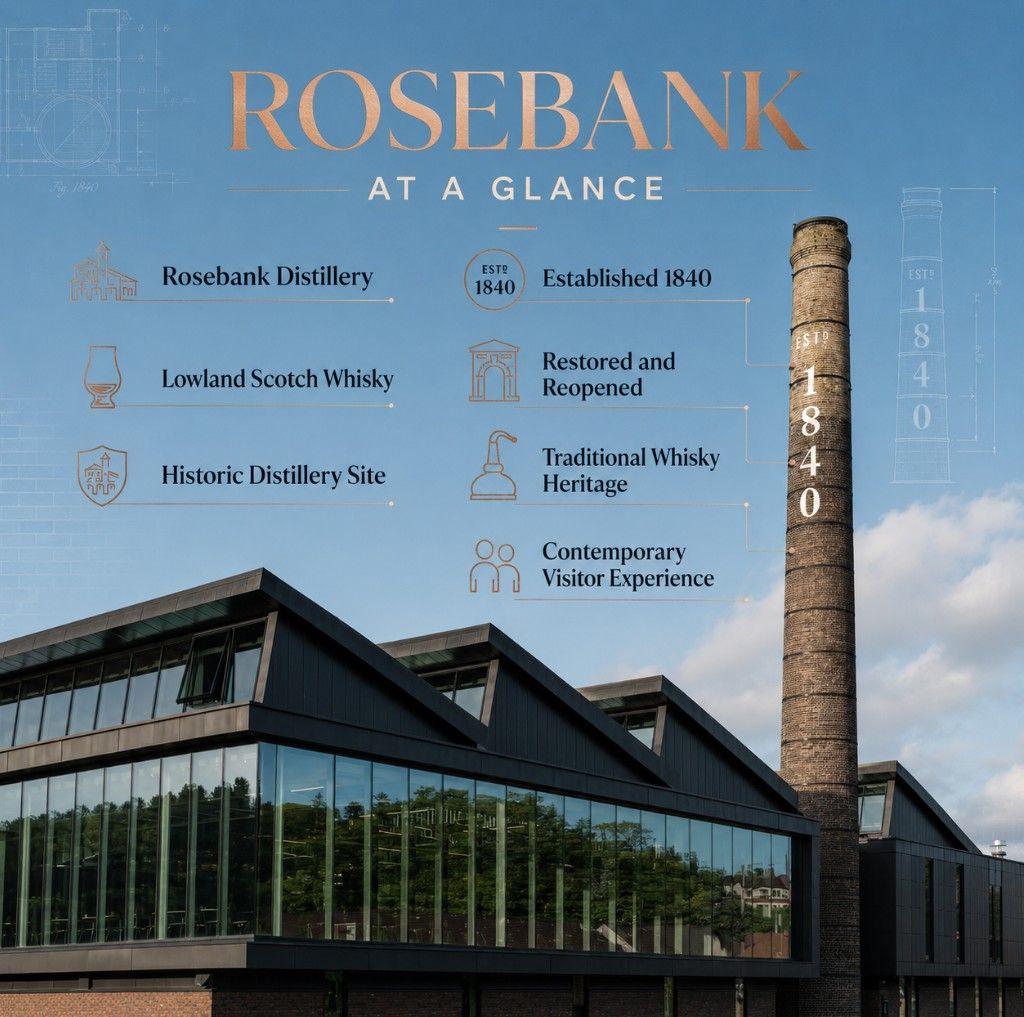
Ian Macleod Distillers retained and repaired important elements of the site, including Rosebank’s landmark chimney. New buildings were designed to respect the industrial heritage of the canal-side location while creating a functioning modern distillery and visitor experience.
The production area was reconstructed using historic drawings and records.
Exact replicas of Rosebank’s original stills were manufactured by Abercrombie Coppersmiths, using surviving blueprints to reproduce their unusual dimensions and shape.
New worm-tub condensers were also installed, preserving one of the defining elements of the original production process.
The intention was not to build a modern distillery carrying an old name. It was to restore Rosebank’s particular method of whisky-making as faithfully as possible.
When Did Rosebank Restart Production?
Production resumed during 2023, almost exactly 30 years after the distillery had fallen silent.
The first cask from the restored Rosebank was filled on 18 July 2023. It was a refill bourbon barrel containing newly distilled spirit produced through the revived triple-distillation and worm-tub system.
This first cask marked a major milestone, but the spirit could not immediately be called whisky.
To qualify as Scotch whisky, it must:
- Be distilled in Scotland
- Be made from permitted cereals, water and yeast
- Mature in oak casks in Scotland
- Remain in cask for at least three years
- Be bottled at no less than 40% ABV
- Meet the wider Scotch whisky production regulations
The first revived Rosebank spirit therefore reached the legal minimum age for Scotch whisky in July 2026.
That does not necessarily mean a standard new-generation Rosebank whisky will be released immediately. Ian Macleod Distillers has the financial support and mature historic stock required to give the new spirit additional time if it is judged to benefit from longer maturation.
Is New Rosebank Whisky Available Yet?
The earliest spirit from the revived distillery has now passed the three-year legal threshold, but a broad permanent release from the new production has not yet been established as Rosebank’s standard range.
The company has consistently emphasised quality and patience rather than rushing a young whisky to market.
Early bottlings from a reborn distillery can be historically important, but the Rosebank name carries unusually high expectations. A whisky released too young would inevitably be compared with delicate, complex and highly mature spirit distilled before the 1993 closure.
For now, the bottles most commonly available remain releases drawn from old Rosebank stocks distilled before closure.
These historic releases allow drinkers to understand the style the revived distillery is seeking to preserve.
What Makes Rosebank’s Production Method Unusual?
Rosebank combines two production choices rarely found together:
- Triple distillation
- Worm-tub condensation
Triple distillation usually creates a lighter, purer and more refined spirit.
Worm tubs often retain heavier compounds, body and texture.
Combining them gives Rosebank an unusual balance between elegance and weight.
This is the key to understanding why Rosebank cannot be described simply as a light Lowland whisky.
Its spirit can be floral and delicate, but it also has enough texture to support extended maturation and develop flavours of wax, spice, tropical fruit and polished oak.
How Does Triple Distillation Work?
Most Scotch malt whisky is distilled twice.
Fermented wash is first distilled in a wash still, creating low wines. These low wines then pass through a spirit still, where the distiller selects the central heart of the run for maturation.
Rosebank traditionally used three stills and a more complex distillation system.
The additional distillation stage increased the alcoholic strength and refinement of the spirit while removing some heavier compounds.
Triple distillation can produce characteristics such as:
- A lighter texture
- Greater floral aroma
- Fresh citrus
- Clean fruit
- Reduced cereal heaviness
- A smooth spirit character
However, still shape, cut points, fermentation and condensation remain equally important. Triple distillation does not automatically make every whisky identical or entirely light.
Rosebank’s worm tubs returned additional structure to the refined spirit.
What Are Worm-Tub Condensers?
A worm tub is a traditional system used to condense alcohol vapour back into liquid.
A long copper pipe, known as the worm, coils through a large vessel of cold water. Vapour from the still passes through the pipe and cools until it becomes liquid spirit.
Many modern distilleries use shell-and-tube condensers, which provide extensive copper contact and can produce a cleaner, lighter spirit.
Worm tubs generally provide less copper contact during condensation. This can retain heavier sulphur compounds and create spirit with greater weight, meatiness or texture.
At Rosebank, worm tubs do not create a heavy or savoury whisky in the same way as some double-distilled Highland malts. Instead, they give structure to spirit already refined through triple distillation.
The restored distillery installed new worm tubs specifically to reproduce this historic balance and preserve Rosebank’s celebrated floral and fruity character.
What Does Rosebank Whisky Taste Like?
Rosebank is traditionally known for an elegant, floral and fruit-led profile.
Common characteristics found across historic bottlings include:
- Lemon
- Grapefruit
- Green apple
- Pear
- White peach
- Fresh flowers
- Cut grass
- Honey
- Vanilla
- Soft malt
- Herbs
- Gentle pepper
- Wax
- Almond
- Light oak
Older releases can develop additional complexity, including:
- Tropical fruit
- Beeswax
- Dried flowers
- Polished oak
- Soft leather
- Herbal tea
- Ginger
- White chocolate
- Almond pastry
The precise profile varies according to vintage, age and cask type.
Rosebank’s defining quality is often its balance. Citrus and flowers can be light and refreshing, while the texture remains rounded enough to avoid becoming fragile.
Tasting Historic Rosebank
A typical mature pre-closure Rosebank may present itself as follows.
Appearance
Pale gold to rich amber depending on age and cask.
Bourbon-matured examples often retain a bright straw or honeyed colour, while long-aged and sherry-influenced releases can become considerably darker.
Nose
Fresh lemon, pear and green apple arrive first, followed by white flowers, honey and soft vanilla.
With time, wax, cut grass, almond and gentle herbs may emerge.
Older bottlings can introduce polished oak, dried citrus and tropical fruit.
Palate
Smooth and refined, with citrus, orchard fruit and honey.
A soft cereal note provides structure before ginger, pepper and wax begin to develop.
The texture is often more substantial than the delicate aroma initially suggests.
Finish
Clean, elegant and persistent.
Lemon peel, flowers and honey fade gradually into gentle spice, almond and dry oak.
Rosebank Silent Release No. 1: 1990 30 Year Old
Rosebank 1990 30 Year Old Release No. 1 was the first bottling in a trilogy created from rare surviving stocks distilled shortly before the distillery closed.
Released at 48.6% ABV, it was limited to 4,350 bottles worldwide.
The whisky was assembled from casks selected to demonstrate Rosebank’s complexity after three decades of maturation.
It helped announce the distillery’s return while providing enthusiasts with an opportunity to experience mature spirit from the original production era.
The release is significant because it connects two periods:
- Whisky distilled before the 1993 closure
- The modern restoration under Ian Macleod Distillers
For collectors, it is both an old Rosebank and an official part of the revival story.
Rosebank Silent Release No. 2: 1990 31 Year Old
Rosebank 1990 31 Year Old Release No. 2 followed the first edition and continued the progression through the remaining pre-closure stock.
This release was bottled at 48.1% ABV and limited to 4,000 bottles worldwide.
Its profile retained the distillery’s elegant fruit and floral character while developing the polished oak, spice and depth expected from more than three decades of maturation.
The Silent Release series has become particularly important to collectors because the number of official old-stock Rosebank bottlings is necessarily finite.
Once the remaining pre-closure casks have been bottled, there can be no replacement until the newly distilled spirit reaches comparable age many years from now.
Why Is Old Rosebank So Collectable?
Historic Rosebank combines several qualities that support strong collector demand.
Closed-Distillery History
For 30 years, Rosebank was a genuinely silent distillery. Every bottle represented whisky from a finite and diminishing stock.
Exceptional Reputation
The distillery was highly regarded before closure and its reputation grew further as more mature bottlings appeared.
Limited Supply
Production had ended in 1993, and surviving casks became progressively scarcer.
Distinctive Production
Triple distillation combined with worm tubs gave Rosebank a style that was difficult to replicate elsewhere.
Official Revival
The restoration created renewed global attention and encouraged collectors to revisit historic releases.
Packaging and Provenance
Modern official bottlings such as the Silent Releases were produced in limited numbers with premium presentation and clear vintage information.
Long Maturation
Rosebank’s spirit has proven capable of ageing for several decades while retaining freshness and elegance.
The distillery’s return changes its status from permanently closed to producing, but it does not make old Rosebank less rare. Pre-1993 spirit remains a distinct historic category.
Is Rosebank Still a Silent Distillery?
No. Rosebank should no longer be described as a silent distillery in relation to its current operational status.
Production resumed in 2023, and the distillery opened to visitors in June 2024.
However, the word silent remains relevant when describing whisky distilled before the 1993 closure.
Product names such as Rosebank Silent Release identify bottles produced from old stock laid down during the original era.
The distinction is:
- Rosebank Distillery today: Producing
- Pre-1993 Rosebank whisky: Historic spirit from the silent era
- New-generation Rosebank whisky: Spirit made after the 2023 revival
Rosebank’s New Visitor Experience
Rosebank opened to visitors in June 2024 following the extensive restoration.
The visitor experience combines the distillery’s industrial history with contemporary architecture and working production.
Tours provide an opportunity to learn about:
- Rosebank’s history
- The 1993 closure
- The restoration project
- Triple distillation
- Worm-tub condensation
- New spirit production
- Historic Rosebank whisky
- The Forth & Clyde Canal setting
The restored site has since received five-star visitor-attraction status from VisitScotland and architectural recognition for the way new construction has been integrated with the surviving historic buildings.
This makes Rosebank one of the most accessible new whisky attractions in Scotland’s Central Belt.
The Architecture of the Restored Distillery
The Rosebank project needed to balance preservation with modern operation.
Important surviving features, including the tall brick chimney, were retained and restored. New glass, metal and brick structures were introduced without attempting to disguise the fact that Rosebank had entered a new era.
The angular modern buildings contrast with the historic industrial fabric while allowing visitors to see parts of the distilling process.
This approach reflects the wider philosophy behind the revival:
- Preserve the history
- Recreate the production method
- Use modern engineering where required
- Avoid turning Rosebank into a replica museum
- Build a functioning distillery for the future
The result has attracted recognition within Scottish architecture as well as the whisky industry.
What Casks Will New Rosebank Use?
The first cask filled after production resumed was a refill bourbon barrel.
Refill bourbon casks are a logical foundation for Rosebank because they allow the refined floral and fruit-led spirit to remain visible.
They can contribute:
- Vanilla
- Honey
- Lemon
- Coconut
- Light oak
- Gentle spice
More active first-fill bourbon casks may provide richer vanilla and sweetness, while refill wood offers slower development and less aggressive oak extraction.
Rosebank’s owners have not limited the future whisky to one cask type, and official historic releases have demonstrated how the spirit can work with different maturation approaches.
Nevertheless, the core revived style is likely to prioritise casks that preserve elegance rather than overwhelming the spirit with dense wine or heavy oak.
How Long Should New Rosebank Mature?
Legally, Scotch whisky requires only three years in oak.
Rosebank’s spirit may benefit from considerably longer maturation.
Triple-distilled whisky can appear approachable at a relatively young age, but Rosebank’s historic reputation rests on complexity rather than softness alone.
Longer maturation can allow:
- Citrus to become richer
- Orchard fruit to develop
- Floral notes to integrate
- Wax and honey to emerge
- Oak spice to soften
- The texture to become more polished
Ian Macleod Distillers is under no obvious pressure to make the revived Rosebank a large-volume young-whisky brand.
The company can continue using historic stock and revenue from its wider portfolio while allowing the new spirit to mature at an appropriate pace.
Rosebank Compared with Auchentoshan
Auchentoshan is the best-known modern example of triple-distilled Lowland single malt.
Both distilleries share:
- Lowland location
- Triple distillation
- Citrus and floral character
- A smooth spirit style
- Strong appeal to drinkers seeking lighter whisky
However, their production methods differ.
Rosebank’s worm tubs provide additional weight and texture, while Auchentoshan’s production creates a particularly clean and refined spirit.
A broad comparison is:
Rosebank
- Triple distilled
- Worm-tub condensed
- Floral and citrus-led
- Greater wax and texture
- Historic collectability
- Recently revived
Auchentoshan
- Triple distilled
- Modern condensation system
- Clean citrus
- Vanilla
- Soft cereal
- Established core range
Customers can browse the Auchentoshan whisky collection for an accessible introduction to triple-distilled Lowland malt while new Rosebank continues to mature.
Rosebank Compared with Glenkinchie
Glenkinchie is another established Lowland distillery, located east of Edinburgh.
Glenkinchie is generally associated with:
- Fresh flowers
- Lemon
- Cut grass
- Soft cereal
- Gentle spice
- A light aperitif style
Rosebank can share some of these flavours but often provides:
- More fruit
- Greater texture
- Waxier depth
- More noticeable citrus
- Stronger long-ageing potential
Glenkinchie offers a useful reference for traditional Lowland freshness, while Rosebank’s triple-distillation and worm-tub combination gives it a distinctive identity.
Explore the Glenkinchie range for further comparison.
Rosebank Compared with Bladnoch
Bladnoch is Scotland’s southernmost working distillery and another important Lowland producer.
Modern Bladnoch can offer:
- Orchard fruit
- Flowers
- Vanilla
- Malt
- Ginger
- Richer oak influence
Rosebank is traditionally more citrus-led and refined, with its triple distillation providing a different texture.
Both demonstrate that Lowland whisky cannot be reduced to one universally light style.
Browse the Bladnoch whisky collection to explore another historic Lowland distillery that has experienced closure and revival.
Rosebank Compared with Littlemill
Littlemill is another legendary lost Lowland distillery, but unlike Rosebank, it has not been rebuilt.
Both names are associated with:
- Historic Lowland production
- Increasingly rare old stock
- Elegant fruit-led whisky
- Strong collector demand
- Long-aged official releases
Littlemill closed in the 1990s and its remaining buildings were later destroyed by fire.
Rosebank’s successful restoration therefore represents the future Littlemill never received.
Historic releases from both distilleries allow collectors to compare different interpretations of the old Lowland style.
Explore HTFW’s Littlemill whisky collection for surviving examples from this permanently closed distillery.
Is Rosebank a Good Investment?
Rare Rosebank whisky has attracted considerable collector interest, but no bottle should be treated as a guaranteed financial investment.
Factors affecting future value include:
- Bottle rarity
- Release size
- Age
- Vintage
- Distillery bottling versus independent bottling
- Packaging condition
- Fill level
- Provenance
- Market demand
- The success of the revived distillery
- Wider economic conditions
Pre-closure Rosebank remains finite, which provides genuine scarcity.
The revival may also introduce more people to the name, increasing interest in older bottlings. However, prices can rise or fall, and purchasing decisions should not rely solely on expected appreciation.
The strongest reasons to buy historic Rosebank are its whisky quality, production history and importance within the Lowland category.
How Should Rare Rosebank Be Stored?
Historic Rosebank bottles should be stored carefully.
Keep the Bottle Upright
Whisky should not remain in prolonged contact with the cork.
Avoid Direct Sunlight
Strong light can damage labels, presentation boxes and the whisky’s appearance.
Maintain a Stable Temperature
Avoid lofts, garages, radiators and areas subject to large seasonal changes.
Protect the Packaging
Boxes, certificates and booklets form part of the bottle’s collector value.
Check the Fill Level
Older bottles should be monitored for unusual evaporation or leakage.
Keep Purchase Records
Invoices, photographs and provenance information can support authenticity and future resale.
Whisky does not continue maturing once it has been bottled.
Frequently Asked Questions
Where is Rosebank Distillery?
Rosebank is located beside the Forth & Clyde Canal in Falkirk, Scotland.
Is Rosebank a Lowland distillery?
Yes. Rosebank belongs to the Lowland Scotch whisky region.
Who owns Rosebank?
Rosebank is owned by Ian Macleod Distillers.
When did Rosebank originally close?
Production stopped in 1993.
When was the distillery purchased for restoration?
Ian Macleod Distillers acquired the site and brand in 2017.
When did production restart?
The first cask from the restored distillery was filled on 18 July 2023.
Is Rosebank producing whisky today?
Yes. Rosebank is an operating distillery and is no longer silent.
Is new Rosebank whisky available?
The earliest revived spirit has reached the minimum legal age, but a permanent new-generation core release has not yet been widely established.
Can Rosebank Distillery be visited?
Yes. The restored visitor experience opened in June 2024.
Why is Rosebank famous?
It is famous for combining triple distillation with worm-tub condensers, creating an elegant but textured Lowland whisky.
Why is it called the King of the Lowlands?
The name reflects Rosebank’s exceptional historic reputation and its status as one of the most highly regarded Lowland single malts.
What does Rosebank whisky taste like?
Typical notes include lemon, pear, apple, flowers, honey, vanilla, herbs, wax and gentle spice.
Is Rosebank peated?
Rosebank is not known as a heavily peated whisky. Its style is generally floral, fruity and citrus-led.
Does Rosebank use triple distillation?
Yes. The revived distillery has restored Rosebank’s traditional triple-distillation process.
What are worm tubs?
Worm tubs are traditional condensers using coiled copper pipes immersed in cold water. They help give Rosebank additional texture and body.
Are the new stills the same as the originals?
The replacement stills were built as replicas using historic plans and original design information.
What happened to the old stills?
The original equipment was lost after closure, including copper stolen from the dormant site.
Are old Rosebank bottles rare?
Yes. Pre-1993 spirit comes from finite remaining stocks and has become highly collectable.
What is the Rosebank Silent Release series?
It is a limited trilogy of mature official bottlings created from surviving whisky distilled before the 1993 closure.
Can Rosebank whisky still be bought?
Yes. Rare official and independent pre-closure releases appear through specialist retailers, although availability is limited.
Why Rosebank’s Return Matters
Rosebank’s revival is important because it restores more than a whisky brand.
It restores a production method that had almost disappeared.
Triple distillation survives elsewhere in Scotland, and worm tubs remain in use at several distilleries. Rosebank’s particular combination of the two, however, created a style unlike any other major Lowland malt.
The project also demonstrates that historic Scotch whisky sites can be revived without abandoning their identity.
Ian Macleod Distillers could have built a new production facility elsewhere and applied the Rosebank name. Instead, the company returned to Falkirk, restored the canal-side location, repaired the landmark chimney and recreated the original still configuration.
That decision connects the revived spirit with:
- The town of Falkirk
- The Forth & Clyde Canal
- Rosebank’s historic buildings
- Its original production method
- The people who made the whisky before closure
- The collectors who kept the name alive
The first whisky from the new era will inevitably face close examination. It will be compared with bottles distilled more than 30 years earlier under a different production team and within a different Scotch whisky industry.
The restoration gives the new spirit the best possible foundation. The stills, triple-distillation system and worm tubs are in place. The remaining ingredient is time.
Explore Rosebank Whisky at Hard To Find Whisky
Rosebank has returned to production, but historic releases from the original distillery remain exceptionally scarce.
Rosebank 1990 30 Year Old Release No. 1 offers a mature official expression from the pre-closure era, limited to 4,350 bottles worldwide.
Rosebank 1990 31 Year Old Release No. 2 continues the official Silent Release series with another exceptionally limited example of long-aged Rosebank.
Collectors can also browse the complete Rosebank whisky range, explore more bottles from the Lowland whisky collection, or discover other historic releases through HTFW’s old and rare whisky selection.