



















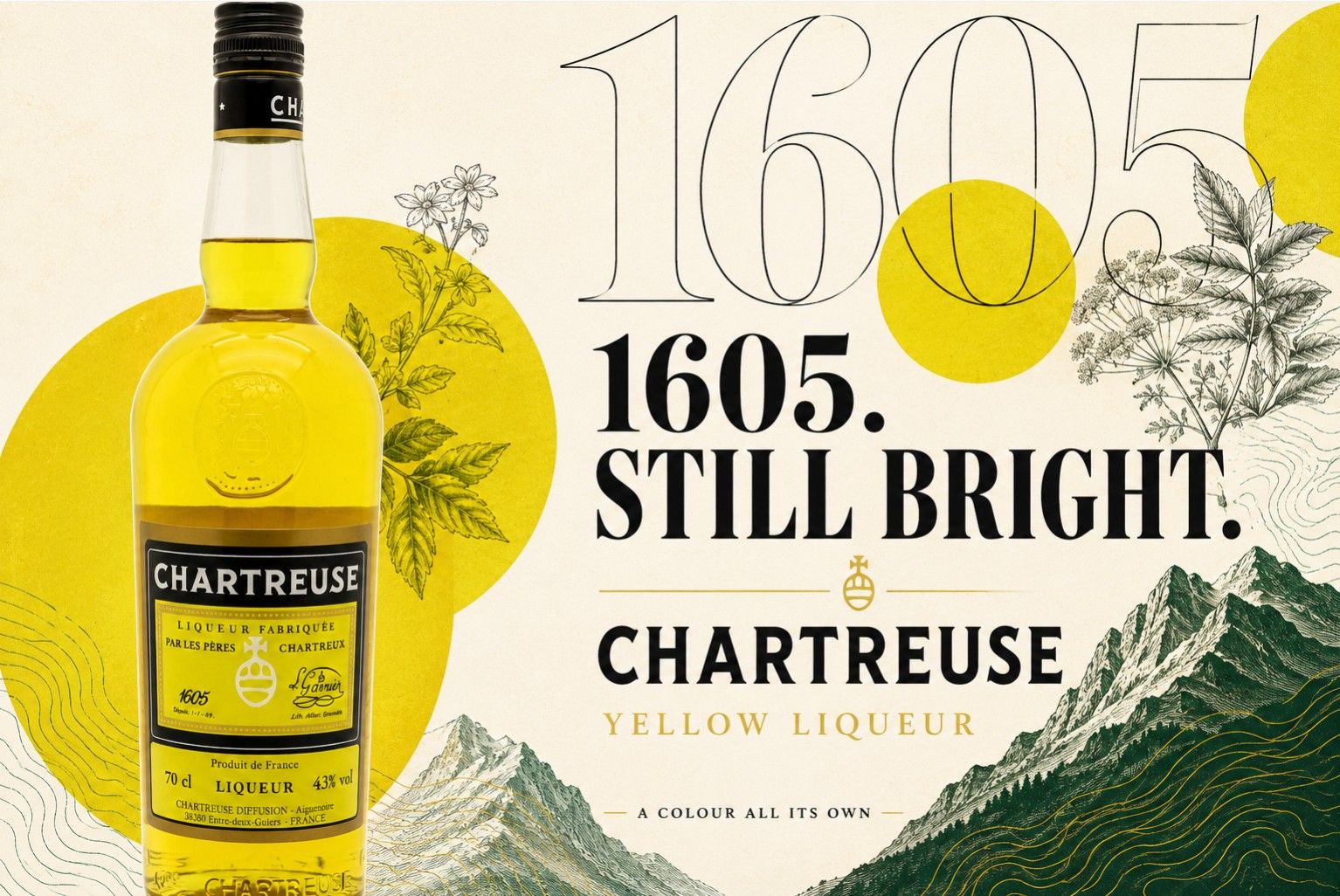
Few liqueurs have a production story quite like Chartreuse.
Chartreuse Yellow Herbal Liqueur is still made by the Carthusian Fathers using a closely guarded formula built around 130 plants, flowers, bark, roots and spices. Created in 1840, Yellow Chartreuse is the softer, sweeter counterpart to Green Chartreuse, but it retains the extraordinary botanical complexity that has made the name famous around the world.
Bottled at 43% ABV, Yellow Chartreuse combines turmeric, citrus, anise, flowers, spice and gentle sweetness before a long period of maturation in oak vats. The finished liqueur is naturally yellow, with its colour derived from the plant material used in production rather than artificial colouring.
It is also one of the most historically important cocktail ingredients in existence, having been used in mixed drinks since the 19th century, while its limited production has helped make bottles increasingly sought after in recent years.
Explore Yellow Chartreuse at Hard To Find Whisky or browse the wider Chartreuse collection at HTFW.
Yellow Chartreuse at a Glance
- Producer: Chartreuse
- Country: France
- Category: Herbal Liqueur
- Created: 1840
- ABV: 43%
- Bottle Size: 70cl
- Botanicals: 130 plants, flowers, bark, roots and spices
- Production: Distillation and multiple macerations
- Maturation: Long ageing in large oak vats
- Colour: Naturally derived from botanicals
- Style: Sweeter and softer than Green Chartreuse
- Key Flavours: Turmeric, citrus, anise, flowers, herbs and spice
- Recommended Serve: Chilled to approximately 12–13°C or over ice
HTFW currently lists Yellow Chartreuse as a 70cl bottle at 43% ABV.
What Is Yellow Chartreuse?
Yellow Chartreuse is a French herbal liqueur produced by the Carthusian monks.
It is made from alcohol, sugar, water and botanical ingredients comprising 130 plants, bark, roots, spices and flowers.
Those ingredients are transformed through a combination of grinding, distillation and maceration before the liqueur spends an extended period ageing in oak vats.
The result is intensely aromatic but noticeably softer than Green Chartreuse.
Where Green Chartreuse tends towards more powerful vegetal, mint, pine and herbal flavours, Yellow Chartreuse places greater emphasis on sweetness, spice, citrus, anise and floral notes.
That makes Yellow Chartreuse particularly interesting for drinkers who want to explore the Chartreuse style without immediately jumping into the intensity of the 55% ABV Green expression.
Who Makes Chartreuse?
Chartreuse is produced by the Carthusian Order, a Roman Catholic monastic order whose history stretches back to the 11th century.
The liqueur itself is still produced under the direction of the Chartreux Fathers.
The monks control the secret recipe and prepare the botanical mixtures used to create Chartreuse.
That religious connection is not merely part of the historical branding.
It remains central to production today.
Chartreuse Diffusion handles the commercial side of the business, while the Carthusian Fathers retain responsibility for the recipe and its preparation.
Where Did Chartreuse Come From?
The story begins in 1605.
According to Chartreuse, François Hannibal d'Estrées presented the Carthusians with a mysterious manuscript containing a recipe involving 130 plants and intended to produce an “Elixir of Long Life.”
The formula was extremely complicated.
It took the monks more than 150 years to develop it into a finished preparation.
By 1764, their work had resulted in the Élixir Végétal de la Grande-Chartreuse, a powerful herbal preparation that remains part of the Chartreuse range today.
The liqueurs that most drinkers now recognise as Chartreuse came later.
When Was Yellow Chartreuse Created?
Yellow Chartreuse was created in 1840.
It was developed from the same wider tradition established by the Élixir Végétal but designed as a softer table liqueur.
The expression proved successful enough that Father Garnier, who was responsible for the liqueurs at the time, officially named it Chartreuse Jaune.
The Chartreuse trademark was then registered in 1852.
That means Yellow Chartreuse has now been produced for more than 180 years.
It is not a modern variation of Green Chartreuse.
Both Yellow and Green Chartreuse belong to the historic range and trace their commercial origins to the 19th century.
Why Is Chartreuse Made from 130 Botanicals?
The number 130 is one of the few aspects of the recipe that is publicly known.
Chartreuse itself states that this is the only clearly disclosed numerical element of a formula whose full composition remains secret.
Those botanicals include:
plants,
flowers,
bark,
roots,
spices,
and other aromatic ingredients.
The significance is not simply the quantity.
Each botanical can behave differently during extraction.
Some release their aromas most effectively through distillation.
Others contribute flavour, bitterness, colour or texture through maceration.
Combining so many components gives Chartreuse its unusual depth.
It is difficult to reduce the finished flavour to one dominant ingredient because the aromatic profile continually shifts as the liqueur develops in the glass.
Is the Yellow Chartreuse Recipe Secret?
Yes.
The exact recipe remains confidential.
Chartreuse publicly identifies the use of 130 botanical ingredients, but not their full identities, quantities or proportions.
That secrecy has become part of the mythology surrounding the liqueur.
Unlike many modern spirits where detailed recipes and production specifications are heavily promoted, Chartreuse deliberately reveals relatively little.
The drinker's understanding therefore comes principally from the broad production process and from tasting the finished liqueur.
How Is Yellow Chartreuse Made?
Yellow Chartreuse takes several weeks to produce before ageing even begins.
The process starts with the Carthusian monks grinding the botanical ingredients in the plant room at the Grande Chartreuse monastery.
The mixture then undergoes different extraction methods.
One stage involves distillation, which captures aromatic compounds.
Other components undergo different forms of maceration, extracting both botanical flavours and the pigments responsible for the liqueur's natural colour.
The resulting liqueur is then transferred to large oak vats.
It remains there for an extended period before bottling.
Even after bottling, Chartreuse states that the liqueur continues to evolve and develop complexity.
Is Yellow Chartreuse Aged in Oak?
Yes.
Yellow Chartreuse undergoes a long maturation in truncated cone-shaped oak vats.
The role of oak here is quite different from whisky.
A whisky barrel may contribute significant flavours such as vanilla, tannin, caramel, dried fruit or spice.
Chartreuse's large vats have a lower wood-to-liquid ratio than a conventional whisky cask.
The objective is therefore not simply to make the liqueur taste strongly of oak.
Instead, extended maturation helps the huge range of herbal and aromatic compounds integrate and soften.
That is particularly important in a recipe involving 130 botanicals.
Is Yellow Chartreuse Naturally Yellow?
Yes.
The colour is derived naturally from the botanicals used during production.
Chartreuse specifically states that maceration extracts the plant compounds responsible for the natural yellow colour.
That makes the colour part of the production process rather than simply a visual branding choice.
The same general principle applies to Green Chartreuse, although its botanical composition and production result in the famous vivid green tone instead.
What Does Yellow Chartreuse Taste Like?
Yellow Chartreuse is powerful aromatically but soft in texture.
Its flavour is complex rather than aggressively bitter.
Appearance
Intense golden yellow.
The colour is deep and luminous, derived naturally from the plant ingredients used during production.
Nose
Fresh and spicy.
Turmeric appears prominently, followed by citrus and anise.
There is also a broad floral quality running behind the spice.
Palate
Soft and rounded.
Sweet herbal notes build first, followed by spice, citrus peel, anise and floral aromatics.
The sweetness is noticeably more prominent than in Green Chartreuse, but the botanical intensity remains substantial.
Finish
Long and gently warming.
Flowers and spice remain prominent, with lingering anise, citrus and herbal notes.
The overall development can be summarised broadly as:
sweet herbs → turmeric → citrus → anise → floral notes → warming spice.
Is Yellow Chartreuse Sweet?
Yes.
Sweetness is one of the major differences between Yellow and Green Chartreuse.
Chartreuse itself describes Yellow as being characterised by its sweetness, spicy aromas and soft structure.
That does not make it a simple sweet liqueur.
There is still enormous botanical complexity underneath.
The sugar instead softens the sharper herbal edges and helps bring forward spice, floral notes and anise.
Yellow Chartreuse vs Green Chartreuse
This is the most important comparison in the range.
Both are made by the Carthusian Fathers.
Both use 130 botanical ingredients.
Both undergo distillation, maceration and ageing.
But they taste significantly different.
Yellow Chartreuse
- 43% ABV
- Softer
- Sweeter
- More floral
- Turmeric
- Citrus
- Anise
- Gentle spice
Green Chartreuse
- 55% ABV
- More powerful
- More herbaceous
- More vegetal
- Mint
- Pine
- Citrus
- Pepper and bitter herbal notes
Chartreuse's official tasting material describes Green as fresh, vegetal and powerful, with mint, pine sap, citrus and bitter tea among its characteristics.
Yellow moves in a softer direction.
Neither is simply a stronger or weaker version of the other.
Their production differs enough to create two genuinely distinct liqueurs.
Explore the wider Chartreuse range at HTFW to compare available expressions.
Which Is Stronger: Green or Yellow Chartreuse?
Green Chartreuse is considerably stronger.
Traditional Green Chartreuse is bottled at 55% ABV, while Yellow Chartreuse is bottled at 43% ABV.
That 12 percentage-point difference is noticeable.
Green carries substantially more alcoholic heat and intensity.
Yellow is still a strong liqueur at 43%, but the lower bottling strength complements its softer, sweeter flavour profile.
Is Yellow Chartreuse Easier to Drink Than Green Chartreuse?
For many drinkers, yes.
The combination of lower alcohol, additional sweetness and softer floral character generally makes Yellow Chartreuse more approachable.
Green Chartreuse can be extremely intense when tasted neat.
Its 55% ABV combines with mint, pine, herbs and bitterness to create a much sharper profile.
Yellow retains enough herbal complexity to remain unmistakably Chartreuse but introduces it in a rounder form.
It is therefore often a sensible starting point for someone discovering the brand.
How Should You Drink Yellow Chartreuse?
Chartreuse recommends serving Yellow Chartreuse as a digestif, ideally chilled to approximately 12–13°C or poured over ice.
That temperature is cool enough to restrain some of the alcohol without completely suppressing the aromatics.
Neat tasting is also worthwhile.
A small measure allows the turmeric, citrus, anise and floral notes to emerge gradually as the liqueur warms.
Yellow Chartreuse is also extremely useful in cocktails.
The producer notes that it has been used as a cocktail ingredient since the 19th century.
Is Yellow Chartreuse a Digestif?
Yes.
Digestif service is one of Chartreuse's recommended ways to enjoy the liqueur.
This fits naturally with its long herbal tradition.
Historically, European botanical liqueurs frequently developed from medicinal preparations before becoming drinks consumed for pleasure.
Chartreuse follows exactly that path.
Its ancestor was the Élixir Végétal, developed from the mysterious 1605 manuscript and finalised by the monks in 1764.
What Cocktails Use Yellow Chartreuse?
Yellow Chartreuse has been used by bartenders for generations because it adds sweetness and botanical complexity simultaneously.
The Alaska is perhaps the classic Yellow Chartreuse cocktail.
It combines gin with Yellow Chartreuse, creating a deceptively simple drink in which the herbal and floral qualities of the liqueur interact directly with gin botanicals.
Another modern classic is the Naked and Famous, which combines Yellow Chartreuse with mezcal, Aperol and lime.
Its popularity has helped introduce Yellow Chartreuse to a new generation of cocktail drinkers.
Because Yellow Chartreuse is powerful, relatively small measures can dramatically change a cocktail.
It works particularly well alongside:
gin,
mezcal,
whisky,
citrus,
sparkling wine,
and other bitter or herbal ingredients.
Can Yellow Chartreuse Be Used in a Last Word?
Traditionally, no.
The classic Last Word uses Green Chartreuse.
Switching to Yellow Chartreuse changes the drink noticeably because Yellow is sweeter, softer and lower in alcohol.
That does not mean the substitution cannot work.
It simply produces a different cocktail rather than a traditional Last Word.
For drinkers comparing the two Chartreuse expressions, making similar drinks with each is actually an excellent way to understand their differences.
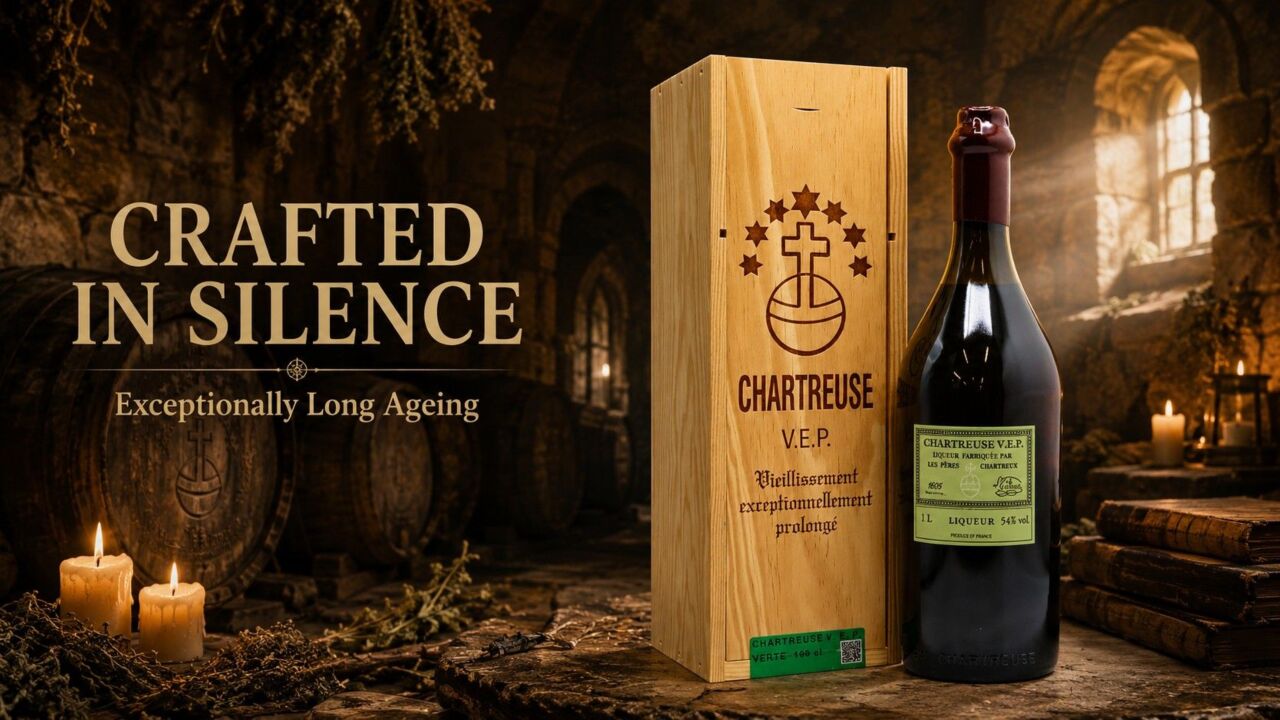
What Is Yellow Chartreuse VEP?
V.E.P. stands for Vieillissement Exceptionnellement Prolongé, meaning exceptionally prolonged ageing.
Yellow Chartreuse VEP is made using the same core processes as traditional Yellow Chartreuse but selected for much longer maturation in large oak vessels.
It is produced in limited quantities.
The extended ageing produces additional complexity and a notably prolonged finish.
It should not be confused with ordinary Yellow Chartreuse.
The VEP is a more specialised and significantly longer-aged interpretation of the same basic style.
Why Is Chartreuse Hard to Find?
Demand has grown substantially while the Carthusian monks have deliberately chosen not to pursue unlimited production growth.
In 2023, Chartreuse attracted widespread attention after the monks explained that they did not intend to continually increase production merely to satisfy rising global demand.
Their priorities remained protecting monastic life, prayer and environmental responsibilities rather than maximising commercial output.
This has created tight allocations in a number of markets.
The important point is that Chartreuse has not simply disappeared because production stopped.
According to Chartreuse representatives, production remained substantial, but demand grew beyond the amount the monks were prepared to supply.
Has Chartreuse Been Discontinued?
No.
Chartreuse continues to be produced.
Green Chartreuse and Yellow Chartreuse remain listed by the producer among its traditional liqueurs, and Yellow is still described as being made by the Chartreux Fathers today.
Limited availability is therefore a supply-and-demand issue rather than evidence that the historic liqueurs have been discontinued.
Why Don't the Monks Just Make More Chartreuse?
Because commercial growth is not their primary purpose.
The Carthusian monks live according to a religious vocation centred on solitude, prayer and monastic life.
The decision to limit growth reflects that priority.
Reports surrounding the 2023 supply situation explained that the monks were specifically unwilling to expand production endlessly at the expense of their religious life and environmental principles.
That makes Chartreuse unusual in the modern spirits industry.
Most drinks companies respond to rising demand by increasing production capacity.
Chartreuse effectively decided not to follow that model indefinitely.
Why Is Chartreuse So Popular with Bartenders?
Because there is very little else that tastes exactly like it.
Chartreuse brings sweetness, high alcoholic strength, bitterness, flowers, herbs, roots and spices simultaneously.
That allows a relatively small quantity to add enormous complexity to a cocktail.
Its historic role in drinks such as the Last Word helped establish it within classical cocktail culture, while more recent drinks have pushed both Green and Yellow Chartreuse back into prominence.
The renewed interest has been strong enough that shortages have encouraged bartenders to experiment with génépy and other herbal alternatives, although none reproduce Chartreuse exactly.
Is Chartreuse an Amaro?
Not technically.
Chartreuse and Italian amaro occupy similar territory because both are botanical liqueurs built around herbs, roots, spices and bitterness.
But Chartreuse is French and belongs to its own specific Carthusian tradition.
Yellow Chartreuse is also generally sweeter and more floral than many traditional amaros.
It therefore makes more sense to describe it simply as a French herbal liqueur rather than forcing it into the amaro category.
Does Chartreuse Improve in the Bottle?
Chartreuse states that Yellow Chartreuse continues to evolve and develop complexity after bottling.
That makes it unusual among many liqueurs.
The high alcohol content and botanical intensity give Chartreuse considerable stability.
Older bottles are consequently of particular interest to collectors and enthusiasts, who often compare different production eras and levels of bottle ageing.
This does not mean every bottle automatically becomes “better”.
But it does mean the flavour can continue to change gradually over time.
Frequently Asked Questions
How strong is Yellow Chartreuse?
Yellow Chartreuse is bottled at 43% ABV.
What size is Yellow Chartreuse?
The standard bottle currently listed by HTFW is 70cl.
How many herbs are in Chartreuse?
Chartreuse uses 130 plants, flowers, bark, roots and spices.
Who makes Yellow Chartreuse?
It is produced by the Carthusian Fathers.
When was Yellow Chartreuse created?
Yellow Chartreuse was created in 1840.
What does Yellow Chartreuse taste like?
Expect a sweet, soft herbal profile with turmeric, citrus, anise, flowers and warming spice.
Is Yellow Chartreuse sweeter than Green?
Yes.
Yellow Chartreuse is softer and sweeter, while Green Chartreuse is stronger and more intensely vegetal and herbal.
Which is stronger, Yellow or Green Chartreuse?
Green is stronger at 55% ABV, compared with 43% ABV for Yellow.
Is Chartreuse naturally coloured?
Yes.
Yellow Chartreuse derives its colour from the botanicals and macerations used during production.
Is Yellow Chartreuse aged?
Yes.
It undergoes extended ageing in large oak vats before bottling.
Should Yellow Chartreuse be chilled?
Chartreuse recommends serving it at around 12–13°C or over ice.
Is Yellow Chartreuse discontinued?
No.
It remains part of Chartreuse's traditional range and continues to be produced by the Carthusian Fathers.
Why is Chartreuse difficult to find?
Demand has exceeded available supply while the monks have deliberately resisted continually expanding production in order to protect their monastic life and wider priorities.
Where can I buy Yellow Chartreuse in the UK?
You can buy Chartreuse Yellow Herbal Liqueur from Hard To Find Whisky or browse the wider Chartreuse range at HTFW.
Final Thoughts
Yellow Chartreuse is unusual even within the already unusual world of herbal liqueurs.
There are 130 plants, flowers, bark, roots and spices.
There is distillation.
There are multiple macerations.
There is extended maturation in oak.
And behind all of it is a recipe tradition that stretches back to a mysterious manuscript handed to the Carthusian monks in 1605.
Yellow Chartreuse itself arrived in 1840 and has now existed for more than 180 years.
The flavour remains just as distinctive.
Turmeric, citrus and anise lead into flowers, sweet herbs and warming spice.
At 43% ABV it has plenty of intensity, but compared with Green Chartreuse it is noticeably softer, sweeter and easier to approach.
Its modern scarcity has only added to the fascination.
The unusual part is that the monks behind Chartreuse have not responded to that demand in the way a conventional drinks company might.
Rather than pursuing unlimited expansion, they have prioritised maintaining their monastic life and deliberately constrained commercial growth.
That leaves Yellow Chartreuse in a category almost entirely of its own: a genuinely historic liqueur, still controlled by the religious order that developed it, made from a recipe the outside world still does not know and capable of playing equally well as a neat digestif or one of the most distinctive ingredients behind a cocktail bar.
Explore Chartreuse Yellow Herbal Liqueur at Hard To Find Whisky or browse the wider Chartreuse collection at HTFW.