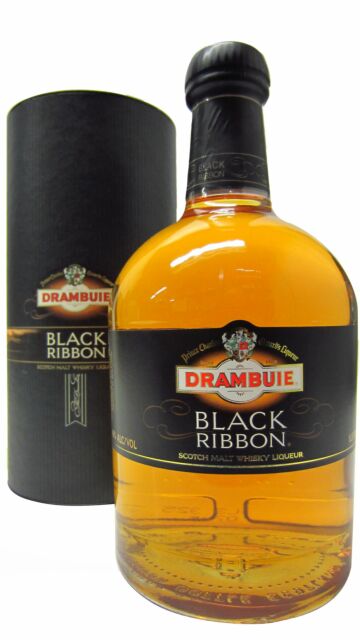
















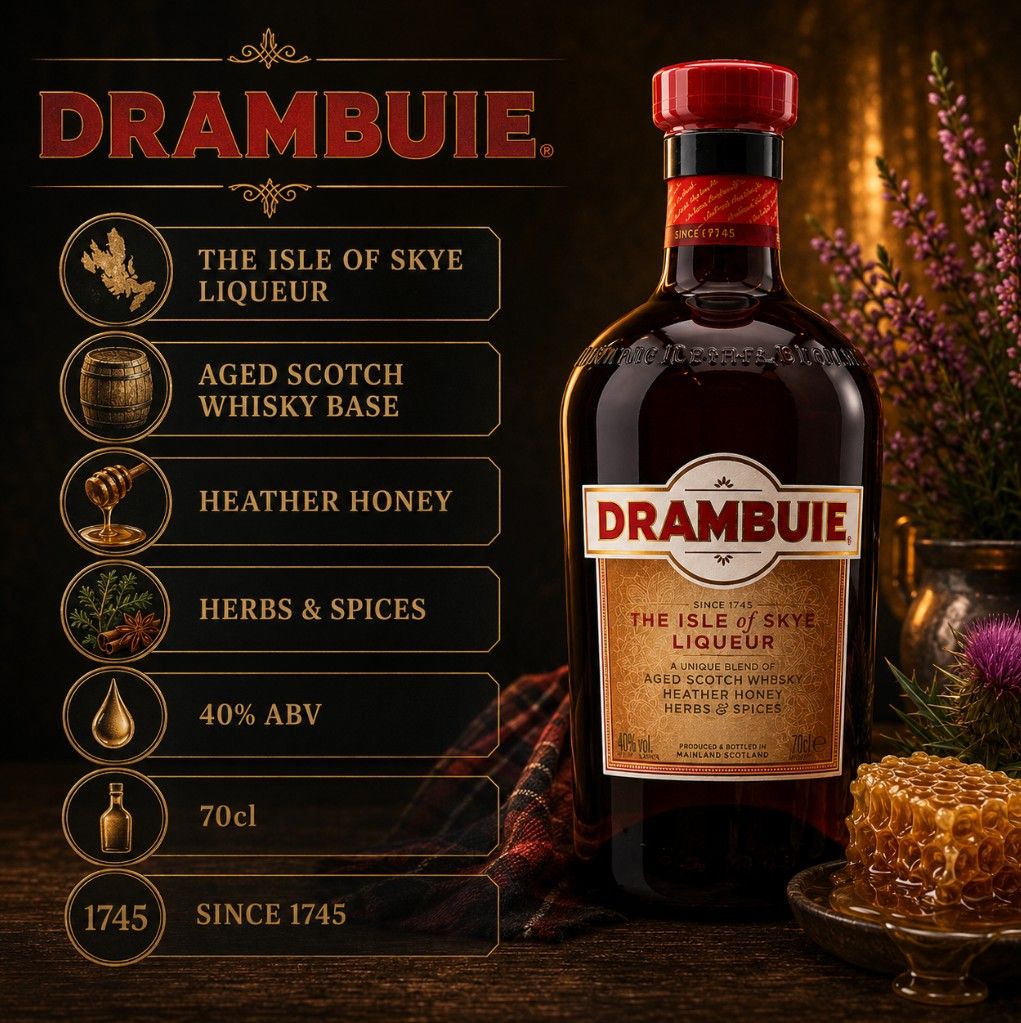
Drambuie Scotch Whisky Liqueur is one of Scotland’s most recognisable liqueurs, combining aged Scotch whisky with heather honey and a closely guarded blend of aromatic herbs and spices.
Its flavour sits between whisky and herbal liqueur. The underlying Scotch brings malt, oak and gentle warmth, while heather honey adds a rich sweetness. Herbs and spices introduce notes of anise, clove, cinnamon, citrus peel and soft medicinal complexity, creating a drink that is fuller and more layered than a straightforward honey-flavoured whisky.
Bottled at 40% ABV, Drambuie is also considerably stronger than many modern liqueurs. It retains enough whisky character to enjoy neat or over ice while providing the sweetness needed to soften Scotch in classic cocktails.
The best-known of these is the Rusty Nail, a simple combination of Drambuie and Scotch whisky that became particularly fashionable during the middle of the 20th century. Drambuie can also be mixed with coffee, ginger beer, sparkling wine, apple juice or citrus, making it more versatile than its traditional after-dinner image might suggest.
For anyone interested in Scotch whisky, Scottish history or classic cocktails, Drambuie Scotch Whisky Liqueur offers a distinctive combination of honeyed sweetness, whisky richness and herbal spice.
What Is Drambuie?
Drambuie is a Scottish whisky liqueur made from aged Scotch whisky, heather honey, aromatic herbs and spices.
The precise recipe remains secret, but its principal character is clear. Drambuie combines:
- Mature Scotch whisky
- Scottish heather honey
- Aromatic herbs
- Spices
- Citrus peel
- Gentle aniseed notes
- Warming oak
- A rich, smooth texture
The official Drambuie description identifies it as a blend of aged Scotch whisky, heather honey and aromatic herbs and spices. It can be enjoyed simply over ice or used in cocktails and coffee-based drinks.
The standard bottle available from Hard To Find Whisky contains 70cl and is bottled at 40% ABV. This places Drambuie at the same strength as many standard Scotch whiskies rather than the lower strength associated with cream, fruit or dessert liqueurs.
Customers can shop Drambuie Scotch Whisky Liqueur, explore the wider Drambuie collection, or browse the full selection of liqueurs available from Hard To Find Whisky.
What Is Drambuie Made From?
Drambuie is built around four broad elements:
- Scotch whisky
- Heather honey
- Herbs
- Spices
Each contributes a different layer to the finished liqueur.
Aged Scotch Whisky
The whisky provides the structure beneath Drambuie’s sweetness.
It contributes flavours associated with:
- Malted barley
- Oak
- Vanilla
- Dried fruit
- Gentle smoke
- Caramel
- Baking spice
- Warming alcohol
Drambuie does not taste like neat Scotch because the honey and botanicals significantly change the profile. However, the whisky remains clearly present, particularly in the finish and at the full 40% ABV.
The use of aged Scotch also gives Drambuie more depth than a neutral-spirit herbal liqueur.
Heather Honey
Heather honey is responsible for much of Drambuie’s distinctive sweetness and Scottish identity.
Unlike a light blossom honey, heather honey can offer a richer, more aromatic profile with flavours suggesting:
- Heather
- Caramel
- Dried flowers
- Herbs
- Dark honey
- Gentle bitterness
- Earthy sweetness
The honey softens the whisky and creates Drambuie’s rounded, coating texture.
It also acts as a bridge between the oak, herbs and spices, making the liqueur taste integrated rather than simply sweetened.
Herbs and Spices
The exact combination remains confidential.
Commonly perceived flavours include:
- Anise
- Clove
- Cinnamon
- Nutmeg
- Saffron-like spice
- Citrus peel
- Herbal roots
- Fennel
- Gentle pepper
- Floral herbs
These botanicals prevent the honey from becoming overly heavy. They add dryness, warmth and complexity, especially towards the finish.
Is Drambuie a Whisky?
Drambuie contains Scotch whisky, but it is legally and stylistically a whisky liqueur rather than Scotch whisky.
Scotch whisky must meet tightly controlled production and maturation rules. It cannot contain added honey, herbs, spices or other flavourings while continuing to be sold simply as Scotch whisky.
Drambuie begins with Scotch whisky but adds heather honey and botanicals. This moves it into the liqueur category.
The distinction is important:
Scotch Whisky
- Made from grain, water and yeast
- Distilled and matured in Scotland
- Matured in oak for at least three years
- Bottled at no less than 40% ABV
- Cannot contain added flavourings
- Generally dry rather than sweetened
Drambuie Whisky Liqueur
- Contains aged Scotch whisky
- Includes heather honey
- Flavoured with herbs and spices
- Naturally sweeter
- Bottled at 40% ABV
- Can be enjoyed neat or used as a cocktail modifier
Drinkers who enjoy Drambuie’s whisky base may wish to explore the wider Scotch whisky collection at HTFW.
Is Drambuie a Scotch Whisky Liqueur?
Yes. Drambuie is specifically a Scotch whisky liqueur.
This means the whisky used within the recipe is Scotch rather than Irish, American, Canadian or Japanese whisky.
The Scotch foundation gives Drambuie a different character from liqueurs made with neutral spirit or bourbon. Its malt, oak and occasional gentle smoke work naturally with heather honey and Highland-style herbs.
This combination is central to its identity and explains why Drambuie works so effectively when mixed with additional Scotch in a Rusty Nail.
Where Is Drambuie Made?
Drambuie is made in Scotland.
The drink’s heritage is particularly associated with the Isle of Skye, Clan MacKinnon and the Jacobite story of Bonnie Prince Charlie.
Modern production is no longer confined to a small family recipe made on Skye, but Drambuie remains a Scottish product built around aged Scotch whisky and Scottish heather honey.
The brand is currently owned by William Grant & Sons, the independent Scottish drinks company behind Glenfiddich, The Balvenie and Monkey Shoulder.
Who Owns Drambuie?
Drambuie is owned by William Grant & Sons.
The company acquired Drambuie in 2014 after the brand had remained under MacKinnon family ownership for around a century.
William Grant & Sons was founded in 1887 and remains family-owned. Its portfolio includes several major Scotch whisky and spirits brands.
The acquisition placed Drambuie alongside:
- Glenfiddich
- The Balvenie
- Monkey Shoulder
- Grant’s
- Hendrick’s Gin
- Tullamore D.E.W.
Although ownership changed, Drambuie continues to be presented around its traditional recipe, Scottish provenance and association with the MacKinnon family.
The Legend of Bonnie Prince Charlie and Drambuie
Drambuie’s origin story is connected with Prince Charles Edward Stuart, better known as Bonnie Prince Charlie.
In 1745, Charles travelled to Scotland to lead the Jacobite rising in an attempt to restore the Stuart dynasty to the British throne.
The campaign initially achieved several notable successes, but the Jacobite army was defeated at the Battle of Culloden on 16 April 1746.
Following the defeat, Charles became a fugitive. Government forces searched the Highlands and Islands while supporters helped him move between hiding places.
According to the Drambuie legend, members of Clan MacKinnon helped the prince escape from the Isle of Skye. In gratitude, Charles gave Captain John MacKinnon the recipe for his personal whisky elixir.
That recipe was said to contain spirit, honey, herbs and spices and was preserved by the MacKinnon family for generations.
The story has become inseparable from the Drambuie identity, although historians have questioned how literally it should be interpreted. The West Highland Museum notes that the historical evidence surrounding the exact origin of the recipe is more complicated than the familiar brand legend suggests.
It is therefore best understood as an important part of Drambuie’s heritage while recognising that some details remain difficult to prove conclusively.
Who Was Bonnie Prince Charlie?
Bonnie Prince Charlie was born Charles Edward Louis John Casimir Sylvester Severino Maria Stuart in Rome in 1720.
He was the grandson of the deposed King James II and VII and was raised to believe that the Stuart family retained a legitimate claim to the British throne.
In 1745, Charles landed in Scotland and gathered support from several Highland clans. His Jacobite army advanced as far south as Derby before retreating towards Scotland.
The campaign ended at Culloden in April 1746. The battle was brief but decisive, and the Jacobite army suffered a major defeat.
Charles spent several months evading capture before eventually escaping to France.
His flight through the Highlands and Islands created numerous stories involving disguises, secret journeys and loyal supporters, including Flora MacDonald and members of Clan MacKinnon.
Drambuie’s traditional origin story places its recipe within this period of escape and concealment.
What Was the Jacobite Rising?
The Jacobite movement supported the restoration of the Stuart monarchy after James II and VII was removed from power during the Glorious Revolution of 1688.
The name Jacobite comes from Jacobus, the Latin form of James.
Several uprisings took place, but the 1745 campaign led by Bonnie Prince Charlie became the most famous.
Charles raised support in the Scottish Highlands and initially defeated government forces at Prestonpans. His army advanced into England but withdrew after reaching Derby.
The final defeat at Culloden effectively ended the Jacobite military threat.
The aftermath transformed the Highlands. Government policies weakened the traditional clan system, restricted Highland dress and weapons, and altered the political and social structure of the region.
The story remains an important part of Scottish history and culture, which gives Drambuie a deeper historical identity than most modern liqueurs.
How Did Drambuie Become a Commercial Product?
The recipe was said to have remained with the MacKinnon family before reaching the Ross family on the Isle of Skye during the 19th century.
John Ross operated the Broadford Hotel on Skye. His son, James Ross, developed the drink further and began serving it to hotel guests.
James Ross is commonly credited with adapting and refining the recipe into something closer to modern Drambuie. Accounts suggest that the base was changed to Scotch whisky and that the drink gained popularity among visitors.
The name Drambuie was registered commercially in the early 20th century, and production subsequently moved beyond the hotel.
The MacKinnon family later became closely involved with the brand and developed it into an internationally recognised Scottish liqueur.
Drambuie’s commercial success therefore combines several strands:
- The Jacobite legend
- The MacKinnon family
- The Ross family and Broadford Hotel
- The Isle of Skye
- A growing international interest in Scotch whisky
- The emergence of classic whisky cocktails
What Does the Name Drambuie Mean?
The name Drambuie is commonly connected with the Scottish Gaelic phrase “An Dram Buidheach.”
This is usually translated as:
“The drink that satisfies.”
The phrase reflects the drink’s rich, warming and comforting character.
Pronunciation can vary slightly, but Drambuie is generally pronounced:
Dram-boo-ee
The “dram” at the beginning also creates a natural association with a measure of Scotch whisky.
How Is Drambuie Made?
The complete production process and botanical recipe are confidential.
Broadly, Drambuie is made by combining aged Scotch whisky with heather honey and a proprietary selection of herbs and spices.
The whisky provides the alcoholic and oak-aged base. Honey introduces sweetness and texture, while the herbs and spices are carefully infused or blended to create the established Drambuie profile.
The finished liqueur must balance several potentially competing elements:
- Honey sweetness
- Whisky warmth
- Oak
- Herbs
- Citrus
- Spice
- Gentle bitterness
- A smooth texture
Too much honey would make the drink heavy and syrupy. Too much botanical bitterness could hide the whisky, while excessive oak or alcohol could make it feel harsh.
Drambuie’s longevity comes partly from maintaining a recognisable balance between all of these components.
What Type of Scotch Whisky Is Used in Drambuie?
Drambuie does not publish a complete recipe listing the exact whiskies or distilleries used.
The brand describes the base simply as aged Scotch whisky.
It is often associated with a malt-rich Highland style, which would suit Drambuie’s honey, herbal and gently smoky character. However, claims about a particular named distillery should be treated cautiously unless officially confirmed for the current recipe.
What can be identified in the finished drink is a Scotch profile built around:
- Malt
- Oak
- Dried fruit
- Gentle smoke
- Vanilla
- Spice
- Warming alcohol
The whisky is not intended to dominate as it would in a single malt. Instead, it acts as the foundation for the honey and herbs.
Does Drambuie Have an Age Statement?
No. Standard Drambuie does not carry an age statement.
The Scotch whisky used in the recipe is described as aged, but the age of the youngest whisky is not declared on the bottle.
As a liqueur, Drambuie is not marketed according to the same age-statement conventions used for single malt Scotch.
Its defining characteristics are the recipe and balance rather than a specific number of years.
Older and discontinued Drambuie expressions have sometimes placed greater emphasis on aged whisky, but the standard bottling remains focused on its established combination of Scotch, heather honey, herbs and spices.
Does Drambuie Mature in the Bottle?
No. Drambuie does not continue to mature once it has been bottled.
The Scotch whisky developed its age and oak character before being used in the liqueur. Once the finished Drambuie enters the bottle, it remains broadly stable rather than continuing to age.
An older bottle may taste slightly different because of:
- Changes in the recipe
- Different whisky stocks
- Oxidation after opening
- Long-term storage conditions
- Changes in packaging or production
However, keeping a current bottle for another decade does not turn it into an older age-statement liqueur.
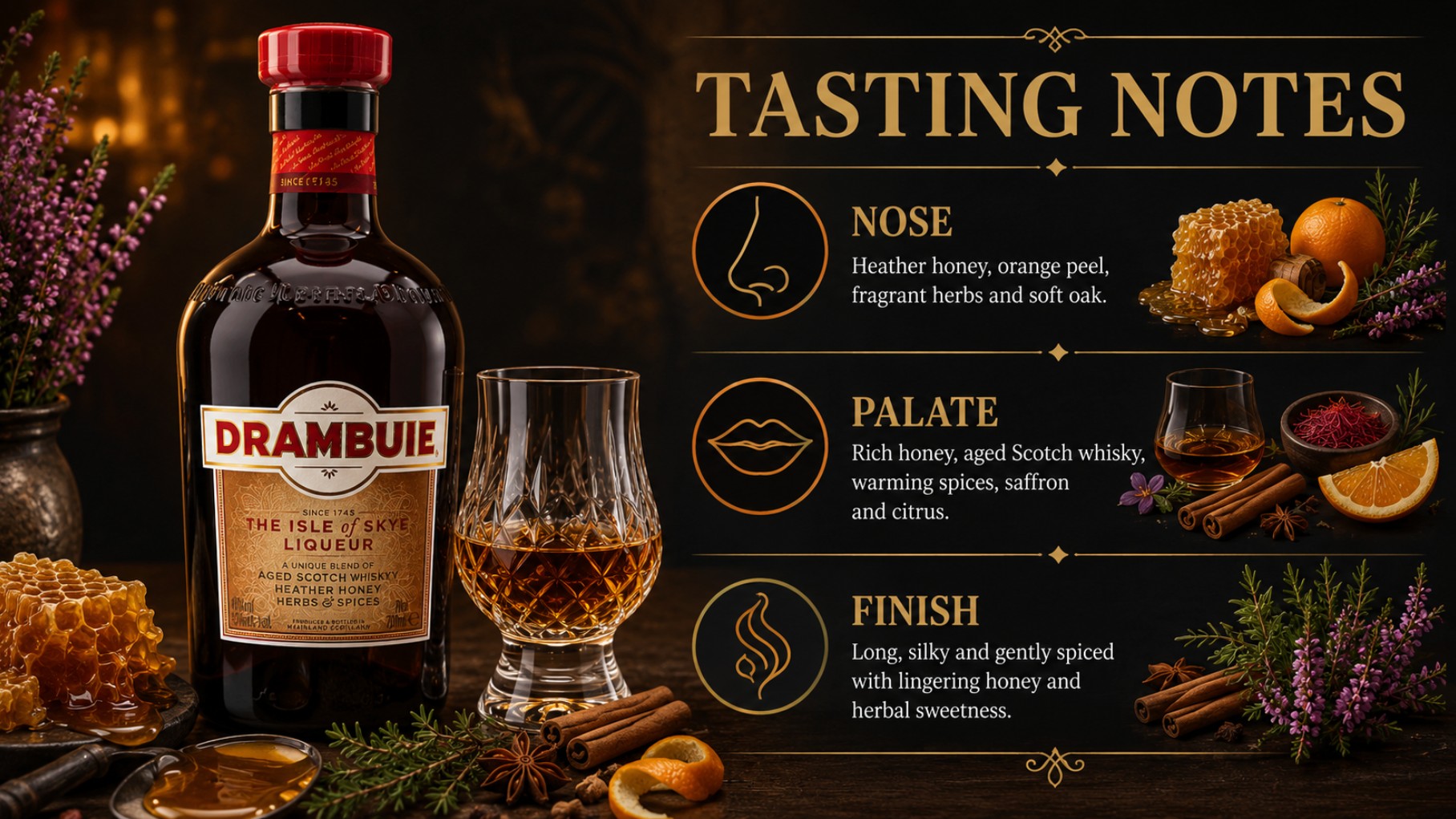
What Does Drambuie Taste Like?
Drambuie is sweet, warming and herbal, with honey at the centre and clear Scotch whisky beneath it.
Appearance
Deep golden amber with warm copper highlights.
The colour reflects the aged Scotch whisky, honey and botanical ingredients.
It has a slightly richer and more viscous appearance than standard whisky.
Nose
Heather honey appears first, followed by caramel, malt and dried herbs.
Orange peel and lemon zest bring freshness, while anise, clove and cinnamon add aromatic depth. Underneath the sweeter notes are gentle oak, vanilla and a trace of Scotch whisky smoke.
The aroma becomes more herbal as the drink rests.
Palate
Rich and coating, with dark honey, caramel and malted whisky.
Citrus peel provides brightness before clove, anise, cinnamon and herbal roots develop through the middle of the palate.
The Scotch adds warming oak and a slightly dry grain character that prevents the honey from becoming overwhelming.
Finish
Long, sweet and gently spicy.
Heather honey, herbs, citrus peel and whisky oak remain on the palate, followed by warming spice and a mild medicinal note.
Is Drambuie Sweet?
Yes. Drambuie is a sweet whisky liqueur.
Its sweetness comes primarily from heather honey, supported by flavours of caramel, vanilla and aged Scotch whisky.
The sweetness may suggest:
- Dark honey
- Toffee
- Caramel
- Malt
- Candied orange
- Dried fruit
- Soft liquorice
However, Drambuie is not purely sugary.
Herbs, spices, citrus peel and whisky oak provide enough bitterness and dryness to keep the flavour balanced.
Its 40% ABV also gives it considerably more warmth and structure than many lower-strength sweet liqueurs.
Is Drambuie Strong?
Yes. Standard Drambuie is bottled at 40% ABV.
This is unusually strong for a liqueur and equal to the standard minimum bottling strength of Scotch whisky.
Many liqueurs are bottled between approximately 15% and 30% ABV, so Drambuie can deliver significantly more alcohol per measure.
The strength gives Drambuie:
- A firmer whisky character
- Greater cocktail presence
- A warming finish
- More structure against the honey
- A longer shelf life after opening
- Enough intensity for sipping over ice
It should therefore be poured in similar measures to whisky rather than treated like a low-strength dessert drink.
Is Drambuie Smoky?
Drambuie can show a gentle smoky or earthy whisky note, but it is not heavily smoky.
The main flavours remain:
- Heather honey
- Herbs
- Citrus
- Spices
- Caramel
- Malt
- Oak
Any smoke sits in the background and comes from the Scotch whisky base rather than being the dominant feature.
Mixing Drambuie with a smoky Scotch in a Rusty Nail can make peat and smoke much more noticeable.
Is Drambuie Spiced?
Drambuie contains aromatic spices, but it is not a spiced whisky in the same sense as a flavoured spirit product.
The spices are part of the traditional botanical recipe and work alongside heather honey and herbs.
Commonly perceived notes include:
- Clove
- Cinnamon
- Anise
- Nutmeg
- Pepper
- Citrus peel
- Herbal roots
The botanical character is sophisticated and integrated rather than tasting like a single added flavour.
Is Drambuie Similar to Honey Whisky?
Drambuie shares some characteristics with honey-flavoured whisky, but it is more complex.
A straightforward honey whisky may focus mainly on:
- Whisky
- Honey sweetness
- Vanilla
- Caramel
Drambuie adds a much stronger herbal and spiced dimension.
Its profile includes:
- Heather honey
- Aged Scotch
- Citrus peel
- Anise
- Clove
- Aromatic herbs
- Oak
- Gentle bitterness
Drambuie is therefore richer, more botanical and more traditional than many modern honey-flavoured whisky drinks.
Is Drambuie Suitable for Beginners?
Drambuie is highly approachable for people who find neat Scotch too dry or intense.
The honey softens the alcohol and introduces an immediately familiar sweetness, while the herbal and whisky notes provide enough complexity for the drinker to explore.
It is particularly suitable for beginners who:
- Prefer sweeter spirits
- Enjoy honey
- Want to explore Scotch whisky
- Like herbal liqueurs
- Enjoy warming after-dinner drinks
- Want a simple cocktail ingredient
- Find heavily peated whisky too intense
The full 40% ABV should still be respected, even though the sweetness can make the alcohol feel softer.
How Should You Drink Drambuie?
Drambuie can be enjoyed neat, chilled, over ice, with coffee or in cocktails.
Neat
Pour a small measure into a liqueur glass, whisky tumbler or tulip-shaped tasting glass.
Serving it at room temperature allows the honey, herbs, citrus and whisky to appear most clearly.
The sweetness can feel fuller when neat, making this a rich after-dinner serve.
Over Ice
Drambuie officially recommends enjoying the liqueur simply over ice.
One large cube is preferable to several small cubes because it melts more slowly.
The cold softens the sweetness and makes the drink feel fresher, while gradual dilution opens the citrus and whisky.
Chilled
Drambuie can be refrigerated before serving.
Chilling produces a thicker texture and reduces the intensity of the honey and herbs. It is particularly suitable after dinner or in warmer weather.
With Water
A few drops of water can open the whisky, citrus and botanical notes.
Because Drambuie is already sweet, water can also make the drink feel lighter and less coating.
With Scotch
Combining Drambuie with Scotch creates the classic Rusty Nail.
The additional whisky makes the drink drier and more spirit-led while Drambuie provides honey, herbs and sweetness.
The Classic Rusty Nail Cocktail
The Rusty Nail is the cocktail most closely associated with Drambuie.
It combines Scotch whisky and Drambuie over ice, creating a rich, simple drink in which the whisky’s oak and malt are softened by honey and herbs.
The official Drambuie recipe uses 40ml of Scotch whisky and 20ml of Drambuie.
Ingredients
- 40ml Scotch whisky
- 20ml Drambuie
- Ice
- Lemon or orange peel
Method
Fill a rocks glass with ice.
Add the Scotch and Drambuie, then stir gently until chilled and lightly diluted.
Garnish with a twist of lemon or orange peel.
The 2:1 ratio produces a balanced and relatively dry Rusty Nail. Equal measures create a noticeably sweeter drink.
What Scotch Is Best for a Rusty Nail?
A blended Scotch whisky is the traditional and most versatile option.
Blended Scotch generally offers enough malt, fruit, grain sweetness and gentle smoke to work with Drambuie without becoming excessively expensive or overpowering.
Suitable styles include:
- Light blended Scotch
- Honeyed Highland whisky
- Fruity Speyside whisky
- Gently smoky blends
- Rich sherry-influenced Scotch
The choice changes the finished cocktail.
Light and Fruity Scotch
Produces a softer Rusty Nail with more honey, apple and citrus.
Sherried Scotch
Adds dried fruit, nuts, chocolate and spice.
Smoky Scotch
Creates a deeper drink with peat smoke set against Drambuie’s honey.
Blended Malt Scotch
Provides fuller malt character without the grain element of a conventional blend.
A whisky such as Monkey Shoulder Blended Malt Scotch Whisky can create a creamy and fruit-led variation.
Browse the wider Scotch whisky collection to explore different styles.
Why Is It Called a Rusty Nail?
The exact origin of the name is uncertain.
The combination of Scotch and Drambuie appeared under several names before Rusty Nail became established.
One account links an early version to the British Industries Fair in 1937. The drink later appeared under names including the D&S and Little Club No. 1 before Rusty Nail became the accepted title.
The cocktail became especially popular during the 1950s and 1960s and was strongly associated with New York’s 21 Club and members of the Rat Pack.
Some stories claim it was stirred with a rusty nail, although the name is more plausibly connected with the drink’s deep golden-brown colour.
The Rusty Nail and the Rat Pack
The Rusty Nail became closely associated with Frank Sinatra and the Rat Pack during the middle of the 20th century.
The group’s image was built around nightclubs, Las Vegas, tailored suits and spirit-forward cocktails. A simple mixture of Scotch and Drambuie fitted that style perfectly.
The cocktail required only two ingredients, could be prepared directly in the glass and offered more sweetness than neat Scotch without moving into a light or fruit-driven drink.
Its popularity faded as cocktail tastes changed, but the modern revival of classic drinks has brought renewed interest in the Rusty Nail.
It remains one of the easiest classic cocktails to recreate at home.
Smoky Rusty Nail
Adding peated Scotch creates a darker and more powerful variation.
Ingredients
- 40ml gently peated Scotch whisky
- 20ml Drambuie
- One large ice cube
- Lemon peel
Method
Add both spirits to a rocks glass over ice.
Stir gently and garnish with lemon peel.
The honey softens the peat, while the smoke adds depth to Drambuie’s herbs and spices.
A heavily peated whisky should be used carefully because it can overwhelm the liqueur.
Explore the peated Scotch whisky range for suitable options.
Drambuie and Coffee
Coffee is one of the most natural partners for Drambuie.
The liqueur’s honey, herbs, caramel and whisky complement:
- Espresso
- Roasted coffee
- Chocolate
- Cream
- Vanilla
- Cinnamon
Drambuie’s official site specifically highlights coffee and iced coffee cocktails as recommended serves.
Drambuie Coffee
- 35ml Drambuie
- Freshly brewed coffee
- Lightly whipped cream
- Nutmeg or cinnamon
Pour the Drambuie into a heatproof glass and add hot coffee.
Float lightly whipped cream across the top and finish with grated nutmeg or cinnamon.
The honey provides sweetness, so additional sugar may not be necessary.
Iced Drambuie Coffee
Ingredients
- 35ml Drambuie
- 50ml cold espresso
- 50ml milk
- Ice
- Optional cream
Method
Fill a glass with ice.
Add the Drambuie, espresso and milk, then stir until chilled.
For a richer serve, finish with a small layer of cream.
The coffee bitterness balances the honey while Drambuie adds whisky warmth and spice.
Drambuie Espresso Martini
Ingredients
- 30ml Drambuie
- 25ml vodka or Scotch whisky
- 30ml fresh espresso
- Ice
- Coffee beans
Method
Shake all ingredients firmly with ice.
Strain into a chilled cocktail glass and garnish with coffee beans.
Using vodka creates a cleaner coffee-led drink. Scotch creates a richer and more strongly whisky-based version.
Drambuie can replace some or all of the coffee liqueur and sugar syrup used in a conventional Espresso Martini.
Drambuie and Ginger Beer
Ginger beer provides spice, freshness and carbonation.
Ingredients
- 40ml Drambuie
- Chilled ginger beer
- Fresh lime
- Ice
Method
Fill a highball glass with ice.
Add Drambuie and a squeeze of lime, then top with ginger beer.
Stir gently and garnish with a lime wedge.
Ginger reinforces Drambuie’s warming spice, while lime balances the honey.
Drambuie Collins
Ingredients
- 40ml Drambuie
- 20ml fresh lemon juice
- Chilled soda water
- Ice
- Lemon slice
Method
Add Drambuie and lemon juice to a tall glass filled with ice.
Top with soda water and stir gently.
The drink is lighter and more refreshing than a Rusty Nail, with lemon cutting through the honeyed sweetness.
Drambuie Highball
A simple soda highball allows Drambuie’s flavour to remain clear.
Ingredients
- 40ml Drambuie
- Chilled soda water
- Plenty of ice
- Lemon or grapefruit peel
Method
Fill a highball glass with ice.
Add Drambuie and top slowly with soda water.
Garnish with citrus peel.
This creates a lighter serve with less sweetness per sip while retaining the herbal and whisky character.
Drambuie and Apple
Apple works naturally with honey, whisky and spice.
Drambuie Apple Highball
- 40ml Drambuie
- 80ml cloudy apple juice
- Soda water
- Ice
- Apple slice
- Cinnamon
Add Drambuie and apple juice to an ice-filled glass.
Top with a small amount of soda and garnish with apple and cinnamon.
The apple brings freshness while cinnamon echoes the liqueur’s spices.
Drambuie Hot Toddy
Drambuie works well in a hot toddy because it already supplies whisky, honey and herbs.
Ingredients
- 40ml Drambuie
- Hot water
- Fresh lemon juice
- Lemon slice
- Cinnamon stick
Method
Add Drambuie and a small squeeze of lemon to a heatproof glass.
Top with hot, but not boiling, water.
Stir gently and garnish with lemon and cinnamon.
Additional honey is usually unnecessary.
Drambuie Old Fashioned
Drambuie can replace some or all of the sugar in an Old Fashioned.
Ingredients
- 50ml Scotch whisky or bourbon
- 10ml Drambuie
- Two dashes of aromatic bitters
- One large ice cube
- Orange peel
Method
Stir the whisky, Drambuie and bitters with ice.
Strain into a rocks glass over one large cube and garnish with orange peel.
Drambuie adds honey and herbs while the base whisky keeps the cocktail dry and structured.
Drambuie Sour
Ingredients
- 40ml Drambuie
- 20ml Scotch whisky
- 25ml fresh lemon juice
- Optional egg white
- Ice
- Aromatic bitters
Method
When using egg white, shake the ingredients without ice first.
Add ice and shake again before straining into a chilled glass.
The lemon balances Drambuie’s sweetness, while the Scotch strengthens the whisky backbone.
What Is the Best Mixer for Drambuie?
The best mixer depends on whether the drink should emphasise sweetness, freshness or whisky.
Soda Water
The cleanest option. It lightens Drambuie without adding more sugar.
Ginger Beer
Adds spice and makes a refreshing long drink.
Coffee
Complements the honey, herbs, caramel and whisky.
Cloudy Apple Juice
Works with the liqueur’s fruit, honey and cinnamon notes.
Lemonade
Creates a sweeter citrus drink suitable for casual serving.
Tonic Water
Adds bitterness, although a strongly flavoured tonic can compete with the herbs.
Sparkling Wine
Produces a rich, celebratory drink with honeyed depth.
Scotch Whisky
Creates the classic Rusty Nail and makes Drambuie drier and more spirit-led.
Can Drambuie Be Mixed with Coke?
Yes. Drambuie can be mixed with cola.
The combination creates a sweet, easy long drink with flavours of:
- Caramel
- Vanilla
- Honey
- Spice
- Citrus
- Whisky
Use plenty of ice and a squeeze of fresh lime to prevent the drink from becoming too sweet.
A sensible starting ratio is:
- 35ml Drambuie
- 100ml cola
- Lime wedge
Soda or ginger beer will preserve more of Drambuie’s detailed herbal character, but cola remains an accessible option.
Can Drambuie Be Drunk as a Shot?
It can be served as a chilled shot, although slow sipping provides a better understanding of its flavour.
At 40% ABV, Drambuie is as strong as many whiskies despite tasting sweeter.
Serving it chilled softens the alcohol and creates a thicker texture. However, very low temperatures reduce some of the herbal and citrus aromas.
A small chilled measure can work as an after-dinner serve, but Drambuie is not a low-strength liqueur and should be treated accordingly.
What Food Goes with Drambuie?
Drambuie’s combination of whisky, honey and herbs makes it especially suitable with cheese, desserts and rich savoury food.
Cheese
Good pairings include:
- Mature Cheddar
- Comté
- Gruyère
- Gouda
- Blue cheese
- Baked Camembert
- Smoked cheese
- Goat’s cheese
Salty and mature cheeses balance the honey.
Blue cheese creates a particularly strong contrast between salt, richness and sweetness.
Meat
Try Drambuie with:
- Glazed ham
- Roast pork
- Duck
- Venison
- Chicken with a honey glaze
- Charcuterie
- Smoked meats
- Haggis
Herbs and honey work naturally with savoury meat, while the Scotch brings warmth and oak.
Desserts
Strong pairings include:
- Sticky toffee pudding
- Bread and butter pudding
- Apple crumble
- Honey cake
- Fruit cake
- Ginger cake
- Crème brûlée
- Vanilla cheesecake
- Dark chocolate tart
- Shortbread
- Cranachan
Scottish desserts built around oats, honey, cream and berries work particularly well.
Nuts and Dried Fruit
Serve with:
- Roasted almonds
- Walnuts
- Hazelnuts
- Dates
- Raisins
- Dried figs
- Candied orange peel
These flavours reflect the whisky, honey and spice already present in the liqueur.
Drambuie and Dark Chocolate
Dark chocolate provides bitterness that balances Drambuie’s honey.
Try chocolate containing:
- Orange
- Sea salt
- Ginger
- Roasted nuts
- Coffee
- Raisins
- Caramel
A cocoa content of around 60% to 75% works well.
Very bitter chocolate can make the liqueur appear sweeter, while milk chocolate may create an excessively rich combination.
Drambuie and Scottish Shortbread
Shortbread is one of the simplest traditional pairings.
The butter and sugar soften the whisky and spice, while Drambuie’s honey complements the biscuit’s richness.
A lightly salted shortbread provides an especially useful contrast.
The pairing works well after dinner or as part of a Scottish-themed tasting alongside Scotch whisky and mature cheese.
Drambuie and Haggis
Drambuie can work surprisingly well with haggis.
The liqueur’s honey contrasts with the savoury meat and pepper, while its Scotch base complements the traditional Scottish flavours.
It is better served in a sauce or small glass rather than in a heavily sweet mixed drink.
A Drambuie cream sauce can be served with haggis, venison or roast meat, provided the liqueur is used carefully to avoid making the dish overly sweet.
Can Drambuie Be Used in Cooking?
Yes. Drambuie can be used in sauces, desserts and baking.
Suitable uses include:
- Whisky cream sauce
- Honey glaze
- Chocolate sauce
- Trifle
- Cheesecake
- Christmas cake
- Fruit cake
- Bread pudding
- Ice cream
- Cranachan
- Coffee desserts
The alcohol should be handled carefully around open flames.
Drambuie’s honey, herbs and whisky are concentrated, so small quantities are often enough.
Drambuie vs Glayva
Glayva is another Scottish whisky liqueur and one of Drambuie’s closest comparisons.
Both combine Scotch whisky with sweetness and aromatic flavouring, but their profiles differ.
Drambuie
- Heather honey
- Strong herbal character
- Anise and warming spice
- Fuller whisky structure
- Bottled at 40% ABV
- Central to the Rusty Nail
Glayva
- Tangerine and citrus
- Honey
- Almond
- Cinnamon
- Softer and more fruit-led
- Usually lower in strength
Drambuie is generally darker, more herbal and more whisky-forward.
Glayva often feels brighter, fruitier and more immediately citrus-led.
Drambuie vs Stroma Whisky Liqueur
Old Pulteney Stroma Malt Whisky Liqueur provides a more coastal alternative.
Stroma is made with malt whiskies associated with Old Pulteney and offers toffee, fruit and subtle maritime character.
Drambuie
- Heather honey
- Herbs and spices
- Stronger historical identity
- Rich sweetness
- Classic Rusty Nail use
- 40% ABV
Stroma
- Malt whisky focus
- Toffee
- Fruit
- Coastal character
- Softer herbal influence
- Lower bottling strength
Drambuie is the better choice for drinkers seeking a botanical and honeyed liqueur.
Stroma may appeal more to those who want a softer whisky liqueur with a coastal malt character.
Drambuie vs Irish Mist
Irish Mist is made with Irish whiskey, honey, herbs and spices.
Its broad concept is similar to Drambuie, but the underlying whiskey style creates a different result.
Drambuie
- Scotch whisky
- Heather honey
- More herbal and spiced
- Greater oak and malt
- Occasional gentle smoke
- 40% ABV
Irish Mist
- Irish whiskey
- Softer cereal character
- Honey and vanilla
- Less smoky
- Generally smoother and lighter
- More rounded sweetness
Drambuie is usually the more powerful and aromatic drink.
Irish Mist may appeal to those who prefer the softer character of Irish whiskey.
Drambuie vs Bénédictine
Bénédictine is a French herbal liqueur made from a large and complex botanical recipe.
Both drinks are herbal and sweet, but their foundations differ.
Drambuie
- Scotch whisky base
- Heather honey
- Malt and oak
- Warming Highland identity
- Central whisky character
Bénédictine
- Neutral or brandy-like spirit base
- Much broader herbal recipe
- Strong medicinal and spice complexity
- Less obvious whisky character
- Frequently used in classic cocktails
Drambuie is more clearly whisky-led.
Bénédictine is usually more intensely herbal and can taste closer to a traditional monastic liqueur.
Drambuie vs Grand Marnier
Grand Marnier combines Cognac with orange liqueur.
Both are high-strength liqueurs built on aged spirits, but the flavour profiles are very different.
Drambuie
- Scotch whisky
- Heather honey
- Herbs
- Spices
- Malt and oak
Grand Marnier
- Cognac
- Bitter orange
- Vanilla
- Candied citrus
- Brandy richness
Grand Marnier is more citrus-led and works naturally in orange-based cocktails and desserts.
Drambuie is more herbal, honeyed and whisky-focused.
Drambuie vs Fireball
Fireball is a cinnamon-flavoured whisky liqueur, but it occupies a very different part of the category.
Drambuie
- Aged Scotch whisky
- Heather honey
- Complex herbs and spices
- 40% ABV
- Designed for sipping and classic cocktails
- Rich and layered
Fireball
- Canadian whisky base
- Strong cinnamon flavour
- Sweeter and simpler
- Lower strength
- Commonly served chilled or as a shot
- More confectionery-led
Drambuie is the more traditional and complex option.
Fireball is designed around an immediate cinnamon flavour rather than a detailed Scotch and botanical profile.
Is Drambuie a Good Alternative to Scotch Whisky?
Drambuie can be a useful alternative for someone who enjoys whisky flavours but prefers greater sweetness.
It retains:
- Malt
- Oak
- Warming alcohol
- Dried fruit
- Gentle smoke
- Spice
The honey and herbs make it softer and more accessible than many neat whiskies.
However, it should not be expected to taste like a single malt. Drambuie is sweeter, more botanical and more heavily flavoured.
It can act as a bridge into Scotch whisky, particularly when used in a Rusty Nail where the proportion of whisky can gradually be increased.
Is Drambuie a Good After-Dinner Drink?
Yes. Drambuie is particularly well suited to after-dinner drinking.
Its honey, herbs, whisky and spice work naturally with:
- Coffee
- Chocolate
- Cheese
- Shortbread
- Fruit cake
- Desserts
- Cigars
It can replace a dessert wine, whisky or brandy when a sweeter drink is preferred.
Serve it neat, over one large ice cube or alongside coffee.
Is Drambuie a Good Christmas Drink?
Drambuie is especially suitable for autumn and winter.
Its flavours of honey, herbs, citrus peel, clove and whisky match many festive foods and drinks.
It works well in:
- Hot toddies
- Coffee
- Christmas cocktails
- Mince pie pairings
- Fruit cake
- Christmas pudding
- Chocolate desserts
- Cheese boards
The Bonnie Prince Charlie story and Scottish identity also make it a distinctive Christmas gift.
Is Drambuie a Good Gift?
Drambuie Scotch Whisky Liqueur makes a strong gift for whisky drinkers, cocktail enthusiasts and anyone interested in Scottish heritage.
It is suitable for:
- Birthdays
- Christmas
- Father’s Day
- Mother’s Day
- Housewarmings
- Burns Night
- Dinner-party hosts
- Whisky beginners
- Rusty Nail drinkers
- Scottish history enthusiasts
Its recognisable name and approachable sweetness make it easier to gift than a heavily peated or unusually powerful Scotch.
A Drambuie Scotch Whisky Liqueur miniature is also available for tasting selections, stocking fillers or smaller gifts.
Is Drambuie Collectable?
The standard Drambuie bottle is primarily intended for drinking rather than investment.
However, older and discontinued versions can attract interest from collectors.
These may include:
- Older bottle designs
- Vintage Drambuie bottlings
- Royal commemorative editions
- Presentation decanters
- Travel-retail releases
- Drambuie 15
- Drambuie Royal Legacy of 1745
- Black Ribbon editions
- Older miniatures
- MacKinnon-era packaging
Changes in ownership, label design and recipe presentation can make historic bottles interesting for side-by-side tasting.
HTFW also stocks Drambuie Black Ribbon Whisky Liqueur 1 Litre when available, offering a different presentation within the wider range.
How Should Drambuie Be Stored?
Store Drambuie upright in a cool, dark place.
Avoid:
- Direct sunlight
- Radiators
- Ovens
- Excessive heat
- Major temperature changes
- Long-term contact with the closure
It does not need to be refrigerated.
Because it is bottled at 40% ABV, Drambuie is more stable than many low-strength cream or fruit liqueurs. It does not contain dairy and does not require the same storage conditions as a cream liqueur.
Once opened:
- Keep the bottle tightly sealed.
- Store it upright.
- Protect it from strong light.
- Avoid excessive heat.
- Wipe the neck if honeyed residue builds up.
Does Drambuie Go Off?
Drambuie does not spoil quickly when stored correctly.
Its high alcoholic strength and sugar content help preserve it.
Over a long period after opening, the drink may gradually change through exposure to oxygen. The freshest citrus and herbal notes may soften, while the overall flavour can become less vibrant.
Signs of poor storage may include:
- A damaged closure
- Excessive evaporation
- Unusual cloudiness
- A significantly altered smell
- Contamination around the bottle neck
A correctly sealed bottle should remain drinkable for a considerable period.
Can Drambuie Be Kept in the Freezer?
Drambuie can be chilled in a domestic freezer and should not freeze solid because it is bottled at 40% ABV.
It will become thicker and more viscous.
Freezer-cold Drambuie can work as a chilled after-dinner serve, but the low temperature reduces its aroma. Honey and sweetness may appear more restrained initially, while herbs and citrus emerge as it warms.
Refrigerator chilling or serving over a large ice cube gives a better balance between temperature and aroma.
Frequently Asked Questions
What is Drambuie?
Drambuie is a Scottish whisky liqueur made from aged Scotch whisky, heather honey, aromatic herbs and spices.
What does Drambuie mean?
The name is connected with the Scottish Gaelic phrase An Dram Buidheach, commonly translated as “the drink that satisfies”.
How do you pronounce Drambuie?
It is generally pronounced “Dram-boo-ee”.
Where is Drambuie made?
Drambuie is produced in Scotland.
What is the alcohol strength?
Drambuie is bottled at 40% ABV.
What size is the standard bottle?
The standard HTFW bottle contains 70cl.
Is Drambuie whisky?
It contains aged Scotch whisky but is classified as a whisky liqueur because honey, herbs and spices are added.
Is Drambuie Scotch?
It is a Scotch whisky-based liqueur, not a bottle of standard Scotch whisky.
What is Drambuie made from?
It combines aged Scotch whisky, heather honey, herbs and spices.
Is the recipe secret?
Yes. The complete botanical recipe and proportions are closely guarded.
Is Drambuie sweet?
Yes. Heather honey gives it a rich sweetness balanced by herbs, citrus, spice and whisky oak.
Is Drambuie smoky?
It can have a gentle smoky whisky note, but it is not heavily smoky.
Is Drambuie a herbal liqueur?
Yes, although its aged Scotch whisky base distinguishes it from most neutral-spirit herbal liqueurs.
Does Drambuie contain cream?
No. It is not a cream liqueur.
Does Drambuie need to be refrigerated?
No. Store it upright in a cool, dark place.
Can Drambuie be drunk neat?
Yes. It can be enjoyed neat at room temperature.
Can Drambuie be served over ice?
Yes. Drambuie officially recommends serving it over ice.
What is the best Drambuie cocktail?
The Rusty Nail is the classic choice, combining Drambuie with Scotch whisky.
What is the Rusty Nail ratio?
The official Drambuie recipe uses 40ml Scotch whisky and 20ml Drambuie.
What is the best mixer for Drambuie?
Scotch whisky, soda water, ginger beer, coffee and cloudy apple juice all work particularly well.
Can Drambuie be added to coffee?
Yes. Honey, herbs and whisky make it an excellent addition to hot or iced coffee.
Is Drambuie suitable for beginners?
Yes. Its honeyed sweetness makes Scotch whisky flavours easier to approach.
Is Drambuie associated with Bonnie Prince Charlie?
According to the traditional story, Bonnie Prince Charlie gave his personal liqueur recipe to Captain John MacKinnon after receiving assistance during his escape following Culloden. The precise historical details remain debated.
Who owns Drambuie?
Drambuie is owned by William Grant & Sons.
Is Drambuie a good gift?
Yes. Its Scottish history, famous recipe and versatile flavour make it suitable for whisky drinkers, cocktail enthusiasts and after-dinner drinking.
Why Drambuie Remains a Scottish Classic
Drambuie has remained relevant because it occupies a distinctive place between Scotch whisky, honey liqueur and herbal spirit.
Its recipe makes whisky more accessible without removing its identity. The honey provides sweetness and texture, but malt, oak and warming alcohol remain beneath it.
The botanicals are equally important. Without the herbs, citrus and spices, Drambuie could feel like a simple sweetened whisky. Instead, anise, clove, aromatic roots and citrus peel create a deeper and more recognisable profile.
Its history also gives it lasting appeal.
The Bonnie Prince Charlie story, Clan MacKinnon, the Isle of Skye and the aftermath of Culloden connect the bottle with one of the most famous periods in Scottish history. Although every detail of the legend cannot be proven conclusively, it has become an essential part of Drambuie’s cultural identity.
The Rusty Nail gave Drambuie another life within cocktail culture. By combining the liqueur with Scotch, bartenders created a drink that was sweeter and softer than neat whisky but still strong, simple and sophisticated.
Today, Drambuie can move comfortably between several occasions:
- A neat after-dinner liqueur
- A chilled drink over ice
- A classic Rusty Nail
- A whisky Old Fashioned sweetener
- A hot toddy
- A coffee cocktail
- A long drink with ginger beer or soda
- A Scottish food pairing
Few liqueurs have such a direct connection with Scotch whisky while remaining accessible to drinkers who may not normally choose whisky neat.
Buy Drambuie Scotch Whisky Liqueur
Drambuie Scotch Whisky Liqueur combines aged Scotch whisky with Scottish heather honey and a secret selection of aromatic herbs and spices.
Its rich flavour brings together dark honey, malt, caramel, citrus peel, warming spice, herbs and gentle whisky oak. Bottling at 40% ABV gives it considerably more structure than many liqueurs and allows it to work equally well neat, over ice or in cocktails.
Serve it simply over one large ice cube, add it to fresh coffee or combine it with Scotch whisky to make the classic Rusty Nail.
Shop Drambuie Scotch Whisky Liqueur, explore the complete Drambuie collection, or discover more bottles within the wider liqueurs range at Hard To Find Whisky.