











Unicum is difficult to separate from Hungary itself.
Dark, intensely bitter and produced from a closely guarded recipe involving more than 40 herbs and spices, Unicum Zwack Herbal Liqueur has a history stretching back to 1790.
It is made in Budapest by the Zwack family, combining botanical extracts and distillates before maturation in large oak casks. The result is a powerful 40% ABV herbal liqueur built around bitterness rather than sweetness, with layers of herbs, roots, spice, citrus peel and mature oak.
Its history is equally distinctive. Unicum has survived the Austro-Hungarian Empire, two world wars, the destruction of the Zwack distillery, communist nationalisation, decades of family exile and the eventual return of the Zwacks to Hungary.
For anyone exploring Hungarian spirits, traditional European herbal liqueurs, digestifs or bitter spirits, few bottles have a story quite like it.
Explore Unicum Zwack Herbal Liqueur at Hard To Find Whisky or browse the wider liqueur collection at HTFW.
Unicum Zwack at a Glance
- Producer: Zwack
- Country: Hungary
- Category: Herbal liqueur / bitter
- Bottle size: 50cl at HTFW
- ABV: 40%
- Recipe origins: 1790
- Botanicals: More than 40 herbs and spices
- Production: Combination of botanical maceration and distillation
- Maturation: Aged for months in large oak casks
- Distillery: Budapest, Hungary
- Style: Intensely herbal, bitter, spicy and warming
- Key flavours: Bitter herbs, roots, citrus peel, spice, liquorice and earthy botanicals
- Serving: Traditionally enjoyed chilled, neat or as a digestif
What Is Unicum?
Unicum is a traditional Hungarian herbal bitter produced by the Zwack family in Budapest.
Its character comes from a secret recipe involving more than 40 herbs and spices, some of which are macerated while others are distilled.
Those botanical components are brought together before the liqueur is matured in oak.
That last stage is important.
Unicum is not simply a flavoured neutral spirit assembled and bottled immediately. The oak maturation allows its concentrated herbal, bitter and spicy elements to integrate before bottling.
At 40% ABV, it also sits considerably higher in strength than many modern liqueurs.
The resulting style is dark, powerful and deliberately bitter.
Why Is Unicum Called Unicum?
The name comes from a story dating back to 1790.
According to the Zwack family history, Dr Zwack was serving as court physician to Joseph II, Holy Roman Emperor and King of Hungary.
He offered the monarch a herbal preparation intended to aid digestion.
The story goes that Joseph II tasted it and responded that it was a Unikum — something unique.
Whether viewed as brand legend or family history, that moment has been associated with the drink ever since.
More than two centuries later, Unicum remains the name carried by the distinctive round bottle.
How Old Is Unicum?
The recipe traces its origins to 1790, making Unicum more than 235 years old.
That does not mean the present bottle has been produced commercially in exactly the same way continuously since 1790.
The commercial story developed over the following decades.
In 1840, József Zwack established his first distillery and developed Unicum as a commercial product.
Unicum was formally registered as a herbal liqueur trademark in 1883.
By the end of the 19th century, the Zwack business had grown into a significant Central European spirits producer with a range extending far beyond Unicum.
The remarkable part is not simply the age of the recipe.
It is how much political and economic change that recipe has survived.
Who Are the Zwack Family?
The Zwacks are one of Hungary's best-known drinks families.
Their association with Unicum stretches across six generations.
József Zwack established the first commercial distillery in 1840, building on the family recipe associated with Dr Zwack half a century earlier.
The business expanded rapidly during the second half of the 19th century.
By 1895, Zwack had become an official supplier to the Imperial and Royal Court of Austria-Hungary.
At that point the company was producing hundreds of different spirits and exporting internationally.
Yet despite the scale of the wider business, Unicum remained the bottle most closely associated with the family name.
Where Is Unicum Made?
Unicum is produced in Budapest, Hungary.
The Zwack family moved production to its present Soroksári Road site beside the Danube in 1892.
That location remains central to the business today.
The historic distillery houses equipment used for botanical extraction and distillation as well as extensive maturation cellars.
The House of Unicum visitor centre also provides access to parts of the historic distillery and cellar complex.
For a liqueur with such a long history, the continuity of location is significant.
Unicum is still being produced in the same part of Budapest where the Zwack family established its purpose-built distillery more than 130 years ago.
How Is Unicum Made?
The exact recipe remains secret, but the broad production method is known.
More than 40 herbs and spices are used.
Some of those botanicals are macerated, allowing their flavour and aromatic compounds to infuse into alcohol.
Others are distilled.
This allows Zwack to extract different characteristics from different botanicals before assembling the components into the final recipe.
The exact botanical list and proportions remain confidential.
That secrecy is a major part of Unicum's identity and became particularly important during the communist period, when possession of the real recipe allowed the Zwack family to preserve the original product outside Hungary.
Why Does Unicum Use More Than 40 Herbs and Spices?
Because its flavour is built through complexity rather than one dominant botanical.
Unlike a citrus liqueur, coffee liqueur or fruit liqueur where a single flavour provides an obvious centre, Unicum is deliberately layered.
Different botanicals contribute bitterness, spice, aromatics, citrus, earthy tones and medicinal character.
The overall impression therefore changes as the drink develops.
Initially there may be strong bitter herbs and citrus peel.
Behind that come roots, liquorice-like flavours, warming spice and darker botanical notes.
The objective is not to identify all 40-plus ingredients individually.
It is the way they combine that creates Unicum's recognisable bittersweet character.
Is Unicum Aged in Oak?
Yes.
After the botanical components have been brought together, Unicum is matured for months in large oak casks.
The cellars beneath the Budapest distillery contain more than 500 oak barrels used in the maturation of Unicum and related expressions.
Oak ageing is an important distinction.
Many liqueurs obtain almost all of their flavour directly from ingredients added to spirit.
Unicum adds another stage.
Time in oak helps bring together the concentrated botanical flavours while contributing additional roundness and maturity to the finished drink.
The wood is not intended to dominate in the way it might in a heavily aged whisky.
Instead, it forms part of the integration process.
What Does Unicum Taste Like?
Unicum is unmistakably bitter.
Anyone approaching it expecting a conventionally sweet liqueur may therefore be surprised.
Its appeal comes from the tension between bitterness, herbs, spice and restrained sweetness.
Appearance
Very dark brown, approaching black in the glass.
That appearance immediately distinguishes Unicum from lighter herbal liqueurs and reinforces the impression of concentrated botanical character.
Nose
Intense herbs lead, followed by bitter roots, dried citrus peel, warming spice and liquorice.
There is also a darker medicinal and earthy quality beneath the brighter aromatics.
Palate
Full-bodied and firmly bitter.
Herbal extracts, root flavours and citrus peel arrive first, followed by liquorice, spice and subtle sweetness.
The 40% ABV gives it considerably more structure and warmth than many lower-strength liqueurs.
Finish
Long, warming and herbaceous.
Bitterness persists alongside spice, dark roots, citrus peel and cooling medicinal notes.
The overall flavour progression moves broadly from bitter herbs → citrus peel → roots and liquorice → spice → lingering herbal warmth.
Is Unicum Sweet?
There is sweetness in Unicum, but sweetness is not the dominant impression.
The defining characteristic is bitterness.
This makes it markedly different from cream liqueurs, fruit liqueurs and many of the sweeter herbal expressions found elsewhere in the category.
Sugar helps provide body and balance, but it does not remove the bitter botanical backbone.
For drinkers accustomed to amaro, Fernet-style spirits or strong European digestifs, that profile will feel familiar.
For someone whose reference point is a sweet liqueur, Unicum can initially seem extremely intense.
Is Unicum an Amaro?
Unicum occupies broadly similar drinking territory to Italian amaro, although it is Hungarian rather than Italian.
Amaro simply means “bitter” in Italian and covers a very broad family of herbal liqueurs.
Unicum shares many of the category's characteristics: botanical ingredients, bitterness, digestive traditions and a balance between herbs, spice and sweetness.
It is therefore reasonable to compare the style.
But Unicum has its own Hungarian identity, its own secret recipe and its own production history dating back to the late 18th century.
It is better understood as Hungary's distinctive answer to the wider European tradition of herbal bitters.
Unicum vs Jägermeister
Jägermeister is probably one of the most familiar reference points for drinkers approaching Unicum for the first time.
Both are dark European herbal liqueurs built around complex botanical recipes.
The similarities largely end there.
Unicum is bottled at 40% ABV, compared with the typically lower strength of Jägermeister, and its flavour profile is considerably more bitter and austere.
Jägermeister tends towards sweeter spice, liquorice, citrus and syrupy richness.
Unicum puts bitterness much further forward.
Its combination of roots, herbs, oak maturation and higher alcoholic strength produces a drier and more medicinal drinking experience.
Someone looking for a sweeter entry into herbal liqueurs may find Jägermeister easier.
Someone specifically looking for traditional bitter character may find Unicum considerably more interesting.
What Happened to Unicum During World War II?
The Second World War nearly destroyed the business physically.
Budapest suffered extensive damage and the Zwack distillery was heavily bombed.
The family began rebuilding after the war.
By 1948, the facility had largely been restored.
Then an entirely different challenge arrived.
Hungary's communist government nationalised the company without compensation.
The Zwack family lost control of the distillery.
But they did not lose the original recipe.
How Did the Zwack Family Save the Unicum Recipe?
The story of the recipe is one of the most remarkable parts of Unicum's history.
When the company was nationalised in 1948, members of the Zwack family fled Hungary.
János Zwack escaped carrying the genuine Unicum recipe.
Another family member, Béla Zwack, remained temporarily at the nationalised distillery.
According to the family's account, he deliberately supplied the communist authorities with a false recipe rather than surrendering the original.
The genuine recipe therefore remained under family control.
Production continued in communist Hungary, but the family maintained that the authentic formula had left the country with them.
The Zwacks later resumed production outside Hungary, particularly in Italy.
The recipe had effectively survived the nationalisation of the company because the government had acquired the factory but not the knowledge required to reproduce the genuine drink.
When Did the Zwack Family Return to Hungary?
Péter Zwack and his family began returning to Hungary during the late 1980s as communist rule weakened.
In 1989, a new joint venture was established involving Péter Zwack and German liqueur producer Underberg alongside Hungarian state organisations.
Following Hungary's transition away from communism, the family ultimately repurchased the former state drinks company as part of the country's privatisation programme.
By the early 1990s, Zwack had regained control of the business associated with the family name.
The original Unicum recipe had come home.
It completed a remarkable cycle: imperial court origins, commercial expansion, war, destruction, nationalisation, exile and eventual return.
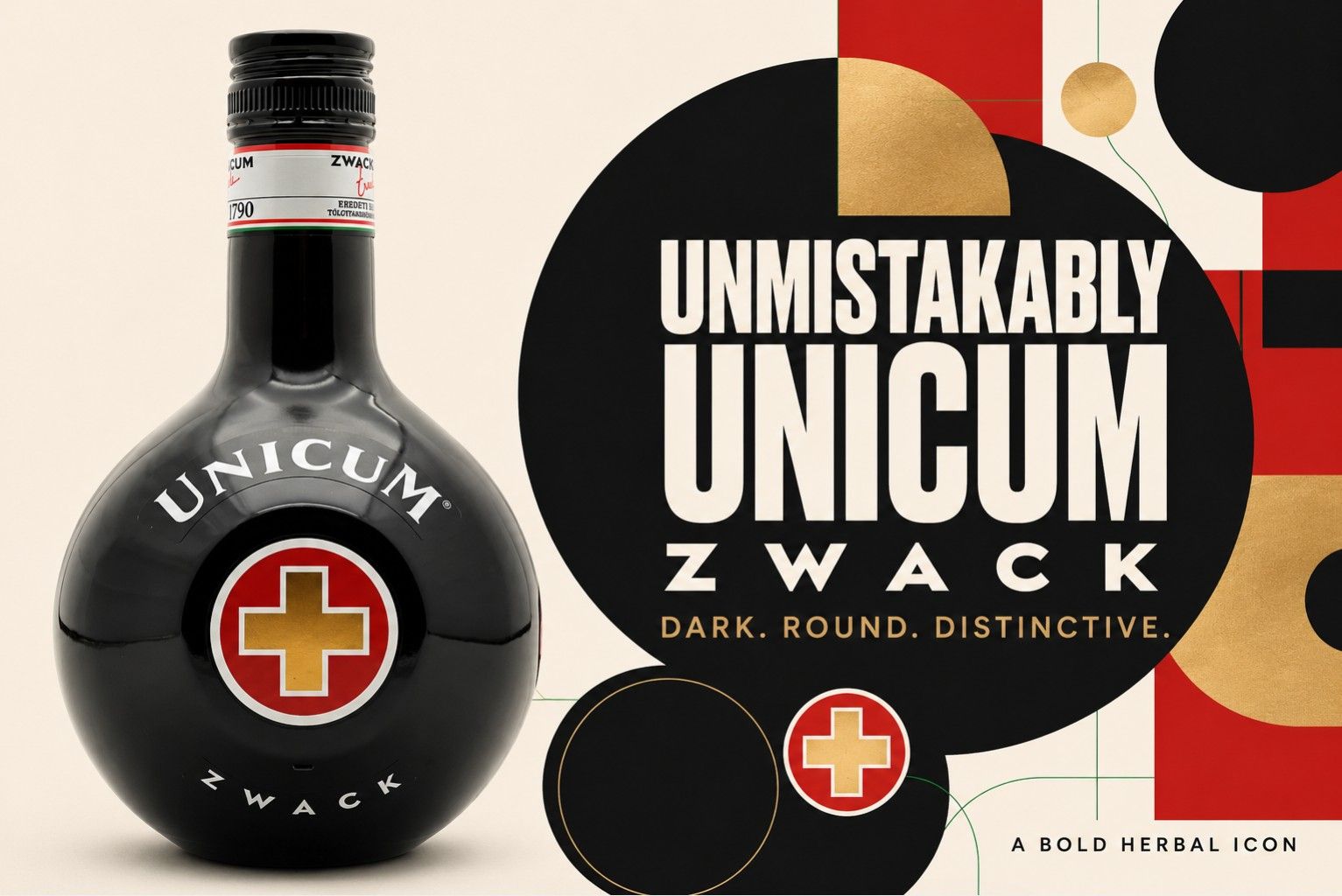
Why Is the Unicum Bottle Round?
The round bottle is one of the most recognisable elements of Unicum.
It has been associated with the product since its earliest commercial years.
The circular shape, dark glass and large central cross give the bottle a visual identity that is difficult to confuse with other liqueurs.
Historically, the label originally carried a red cross.
Zwack later paid the Hungarian Red Cross Association for permission to use the symbol.
After that agreement ended in the early 1920s, the label design evolved towards the gold cross on a red background familiar today.
The result is a bottle whose design has become almost as recognisable in Hungary as the flavour inside it.
How Should You Drink Unicum?
Unicum is traditionally consumed as either an aperitif or digestif.
It can be served neat at room temperature, which exposes the full bitterness and herbal intensity.
It can also be chilled.
Lower temperatures slightly restrain the most aggressive bitter elements and can make the drink feel more compact and refreshing.
For a first tasting, trying it chilled and then at room temperature provides a useful comparison.
The flavour changes noticeably.
Cold Unicum emphasises freshness, bitter herbs and citrus.
As it warms, the darker roots, spice and oak become easier to identify.
Is Unicum a Digestif?
Yes.
Unicum has a long association with drinking after food.
Its very origin story describes Dr Zwack offering the drink to Emperor Joseph II as a digestive preparation.
That places it within the broader European tradition of herbal bitters consumed after meals.
Today it is drunk for enjoyment rather than as medicine, but the digestif association remains central to the way the product is understood and served.
Small neat measures after dinner remain one of the most traditional ways to drink it.
Can You Use Unicum in Cocktails?
Yes, although its intensity means restraint is useful.
Unicum can function in a cocktail in much the same way as other strong herbal bitters or amaros.
Its bitterness can cut through sweetness.
Its botanical character can add complexity.
Its 40% ABV also means it behaves more like a full-strength spirit than many lower-strength liqueurs.
Citrus, soda, tonic, dark spirits and other bitter ingredients can all work alongside it.
But Unicum is powerful enough that even a relatively small quantity can substantially change a drink.
For anyone unfamiliar with the flavour, tasting it neat first makes sense before using it as a cocktail ingredient.
Is Unicum Hungary's National Drink?
It is frequently described as one of Hungary's national drinks rather than holding a formal legal title.
That distinction matters.
Hungary has several spirits closely connected with its national food and drinking culture, particularly pálinka and Unicum.
Unicum's claim comes from history, familiarity and cultural recognition rather than an official government designation.
After more than two centuries of production and generations of association with Budapest and the Zwack family, it has become one of the bottles most strongly associated with Hungarian drinking culture.
Frequently Asked Questions
What percentage is Unicum?
Unicum Zwack Herbal Liqueur at HTFW is bottled at 40% ABV.
How big is a bottle of Unicum?
The expression currently listed by HTFW is a 50cl bottle.
How many herbs are in Unicum?
Zwack states that Unicum is made using more than 40 herbs and spices.
When was Unicum invented?
The Zwack family traces the original recipe back to 1790.
Who invented Unicum?
The origin story centres on Dr Zwack, physician to Emperor Joseph II.
Where is Unicum made?
Unicum is made in Budapest, Hungary, at the historic Zwack site on Soroksári Road.
Is Unicum aged?
Yes. Unicum is matured for months in large oak casks before bottling.
Is Unicum bitter?
Very.
Its strong herbal bitterness is one of the defining characteristics of the drink.
Is Unicum an amaro?
It is a Hungarian herbal bitter rather than an Italian amaro, although the styles share many characteristics and are frequently compared.
Is Unicum the same as Jägermeister?
No.
Both are herbal liqueurs, but Unicum is stronger, considerably more bitter and has a noticeably drier herbal profile.
How should Unicum be served?
It can be enjoyed chilled or at room temperature, most traditionally neat as an aperitif or digestif.
Where can I buy Unicum in the UK?
You can buy Unicum Zwack Herbal Liqueur from Hard To Find Whisky or explore the wider liqueur range at HTFW.
Final Thoughts
The appeal of Unicum Zwack Herbal Liqueur goes considerably further than an unusual flavour.
There are more than 40 herbs and spices, extracted through both maceration and distillation.
There is maturation in large oak casks beneath the historic Budapest distillery.
There is a 40% ABV strength that gives the liqueur considerably more structure than many of its sweeter modern counterparts.
And then there is the history.
A recipe associated with the Imperial Court in 1790 became a commercial spirit in the 19th century, survived the destruction of the Zwack distillery during the Second World War, escaped Hungary during communist nationalisation and eventually returned with the family who created it.
The flavour is equally uncompromising.
Bitter herbs and citrus lead into liquorice, roots and spice before a long, warming and medicinal finish.
It is not designed to taste like a conventional sweet liqueur.
That is precisely the point.
More than 235 years after its origin story began, Unicum remains one of Europe's most distinctive herbal spirits and one of the bottles most closely associated with Hungary.
Explore Unicum Zwack Herbal Liqueur at HTFW or browse the complete liqueur collection at Hard To Find Whisky.