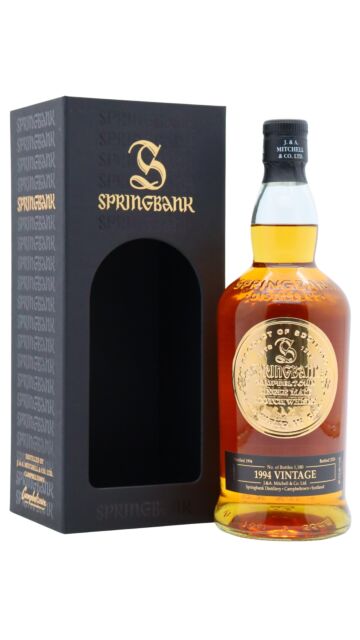




















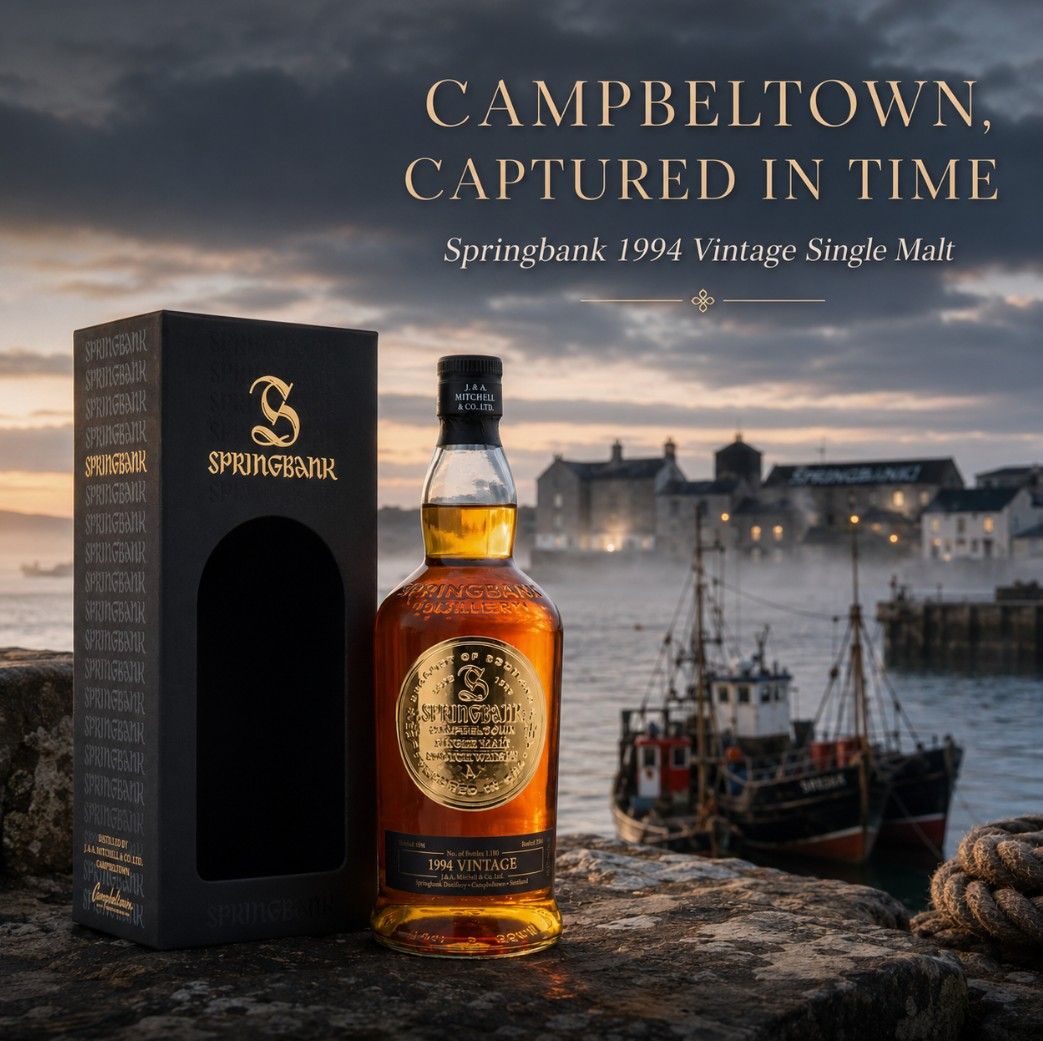
Springbank 1994 Vintage Campbeltown Single Malt Scotch Whisky is an exceptionally limited 31-year-old release from one of Scotland’s most sought-after traditional distilleries.
Distilled in 1994 and bottled in 2026, this official Springbank Vintage Series release was matured in a combination of 80% bourbon, 10% sherry and 10% red wine casks. Only 1,180 bottles were produced, each presented at 45.1% ABV without chill filtration or added colouring.
The long maturation has developed a layered profile of dried pineapple, mango, ripe melon, honey and sandalwood, followed by caramelised lemon, custard cream, tropical fruit, toffee popcorn and the earthy, coastal character closely associated with old Springbank.
What Is Springbank 1994 Vintage?
Springbank 1994 Vintage is a 31-year-old Campbeltown single malt distilled in 1994 and bottled by Springbank Distillery in 2026.
It forms part of the distillery’s Vintage Series, a collection created to showcase selected parcels of older Springbank whisky by their year of distillation.
The release combines whisky matured in three different cask types:
- 80% bourbon casks
- 10% sherry casks
- 10% red wine casks
The bourbon casks make up the clear majority of the composition, allowing tropical fruit, vanilla, honeyed malt and coconut to remain central. The smaller sherry and red wine components bring additional richness, fruit and structure without dominating the recognisable Springbank character.
With just 1,180 bottles released worldwide, it is considerably more limited than the distillery’s core age-stated expressions.
Key Release Details
- Distillery: Springbank
- Region: Campbeltown
- Classification: Single Malt Scotch Whisky
- Vintage: 1994
- Bottled: 2026
- Age: 31 years old
- Cask composition: 80% bourbon, 10% sherry and 10% red wine
- Bottle size: 70cl
- Strength: 45.1% ABV
- Outturn: 1,180 bottles
- Chill filtration: No
- Added colouring: No
These details position the release as one of the most significant old Springbank bottlings of 2026.
The Second Springbank Vintage Series Release
Springbank 1994 is the second release in the distillery’s annual Vintage Series, following the 1998 Vintage introduced in 2025.
Rather than presenting whisky only through an age statement, the series places the year of distillation at the centre of each release. This allows collectors and drinkers to explore a particular period in Springbank’s production history.
The 1994 release is particularly significant because it comes from the decade in which Springbank’s international reputation accelerated. The distillery records the 1990s as a period when a series of high-quality bottlings helped cement Springbank’s reputation for world-class whisky.
The distillery’s official website also confirmed that its Summer 2026 tasting pack included the new Springbank 1994 Vintage, placing the release among its principal new bottlings for the year.
What Does “1994 Vintage” Mean?
The vintage identifies the year in which the spirit was distilled.
Springbank 1994 Vintage was distilled during 1994 and remained in oak until it was bottled in 2026. Its official age statement is 31 years.
A vintage and an age statement provide related but slightly different information:
- The vintage identifies the distillation year.
- The bottling year identifies when the whisky left the cask.
- The age statement confirms the minimum complete number of years spent maturing.
The dates 1994 and 2026 span parts of 32 calendar years, but the precise distillation and bottling dates determine the legally stated age. The youngest whisky in this release had completed 31 full years of maturation when bottled.
Three Decades of Maturation in Campbeltown
Whisky maturation does not simply become better with age. The casks must remain balanced enough to develop complexity without allowing oak to overwhelm the original spirit.
After 31 years, the natural strength of the whisky had fallen to 45.1% ABV. The relatively moderate bottling strength suggests a long period of interaction between spirit, wood and the cool, damp warehouse environment.
Springbank matures its whisky in Campbeltown, where the coastal climate contributes to the distillery’s distinctive combination of fruit, oiliness, mineral character, salt and gentle smoke.
The official production process states that filled casks are taken to the distillery’s dark, moist warehouses and monitored throughout maturation. Springbank also confirms that cask choice and the Kintyre peninsula climate contribute greatly to its whisky’s flavour.
Matured in 80% Bourbon Casks
Bourbon casks account for 80% of the final composition.
These casks commonly contribute flavours such as:
- Vanilla
- Honey
- Coconut
- Citrus
- Caramel
- Tropical fruit
- Toasted oak
- Gentle spice
In the Springbank 1994 Vintage, the bourbon influence appears particularly clearly through mango, pineapple, ripe melon, custard cream, lemon meringue and coconut.
The high proportion of bourbon casks helps retain brightness after more than three decades in oak. Rather than becoming dominated by dark dried fruit or heavy tannin, the whisky remains strongly tropical and citrus-led.
The Influence of Sherry Casks
Sherry casks make up 10% of the release.
Although this is a relatively small part of the composition, sherry-seasoned wood can contribute considerable flavour, including:
- Dried fruit
- Nuts
- Toffee
- Darker sweetness
- Baking spice
- Additional body
Here, the sherry component appears to support the whisky’s custard, caramelised citrus, honey and toffee popcorn notes without turning it into a heavily sherry-led Springbank.
This restrained use of sherry allows the mature distillery character and bourbon-cask fruit to remain the main focus.
Why Were Red Wine Casks Used?
The remaining 10% of the whisky was matured in red wine casks.
Wine casks can introduce ripe fruit, tannin, spice and additional texture. However, they can become dominant when used too heavily, particularly alongside an already mature spirit.
By limiting red wine casks to 10% of the final composition, Springbank has used them as a supporting element rather than the defining influence.
The resulting whisky remains clearly recognisable as Springbank, with tropical fruit, earthy warehouse character, gentle smoke and salinity continuing to lead the experience.
What Does Springbank 1994 Taste Like?
Springbank 1994 Vintage combines mature tropical fruit with honey, citrus, creamy sweetness and earthy Campbeltown character.
Dried pineapple, mango and ripe melon lead the aroma, supported by honey and sandalwood. The palate develops through caramelised lemon meringue, custard cream, tropical fruit, wood and toffee popcorn.
The finish introduces coconut, fresh basil, gorse and persistent earthiness.
Tasting Notes
Nose: Dried pineapple, mango and ripe melon with honey, sandalwood and an earthy, old-style Springbank character.
Palate: Caramelised lemon meringue and custard cream, followed by mango, pineapple, mature wood and sweet toffee popcorn.
Finish: Long and earthy with coconut, fresh basil, gorse bush, gentle coastal salinity and restrained smoke.
The tropical fruit remains unusually lively for a 31-year-old whisky, while the earthy and herbal finish adds the complexity expected from mature Springbank.
Old-School Springbank Character
The phrase “old-school Springbank” is often used to describe a distinctive combination of characteristics found in older distillery bottlings.
These can include:
- Oily or waxy texture
- Dunnage warehouse earthiness
- Tropical fruit
- Mineral and coastal notes
- Barley and malt
- Gentle peat smoke
- Salinity
- Herbs and subtle industrial character
Springbank 1994 displays several of these qualities. The fruit is ripe and tropical, but it is balanced by sandalwood, earth, herbs and the coastal structure that prevents the whisky from becoming overly sweet.
This balance helps explain why old Springbank is so highly regarded. Extended maturation develops luxury and richness without entirely polishing away the distillery’s rugged identity.
Made Entirely at Springbank Distillery
Springbank is one of Scotland’s most self-contained whisky distilleries.
Every major stage of production is completed at the Campbeltown site, including:
- Floor malting the barley
- Kilning
- Milling
- Mashing
- Fermentation
- Distillation
- Cask filling
- Maturation
- Bottling
- Labelling
Springbank states that 100% of its whisky-making process is carried out on one site, giving the distillery direct control from raw barley to the finished bottle.
This traditional structure is increasingly unusual in modern Scotch whisky, where malting, warehousing or bottling may take place at separate facilities.
Traditional Floor Malting
Springbank remains one of the small number of Scottish distilleries that malt barley using traditional floor-malting methods.
The barley is steeped in water before being spread across the malting floors. The distillery team turns it regularly as germination develops the enzymes required for fermentation.
The malt is then dried in the kiln using a combination of peat and hot air when producing Springbank.
This creates the lightly peated foundation found across the Springbank range. The smoke is normally integrated rather than dominant, supporting the malt, fruit and coastal notes instead of overwhelming them.
Distilled Two-and-a-Half Times
Springbank uses an unusual two-and-a-half-times distillation process.
Part of the spirit is distilled twice, while another portion receives an additional distillation before the different components are brought together.
This places Springbank between the more common double distillation used by many Scottish malt distilleries and the triple distillation associated with lighter styles.
The process helps create a spirit that can combine:
- Weight and oiliness
- Fruit and elegance
- Gentle smoke
- Mineral character
- Complexity
- A long, textured finish
Springbank confirms that its whisky is distilled 2.5 times, while Longrow is distilled twice and Hazelburn three times.
Never Chill Filtered or Artificially Coloured
Springbank does not chill filter its whisky and does not add artificial colouring.
Chill filtration removes certain natural fatty acids and compounds to prevent cloudiness at low temperatures. Some producers use the process for visual consistency, but it can also remove part of the spirit’s natural texture.
Springbank instead retains these compounds, preserving the oily and substantial mouthfeel closely associated with the distillery.
The natural colour reflects the actual influence of the bourbon, sherry and red wine casks rather than caramel colouring.
The History of Springbank Distillery
Springbank was officially founded in 1828 on the site of an illicit still previously used by Archibald Mitchell.
It became Campbeltown’s 14th licensed distillery and remains connected with the Mitchell family. During the 19th century, Campbeltown developed into one of Scotland’s most important whisky-producing centres, with demand supported by its coastal location and access to shipping.
The region later declined as some producers prioritised volume over quality. By 1934, Springbank and Glen Scotia were the only operational Campbeltown distilleries remaining.
Springbank survived further downturns, resumed regular production in 1989 and built an international reputation through highly regarded releases during the 1990s.
Today, Springbank remains one of the central names in the revival of Campbeltown single malt Scotch whisky.
Why Is Springbank Whisky So Sought After?
Demand for Springbank is driven by several connected factors:
- Limited production
- Traditional in-house methods
- Floor-malted barley
- Two-and-a-half-times distillation
- Campbeltown maturation
- Natural colour
- No chill filtration
- A distinctive house character
- Strong demand from drinkers and collectors
- Limited allocations of each release
The distillery’s whisky offers a profile that is difficult to reproduce elsewhere. Its combination of malt, fruit, oiliness, light smoke, earth and sea air remains recognisable across different ages and cask types.
Older Springbank is especially scarce because the distillery experienced periods of reduced and sporadic production during the 1980s before regular operations resumed in 1989. Stocks aged for three decades or more are therefore naturally restricted.
Is Springbank 1994 Rare?
Yes. Only 1,180 bottles of the Springbank 1994 Vintage were produced.
That outturn is small for an official global release, particularly when combined with:
- A 31-year age statement
- A declared 1994 vintage
- Official distillery bottling
- The second release in the Vintage Series
- Natural presentation
- High international demand for Springbank
It is not a single-cask whisky, but its limited multi-cask composition allows Springbank to create a balanced profile while still keeping the worldwide outturn exceptionally low.
Once the initial allocation has sold, replacements will depend on bottles returning to the secondary or collector market.
Is Springbank 1994 a Collectable Whisky?
The release has several characteristics associated with strong collector interest:
- It is an official Springbank bottling
- It carries a 31-year age statement
- It was distilled in 1994
- It is part of a newly established Vintage Series
- It has a declared outturn of 1,180 bottles
- It uses an unusual three-cask composition
- It is naturally coloured and non-chill filtered
- Springbank has a substantial international following
No bottle should be purchased solely on the assumption that its financial value will increase. Whisky prices can rise or fall, and storage condition, demand and future releases all influence resale value.
Its strongest appeal lies in the combination of rarity, provenance, mature Campbeltown whisky and its position near the beginning of the Vintage Series.
Should Springbank 1994 Be Opened?
That depends on the reason for purchasing it.
Collectors may prefer to keep the bottle sealed to preserve its original condition. Drinkers, however, will find a mature whisky specifically selected and bottled to be experienced.
Opening it provides access to a style of Springbank that relatively few people will encounter:
- More than three decades of maturation
- Mature tropical fruit
- Integrated old oak
- Earthy warehouse character
- Gentle peat
- Coastal salinity
- The combination of bourbon, sherry and red wine casks
A carefully stored open bottle can remain enjoyable for a considerable period. Oxidation usually becomes more noticeable when the liquid level falls substantially and the amount of air inside the bottle increases.
How to Drink Springbank 1994 Vintage
A whisky of this age and rarity is best approached slowly.
Serve It Neat
Begin with a 20ml to 25ml measure in a tulip-shaped whisky glass.
Allow it to rest for at least 10 minutes before drinking. Older whisky can change noticeably after exposure to air, with tropical fruit, wax, herbs and oak becoming more clearly defined.
Take small sips and allow the whisky to develop naturally across the palate.
Add Water Carefully
At 45.1% ABV, the whisky does not necessarily require water.
A few drops may open additional tropical fruit, honey and herbal character, but too much could weaken its naturally delicate balance after 31 years in cask.
Taste it neat first before adding water gradually.
Avoid Excessive Ice
Ice is not recommended when exploring the complete aroma and texture.
Low temperatures can suppress tropical fruit, herbs and mature oak. Drinkers who prefer a cooler serve should use one large cube briefly rather than several small cubes.
For the fullest experience, serve at a comfortable room temperature.
What Food Pairs with Springbank 1994?
A mature whisky with tropical fruit, citrus, earth and restrained smoke works best with food that complements rather than overwhelms it.
Suitable pairings include:
- Mature Comté
- Aged Gouda
- Lightly smoked salmon
- Roasted almonds
- Coconut desserts
- Lemon tart
- Pineapple upside-down cake
- Vanilla custard
- White chocolate
- Mildly spiced fruit cake
Avoid heavily smoked meat, aggressive chilli or very sweet desserts, which could cover the whisky’s more delicate mature character.
Mature cheese and toasted nuts can complement its oak and earthiness, while citrus or tropical fruit desserts reflect the pineapple, mango and lemon notes.
Springbank 1994 Vintage vs Whiskyland 1994
HTFW also stocks the Springbank Whiskyland Chapter 15 1994 30 Year Old.
Both whiskies were distilled at Springbank in 1994, but they offer very different interpretations of the vintage.
| Springbank 1994 Vintage | Whiskyland Chapter 15 |
|---|---|
| Official distillery bottling | Independent bottling |
| 31 years old | 30 years old |
| Bottled in 2026 | Earlier bottling |
| 80% bourbon, 10% sherry, 10% red wine | Single refill hogshead |
| 45.1% ABV | Natural cask strength |
| 1,180 bottles | Single-cask outturn |
| Balanced multi-cask profile | Individual cask character |
The official Vintage release offers a carefully composed view of mature Springbank using several cask styles.
The Whiskyland bottling provides a more narrowly focused expression of one refill hogshead from the same distillation year.
Explore More Old Springbank at HTFW
Collectors and drinkers can explore further mature and independently bottled Springbank releases at HTFW.
The Springbank Single Malts of Scotland Director’s Special 25 Year Old offers lychee, dried mango, cinnamon, vanilla, citrus and mature wood.
The Springbank Whisky Business 1997 28 Year Old provides another rare long-aged single-cask interpretation of the Campbeltown distillery.
The Springbank Whiskyland Chapter 19 1999 25 Year Old was matured in a refill hogshead, allowing the distillery’s wax, minerals and restrained fruit to remain prominent.
For younger whisky with considerably more strength, the Springbank 12 Year Old Cask Strength Batch 14 provides a powerful contrast to the refined 1994 Vintage.
Browse every currently available bottle in the Springbank whisky collection.
Explore Campbeltown Whisky
Campbeltown was once home to more than 30 distilleries and was known as one of the great whisky-producing centres of Scotland.
Its surviving whiskies are often associated with:
- Sea air
- Oiliness
- Malt
- Salt
- Fruit
- Smoke
- Earth
- A slightly industrial or mineral character
Springbank remains the region’s most internationally sought-after name, but Campbeltown is also represented by Glen Scotia and Glengyle, where Kilkerran whisky is produced.
Explore HTFW’s complete selection of Campbeltown single malt Scotch whisky to compare the region’s distinctive styles.
How Should the Bottle Be Stored?
A collectable whisky should be stored carefully whether it is intended for future drinking or long-term display.
Keep the bottle:
- Standing upright
- Away from direct sunlight
- At a stable room temperature
- Away from radiators and heat sources
- In a dry environment
- Inside its original packaging where possible
- Protected from repeated handling
Unlike wine, whisky should not be stored on its side. Prolonged contact between high-strength alcohol and the cork can damage the closure.
Direct sunlight can also fade the label, damage presentation materials and gradually affect the liquid.
Why Springbank 1994 Vintage Stands Out
This release offers:
- A 1994 distillation vintage
- A full 31-year age statement
- Bottling in 2026
- Official Springbank Vintage Series status
- 80% bourbon cask maturation
- 10% sherry cask maturation
- 10% red wine cask maturation
- A limited outturn of exactly 1,180 bottles
- Natural colour
- No chill filtration
- A mature 45.1% ABV
- Tropical fruit, honey and citrus
- Earthy and herbal old-Springbank character
- Traditional production entirely in Campbeltown
- Exceptional drinking and collector appeal
Its rarity is important, but the underlying whisky is the real attraction. Tropical fruit, creamy sweetness and mature oak are balanced by earth, herbs, gentle smoke and coastal structure.
Why Buy Springbank 1994 Vintage at HTFW?
Hard To Find Whisky stocks an extensive selection of rare Springbank, old Campbeltown whisky, independent bottlings and collectable Scotch.
Customers ordering from HTFW benefit from:
- Authentic bottles sourced through established suppliers
- Secure, purpose-designed bottle packaging
- UK and international delivery options
- Free personalised gift messaging
- Access to rare and discontinued whisky
- A family-run whisky specialist trading since 1991
- A Birmingham retail store for in-person shopping
- Extensive experience handling high-value bottles
The current listing contains 70cl of Springbank 1994 Vintage at 45.1% ABV, with only 1,180 bottles produced worldwide.
Final Thoughts
Springbank 1994 Vintage is one of the most important mature Campbeltown releases of 2026.
Distilled during a decade that helped establish Springbank’s modern reputation, the whisky spent 31 years developing in bourbon, sherry and red wine casks before being selected for the second release in the distillery’s Vintage Series.
The bourbon-led composition preserves a remarkable level of tropical fruit. Dried pineapple, mango, ripe melon and honey move into caramelised lemon, custard cream and toffee popcorn before an earthy finish of coconut, basil and gorse.
Its age, rarity and official distillery provenance will naturally attract collectors. However, the balance of mature fruit, old oak, herbs, earth and coastal Springbank character also makes it a compelling whisky to open and experience.
Shop Springbank 1994 Vintage 31 Year Old Campbeltown Single Malt Scotch Whisky now at HTFW.
Frequently Asked Questions
What is Springbank 1994 Vintage?
It is an official 31-year-old Springbank single malt distilled in 1994 and bottled in 2026 as part of the Vintage Series.
How old is Springbank 1994?
It carries an official age statement of 31 years.
Why is it not described as 32 years old?
Although 1994 and 2026 span parts of 32 calendar years, the exact distillation and bottling dates mean the whisky completed 31 full years of maturation.
What casks were used?
The release combines 80% bourbon casks, 10% sherry casks and 10% red wine casks.
How many bottles were produced?
The exact worldwide outturn was 1,180 bottles.
What is the alcohol percentage?
It is bottled at 45.1% ABV.
How large is the bottle?
The release contains 70cl.
Is Springbank 1994 chill filtered?
No. Springbank does not chill filter its whisky.
Does it contain artificial colouring?
No. It is presented at natural colour.
What does Springbank 1994 taste like?
It offers dried pineapple, mango, ripe melon, honey and sandalwood, followed by lemon meringue, custard cream, tropical fruit, toffee popcorn, coconut and herbs.
Is it smoky?
It contains gentle, integrated peat smoke rather than the intense medicinal smoke associated with heavily peated Islay whisky.
Is this an official Springbank bottling?
Yes. It was selected and bottled by Springbank Distillery as part of its Vintage Series.
Is it a single-cask whisky?
No. It is a limited multi-cask release combining bourbon, sherry and red wine casks.
Is it rare?
Yes. Its 31-year age statement, official provenance and outturn of 1,180 bottles make it an exceptionally limited release.
How should it be served?
Begin with a small neat measure at room temperature. Allow it to rest before drinking and add only a few drops of water when required.
Is Springbank 1994 a good investment?
Its rarity and collector demand may create long-term interest, but future values cannot be guaranteed. It should be purchased primarily for its whisky, provenance and collectable significance.