























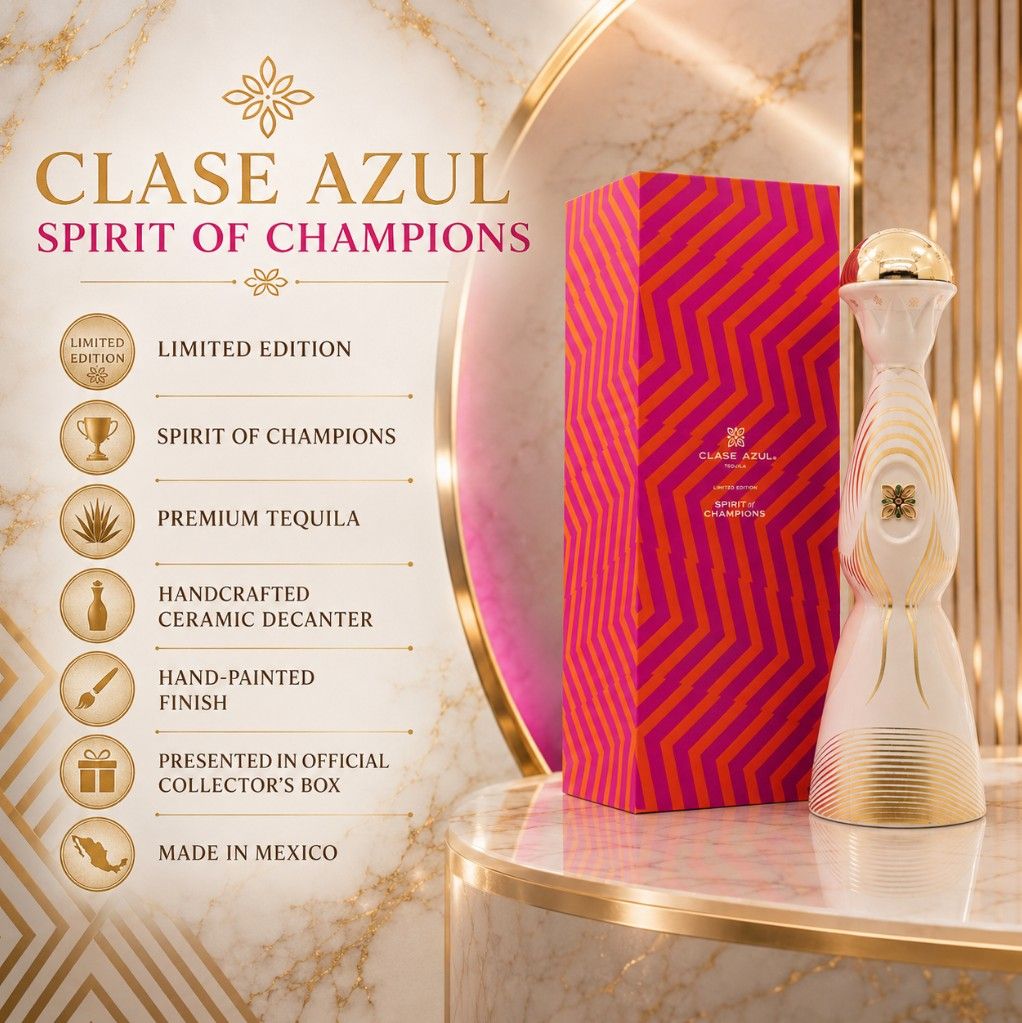
Clase Azul Spirit of Champions Limited Edition Tequila is a rare joven tequila created for a moment when international attention turns towards Mexico and millions of supporters come together through football.
Released in April 2026, Spirit of Champions celebrates the anticipation, pride and shared emotion surrounding one of the world’s greatest sporting occasions. The release coincides with the 2026 World Cup in Mexico, Canada and the United States, with Mexico becoming the first country to host matches at three editions of the tournament.
Clase Azul has not presented Spirit of Champions as an officially FIFA-branded bottle. Instead, it draws inspiration from the wider atmosphere surrounding the competition: national pride, human achievement, collective emotion and the way sport can bring people from different countries together.
The tequila is equally distinctive. Clase Azul’s Master Distiller Viridiana Tinoco created a joven expression combining tequila matured for 28 months in large French oak vats with a carefully judged amount of unaged tequila. The aged component supplies walnut, almond, toasted coconut and cinnamon, while the younger tequila preserves freshness and the natural character of cooked Blue Weber agave.
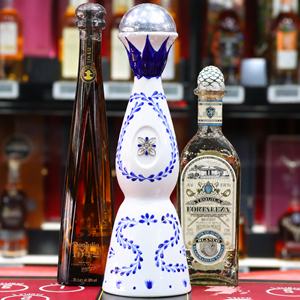
Only 10,000 one-litre decanters have been produced worldwide. Each is presented in a handcrafted ceramic vessel decorated with flowing gold lines and malachite details, turning the release into both an ultra-premium sipping tequila and an important piece of contemporary Mexican decorative art.
For collectors of Clase Azul, football memorabilia and limited-edition tequila, Clase Azul Spirit of Champions is one of the most significant new releases of 2026.
What Is Clase Azul Spirit of Champions?
Clase Azul Spirit of Champions is a limited-edition joven tequila released in 2026.
It was created as a tribute to the powerful collective emotion generated when nations gather in pursuit of a shared prize. Clase Azul describes the release as being inspired by a moment when the world’s gaze turns towards Mexico and the potential of human greatness comes into view.
Its principal details include:
- Producer: Clase Azul México
- Release: Spirit of Champions
- Style: Joven tequila
- Agave: Blue Weber agave
- Maturation: 28 months in French oak vats
- Oak origin: Tronçais forest, France
- Additional component: A carefully selected quantity of unaged tequila
- Strength: 40% ABV
- Bottle size: One litre
- Release date: April 2026
- Worldwide outturn: 10,000 decanters
- Presentation: Handcrafted ceramic decanter with gold and malachite details
- Master Distiller: Viridiana Tinoco
- Flavour profile: Cooked agave, coconut, vanilla, toasted wood, almonds, walnuts and cinnamon
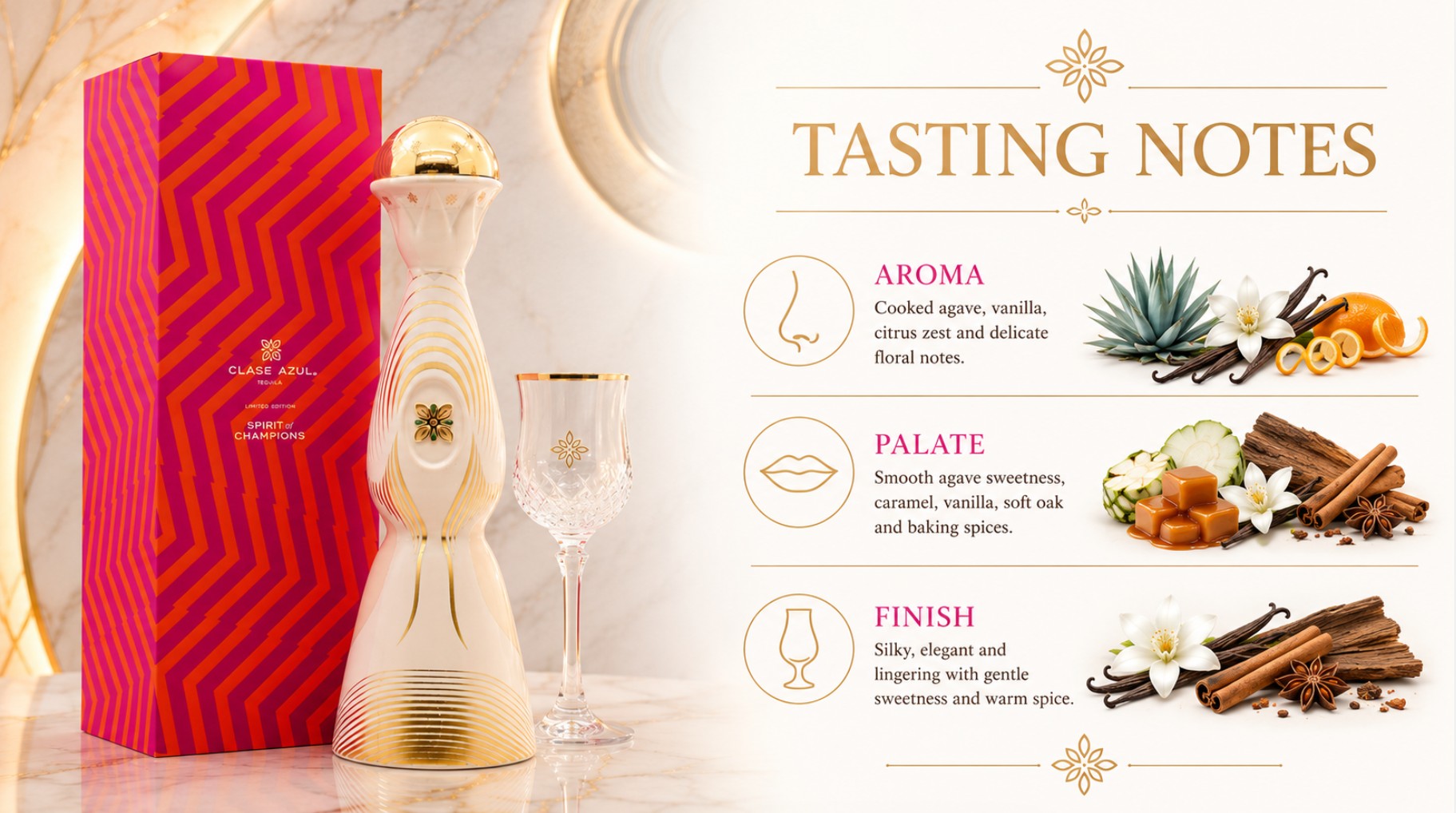
The tequila is deep gold with luminous highlights and has a full body. Its aroma combines cooked agave, coconut and toasted oak with vanilla, almond, white pepper, beeswax and toasted bread. The palate brings cooked agave, walnut, almond and toasted coconut before a long, sweet and gently spiced cinnamon finish.
Customers can shop Clase Azul Spirit of Champions Tequila, explore the complete Clase Azul collection, or discover more bottles within HTFW’s wider premium tequila range.
Is Clase Azul Spirit of Champions an Official World Cup Tequila?
Clase Azul Spirit of Champions is closely connected in theme and timing with the 2026 World Cup, but it should not be described as an official FIFA World Cup licensed tequila unless official tournament branding is shown on the specific product.
Clase Azul’s own language is more subtle.
The brand describes Spirit of Champions as inspired by a period when the world’s attention turns towards Mexico and people experience anticipation, pride and shared emotion. It celebrates unity, excellence and the human capacity to achieve something extraordinary.
This distinction matters because other tequila producers have released bottles carrying explicit FIFA World Cup 2026 branding and marks. Spirit of Champions instead uses the cultural atmosphere surrounding the competition as its creative foundation.
The HTFW product title includes “2026 World Cup” because that provides clear context for the event that inspired the edition. However, the bottle is best understood as:
- A football-inspired limited edition
- A celebration of Mexico in 2026
- A tribute to sporting excellence
- A release timed around the global tournament
- A collector’s tequila rather than an official match souvenir
This approach gives Clase Azul more creative freedom. The bottle is not covered in team colours, football graphics or tournament logos. Its design focuses on timeless themes of movement, unity, triumph and Mexican craftsmanship.
Why Is Mexico Important to the 2026 World Cup?
The 2026 World Cup is being hosted jointly by Mexico, Canada and the United States.
For Mexico, the tournament carries exceptional historical importance. The country previously hosted the competition in 1970 and 1986, making 2026 its third time as a host nation.
No other country had previously hosted men’s World Cup matches on three separate occasions.
Mexico’s role also gives the tournament a strong cultural connection with tequila. Tequila is legally tied to Mexico and remains one of the country’s best-known international products.
Clase Azul’s release brings together several forms of Mexican identity:
- Blue Weber agave
- Traditional tequila-making
- Ceramic craftsmanship
- Hand-painted decoration
- Contemporary luxury design
- Mexican hospitality
- National pride
- The shared emotion of international football
Spirit of Champions is therefore not simply a football-themed bottle. It is a Mexican luxury release designed for a year in which the country takes a central position on the international stage.
The Meaning Behind “Spirit of Champions”
The name Spirit of Champions works on several levels.
At its most direct, it refers to athletes competing for the highest honour in international football. However, Clase Azul extends the idea of championship beyond winning a match or lifting a trophy.
The edition celebrates:
- Dedication
- Discipline
- Collective ambition
- Human excellence
- National pride
- Shared emotion
- Cultural unity
- The pursuit of greatness
Clase Azul founder Arturo Lomelí has described the edition as a tribute to the unique atmosphere created when different nations pursue the same prize and, for 90 minutes, remind people of the power of feeling something collectively.
That idea suits Clase Azul’s wider philosophy. The producer regularly presents tequila as a means of bringing people together through hospitality, art and shared experiences.
The name also avoids restricting the bottle to one team or one eventual winner. It can be enjoyed by supporters from any participating nation and retains its meaning long after the 2026 competition has ended.
How Limited Is Clase Azul Spirit of Champions?
Production is limited to 10,000 one-litre decanters worldwide.
That is a relatively small global release for a luxury tequila associated with a major international moment. The bottles are being distributed across multiple countries, meaning availability within any individual market is considerably more restricted.
The release became available from 14 April 2026 through selected luxury retailers and Clase Azul destinations. Contemporary release coverage listed an initial UK price of approximately £2,100.
The limited outturn gives the bottle several points of collector interest:
- It is tied to a specific year.
- Production will not continue indefinitely.
- The edition has a clearly stated global quantity.
- It coincides with a historic event in Mexico.
- Every decanter is handcrafted.
- The release contains a specially developed joven tequila.
- The one-litre format differs from many standard UK spirits bottles.
- The ceramic vessel remains displayable after the tequila has been enjoyed.
Not every limited bottle becomes valuable, and future prices cannot be guaranteed. However, Spirit of Champions has stronger foundations than a standard bottle carrying temporary football-themed packaging.
The tequila, decanter and cultural timing were all developed specifically for the release.
What Is Joven Tequila?
Joven means young in Spanish.
Within tequila, the term usually describes an expression that combines unaged tequila with aged tequila or has been blended to create a profile sitting between blanco and mature oak-aged styles.
Spirit of Champions combines:
- Tequila matured for 28 months in French oak vats
- A carefully judged amount of unaged tequila
The mature component brings:
- Toasted wood
- Walnut
- Almond
- Coconut
- Cinnamon
- Vanilla
- Greater body
- Rounded texture
The unaged tequila brings:
- Fresh cooked agave
- Citrus-like brightness
- Herbal freshness
- White pepper
- Energy
- A cleaner finish
This structure allows Clase Azul to achieve substantial oak complexity without losing the natural flavour of the agave.
It also distinguishes Spirit of Champions from a conventional añejo or extra añejo. The tequila is not defined only by its time in wood. Its identity comes from the balance between maturity and freshness.
Is Joven Tequila Lower Quality?
No. Joven is a production category rather than a quality judgement.
Some inexpensive gold tequilas are also labelled joven and may combine young spirit with caramel colouring or other permitted adjustments. This has sometimes caused drinkers to assume that all joven tequila is a lower-cost style.
Premium joven tequila is very different.
A producer can combine high-quality aged and unaged tequila to create a carefully controlled flavour profile. This is similar in principle to blending whiskies of different ages or bringing together wines from different vineyards.
Spirit of Champions is an ultra-premium example. Its mature component spends 28 months in French oak vats before fresh tequila is added for balance.
The process was developed by Clase Azul Master Distiller Viridiana Tinoco and is intended to create a complete, layered tequila rather than simply alter its colour.
Who Is Viridiana Tinoco?
Viridiana Tinoco is the Master Distiller responsible for Clase Azul’s tequila production and liquid development.
Her work involves balancing the flavour of the agave, fermentation, distillation and maturation while creating expressions that remain recognisably Clase Azul.
For Spirit of Champions, she selected a process based on extended maturation in large French oak vats rather than conventional small barrels.
This required careful judgement. Twenty-eight months is long enough for the tequila to develop substantial oak, nut and spice, but the use of large vats moderates the speed and intensity of extraction.
Tinoco then added unaged tequila to preserve freshness and bring the cooked-agave character back into focus.
The final liquid reflects both sides of Clase Azul’s identity:
- Traditional Mexican agave spirit
- Innovative luxury blending and maturation
Her role is particularly important because the handcrafted decanter could easily overshadow the tequila inside. Spirit of Champions needed a liquid capable of matching the rarity and ambition of its presentation.
What Agave Is Used?
Clase Azul Spirit of Champions is made from Blue Weber agave.
Blue Weber, or Agave tequilana Weber var. azul, is the only agave variety permitted for tequila production.
The plants are grown in the highlands of Jalisco, an area known as Los Altos. The region’s elevation, climate and iron-rich red soil can support agave with a particularly sweet, fruit-forward character.
Blue Weber agave takes several years to mature.
During its growth, the plant stores carbohydrates in its central heart, known as the piña. Once harvested and cooked, these carbohydrates convert into fermentable sugars.
Cooked highland agave can produce flavours including:
- Honey
- Citrus
- Roasted fruit
- Sweet herbs
- Light florals
- Pepper
- Earth
- Caramelised vegetables
In Spirit of Champions, the cooked-agave character remains clearly visible despite the extended French oak maturation.
Where Is Clase Azul Made?
Clase Azul tequila is made in Jalisco, Mexico.
The company’s identity is closely tied to Los Altos de Jalisco, the elevated tequila-producing region known for its red soil and sweet Blue Weber agave.
The liquid and decanters are created through separate but connected processes.
The tequila is produced from Blue Weber agave through cooking, fermentation, distillation and maturation.
The ceramic decanters are made and decorated by Mexican artisans, turning each bottle into an individually handled object.
This combination of agriculture, distillation and decorative craft is central to Clase Azul’s position within luxury tequila.
The History of Clase Azul
Clase Azul was founded in 1997 by Arturo Lomelí.
The company began with the ambition of creating a tequila brand capable of representing Mexican culture at the highest level of international luxury.
Its first bottles looked very different from the sculptural ceramic decanters now associated with Clase Azul. Over time, the producer developed its combination of premium tequila and handcrafted presentation.
The iconic ceramic decanter became the defining symbol of the brand.
Clase Azul’s growth has been built around several principles:
- Mexican ownership and identity
- High-quality agave spirit
- Handcrafted ceramics
- Support for artisan communities
- Distinctive luxury presentation
- Hospitality and shared experience
- Limited editions inspired by Mexican culture
The producer now creates tequila and mezcal expressions ranging from the well-known Reposado to highly limited releases matured in unusual woods or created for cultural moments.
Customers can browse current and collectable releases within the Clase Azul tequila collection.
How Is Clase Azul Spirit of Champions Made?
The production begins with mature Blue Weber agave grown in the highlands of Jalisco.
Harvesting
Skilled jimadores remove the long outer leaves of the mature agave using a flat-bladed tool called a coa.
The trimmed heart is known as the piña because it resembles an oversized pineapple.
Cooking
The agave hearts are slowly cooked, converting their stored carbohydrates into fermentable sugars.
Cooking also develops the sweet roasted-agave profile that appears throughout the finished tequila.
Milling and Extraction
Once softened, the cooked agave is crushed or milled to extract the sweet juice required for fermentation.
Fermentation
Yeast converts the agave sugars into alcohol while producing flavour compounds associated with fruit, herbs, flowers and spice.
Distillation
The fermented liquid is distilled to concentrate the alcohol and refine the agave character.
The distiller selects the desired central portion of the distillation, avoiding the sharper early spirit and heavier late components.
French Oak Maturation
The tequila selected for ageing is transferred into large French oak vats made using fine-grained wood from the Forest of Tronçais.
It remains there for 28 months.
Blending
After maturation, Viridiana Tinoco blends in a carefully controlled amount of unaged tequila.
This restores freshness, white pepper and cooked agave while retaining the mature wood, nuts, coconut and cinnamon.
Bottling
The completed joven tequila is bottled at 40% ABV in one-litre handcrafted ceramic decanters.
Why Is Tronçais Oak Important?
The Forest of Tronçais in central France is one of the world’s most respected sources of fine-grained oak.
Its wood has long been used for ageing fine wine and spirits because it grows slowly and develops a tight grain.
Fine-grained oak generally allows a slower and more controlled interaction between the wood and liquid.
It can contribute:
- Refined tannin
- Vanilla
- Almond
- Walnut
- Toasted bread
- Gentle spice
- Coconut
- Cedar
- Subtle sweetness
The use of Tronçais oak suits Spirit of Champions because Clase Azul wanted mature complexity without overwhelming the agave.
The oak brings depth and polish rather than the forceful caramel and vanilla sometimes associated with heavily charred new American oak.
Why Use Large French Oak Vats?
Large vats create a different maturation environment from conventional barrels.
A smaller barrel exposes a greater proportion of the liquid to oak. This can accelerate extraction and create a more intense wood influence.
A large vat has a lower wood-to-liquid ratio.
This allows:
- Slower flavour extraction
- Greater integration
- Less aggressive tannin
- More controlled oxidation
- Preservation of agave character
- A smoother transition between spirit and wood
Spirit of Champions spends 28 months in these vats, a substantial maturation period for tequila.
The large format helps explain why the final liquid can display clear toasted wood, nuts and cinnamon while retaining cooked agave and freshness.
What Does Clase Azul Spirit of Champions Taste Like?
Spirit of Champions is full-bodied and mature, with cooked agave, toasted coconut, nuts and cinnamon supported by refined French oak.
Appearance
Deep gold with luminous highlights.
The colour reflects extended oak maturation while remaining bright and polished rather than extremely dark.
Nose
Cooked agave leads the aroma, joined by toasted coconut and refined wood.
Fresh vanilla and almond add sweetness, while white pepper provides lift. Beeswax and toasted bread create additional depth and texture.
The official profile identifies:
- Cooked agave
- Coconut
- Toasted wood
- Fresh vanilla
- Almond
- White pepper
- Beeswax
- Toasted bread
Palate
Full and rounded.
Cooked agave remains at the centre before walnut, almond and toasted coconut develop across the palate.
The oak supplies structure without hiding the spirit. The unaged tequila adds enough brightness to prevent the profile from becoming overly heavy.
Finish
Long, sweet and gently spiced.
Cinnamon remains on the palate alongside toasted nuts, coconut and agave.
The finish is warming rather than aggressive, with the 40% ABV supporting flavour without excessive alcohol heat.
Is Spirit of Champions Sweet?
It has a naturally sweet profile, but it is not a tequila liqueur.
Its sweetness comes from:
- Cooked agave
- Vanilla
- Toasted coconut
- French oak
- Almond
- Cinnamon
- Slow maturation
These flavours are balanced by white pepper, toasted wood, walnut and oak tannin.
The result is rich and rounded rather than syrupy.
Drinkers familiar with Clase Azul Reposado will recognise the producer’s preference for smoothness and sweetness, but Spirit of Champions adds a more restrained nutty and wood-led complexity.
Is It Smoky?
No. Spirit of Champions is not a smoky tequila.
It does contain toasted wood, toasted coconut and toasted bread, but these are oak and roasting notes rather than smoke from pit-cooked agave.
The tequila should not be confused with mezcal, where agave is frequently roasted underground and can develop pronounced smoke.
Its dominant flavours remain:
- Cooked agave
- Coconut
- Vanilla
- Nuts
- White pepper
- Cinnamon
- French oak
Is It an Añejo Tequila?
Spirit of Champions contains tequila matured for 28 months, which would ordinarily place that aged component within the añejo range.
However, the final expression also contains unaged tequila.
Because it combines mature and unaged components, it is presented as a joven tequila rather than a conventional añejo.
This is not a way of disguising the maturation. The 28-month French oak period is central to the product story.
The joven classification more accurately reflects the final blend.
Is It an Extra Añejo?
No.
Extra añejo tequila must be aged for at least three years in oak containers meeting the relevant size requirements.
The aged component of Spirit of Champions matures for 28 months, which is less than three years. The addition of unaged tequila would also prevent the final blend from being presented as an extra añejo.
Drinkers seeking a heavily matured Clase Azul can explore expressions such as Clase Azul Ultra Extra Añejo Tequila, while Spirit of Champions offers a fresher, blended approach.
How Should You Drink Clase Azul Spirit of Champions?
This tequila is best enjoyed slowly and with minimal alteration.
Its rarity and layered profile make neat serving the most appropriate starting point.
Neat
Pour a small measure into a tequila tasting glass, narrow wine glass or tulip-shaped spirits glass.
Allow the tequila to rest for several minutes.
Begin with gentle aromas rather than placing the nose deeply into the glass. Look for cooked agave, coconut, vanilla, almonds and toasted bread.
Take small sips and allow the tequila to coat the palate.
At Room Temperature
Room temperature allows the full aroma to develop.
Serving it too cold can suppress the toasted wood, beeswax and nutty notes.
With a Few Drops of Water
A small amount of water can reveal additional vanilla, agave and coconut.
At 40% ABV, extensive dilution is unnecessary. Add water only a few drops at a time.
Over One Large Ice Cube
Ice creates a cooler and softer serve.
The colder temperature may emphasise vanilla and coconut while reducing some of the white pepper and oak.
This is enjoyable, although neat service provides greater aromatic detail.
Should Spirit of Champions Be Used in Cocktails?
It can be used in cocktails, but its rarity, price and subtle oak profile make elaborate mixing difficult to justify.
Strong fruit juice, syrup or heavily flavoured liqueurs would cover much of the character developed during its 28 months in French oak.
The best cocktail-style serves are restrained.
Spirit of Champions Old Fashioned
- 50ml Clase Azul Spirit of Champions
- 2.5ml agave syrup
- One dash of aromatic bitters
- Orange peel
- One large ice cube
Stir gently with ice and strain over one large cube.
Only a very small amount of syrup is needed because the tequila already offers cooked-agave sweetness.
Spirit of Champions Highball
- 40ml Spirit of Champions
- Chilled soda water
- Large clear ice
- Grapefruit peel
This lengthens the tequila while preserving the coconut, almond and agave.
Championship Serve
A small neat measure served alongside chilled mineral water is the best option for a major match or celebration.
The water can be used between sips rather than added directly to the tequila.
What Food Goes with Spirit of Champions?
The tequila’s cooked agave, coconut, nuts and cinnamon work particularly well with refined dishes rather than heavily sauced match-day food.
Mexican Cuisine
Suitable pairings include:
- Mole poblano
- Slow-cooked pork
- Grilled lamb
- Duck with fruit sauce
- Roasted agave-glazed vegetables
- Mature Mexican cheese
- Corn-based dishes
- Toasted nuts
- Refined chocolate mole
Seafood
Try it with:
- Seared scallops
- Grilled prawns
- Lobster
- Tuna
- Octopus
- Butter-roasted white fish
The unaged component provides enough freshness to work with seafood, while the aged tequila supports richer preparation.
Cheese
Good options include:
- Manchego
- Comté
- Mature Gouda
- Parmesan
- Gruyère
- Aged Cheddar
- Smoked cheese
Nutty cheeses reflect the almond and walnut notes.
Desserts
Suitable desserts include:
- Almond tart
- Walnut cake
- Coconut pudding
- Cinnamon pastries
- Crème brûlée
- Vanilla flan
- Dark chocolate
- Caramelised pineapple
- Churros with restrained sugar
- Mexican chocolate
Desserts should not be overwhelmingly sweet, as excessive sugar can make the tequila appear drier and more oak-led.
Clase Azul Spirit of Champions and Chocolate
Chocolate is one of the strongest pairings for this tequila.
Dark or milk chocolate containing nuts complements the almond, walnut and toasted coconut.
Try:
- Dark chocolate with almonds
- Milk chocolate with hazelnuts
- Mexican chocolate with cinnamon
- Chocolate with coconut
- Sea-salted chocolate
- White chocolate with toasted nuts
Allow a small piece to soften on the palate before taking a sip.
The cocoa can bring forward more cinnamon and toasted oak, while the tequila makes the chocolate appear creamier.
The Spirit of Champions Decanter
The decanter is central to the release.
Clase Azul’s ceramic bottles are designed to remain decorative objects after the spirit has been consumed. Spirit of Champions develops that idea with a design connected to movement, unity and shared ambition.
The vessel features:
- An ivory-toned ceramic body
- Flowing gold lines
- A central Clase Azul emblem
- Malachite details
- Sculptural proportions
- Hand-applied decoration
- A distinctive ornamental closure
The gold lines move around the surface rather than sitting as a static pattern. They suggest energy, people converging and the movement of players across a pitch.
Malachite introduces a deeper green accent and reinforces the association with victory, prestige and Mexico.
The result resembles a ceremonial trophy without copying the shape or branding of the World Cup itself.
Are Clase Azul Bottles Handmade?
Clase Azul decanters are handcrafted and hand-decorated by Mexican artisans.
This means small variations may occur between examples.
Those differences should not automatically be regarded as defects. They are part of the character of a handmade ceramic object.
The production involves several stages:
- Forming the ceramic body
- Drying
- Firing
- Surface preparation
- Decoration
- Painting or applying finishes
- Further firing where required
- Final assembly
- Inspection
The process gives each decanter a human element that cannot be reproduced perfectly by fully automated production.
For a limited edition of 10,000 one-litre bottles, creating and decorating every vessel represents a substantial undertaking.
Why Is Malachite Used?
Malachite is a green mineral recognised for its swirling bands and ornamental appearance.
It has been used in jewellery, sculpture and decorative objects for centuries.
Within Spirit of Champions, malachite introduces:
- Natural variation
- A strong green accent
- A sense of prestige
- A connection with triumph and ceremony
- Greater visual depth
The green also carries an indirect association with Mexico without turning the bottle into a literal national-flag design.
Malachite details help elevate the decanter beyond ordinary ceramic packaging and contribute to its position as a luxury decorative object.
Is Spirit of Champions Collectable?
Yes. It has clear collector potential, although future value is never guaranteed.
Its collector appeal comes from the combination of:
- A stated global outturn of 10,000
- A one-year cultural moment
- The 2026 international football tournament
- Mexico’s historic third hosting role
- A bespoke joven tequila
- Twenty-eight months in Tronçais oak vats
- A one-litre format
- Handcrafted ceramics
- Gold and malachite decoration
- Clase Azul’s established collector following
- A defined April 2026 release
Collectors should distinguish between scarcity and guaranteed investment performance.
Ten thousand bottles is limited for a global luxury brand, but it is not a one-off single cask with only a few hundred examples.
Its long-term desirability will depend on:
- The continued reputation of Clase Azul
- The cultural significance of the 2026 tournament
- Surviving bottle numbers
- Decanter and closure condition
- Original packaging
- Fill level
- Proof of purchase
- Market demand
The strongest examples will be complete, unopened and carefully stored.
What Should Collectors Check?
Important condition points include:
Ceramic Body
Check for cracks, chips, crazing or restoration.
Painted and Gold Details
Look for scratches, fading, abrasion or missing decoration.
Malachite Elements
Confirm that ornamental details are intact and securely attached.
Closure
The closure should remain undamaged and properly seated.
Seal
An intact original seal supports condition and authenticity.
Fill Level
The tequila should show no evidence of significant leakage or evaporation.
Packaging
Retain any original box, outer carton, protective material and documentation.
Provenance
Keep purchase receipts, photographs and delivery records.
The ceramic is heavier and more fragile than a conventional glass bottle, making careful storage particularly important.
How Should the Decanter Be Stored?
Keep the bottle upright on a strong, level surface.
Avoid:
- Direct sunlight
- Radiators
- Large temperature changes
- Damp storage
- High shelves
- Unstable display cabinets
- Areas where the bottle may be knocked
- Prolonged pressure on decorative elements
The one-litre ceramic decanter is heavier than a normal 70cl glass bottle.
It should be lifted using the body rather than carried only by the ornamental closure.
Collectors should preserve the original packaging separately but nearby, ensuring it remains dry and protected from crushing.
Clase Azul Spirit of Champions vs Clase Azul Reposado
Clase Azul Reposado Tequila is the brand’s best-known expression and the most useful starting point for comparison.
Clase Azul Reposado
- Matured for several months
- American whiskey cask influence
- Vanilla
- Caramel
- Cooked agave
- Hazelnut
- Cinnamon
- Regular core-range release
- Familiar blue-and-white decanter
Spirit of Champions
- Joven tequila
- Aged component matured for 28 months
- Large Tronçais oak vats
- Fresh tequila added for balance
- Toasted coconut
- Walnut
- Almond
- Beeswax
- Toasted bread
- Malachite and gold limited decanter
- Only 10,000 produced
Reposado is sweeter, more familiar and more accessible.
Spirit of Champions is nuttier, more mature and more structured, with significantly stronger collector positioning.
Spirit of Champions vs Clase Azul Gold
Clase Azul Gold is itself a joven-style expression combining different tequilas and cask influences.
It is known for a layered profile and a distinctive gold-toned decanter.
Clase Azul Gold
- Blend of different tequila styles
- Fruit, vanilla and oak
- Rich modern profile
- Continuing luxury expression
- Gold decorative presentation
Spirit of Champions
- Matured tequila plus unaged tequila
- Twenty-eight months in French oak vats
- Greater almond and walnut
- More toasted coconut
- Stronger cinnamon finish
- Event-inspired limited edition
- Defined 10,000-decanter outturn
Clase Azul Gold is the more accessible way to explore the producer’s approach to blended tequila.
Spirit of Champions provides a much rarer and more focused expression built around Tronçais oak and the 2026 cultural moment.
Spirit of Champions vs Clase Azul Añejo
Clase Azul Añejo is a traditionally aged tequila with a mature oak-led profile.
Clase Azul Añejo
- Añejo classification
- Extended barrel maturation
- Vanilla
- Toffee
- Spice
- Dried fruit
- Greater conventional aged-tequila identity
Spirit of Champions
- Joven classification
- Matured in large French vats
- Fresh tequila blended in
- Cooked agave remains brighter
- Almond and walnut
- Toasted coconut
- White pepper
- Limited collector edition
Añejo is more conventional in its maturation structure.
Spirit of Champions is more experimental, balancing aged richness with younger tequila freshness.
Spirit of Champions vs Clase Azul Ultra
Clase Azul Ultra Extra Añejo occupies one of the highest positions in the regular Clase Azul portfolio.
Clase Azul Ultra
- Extra añejo tequila
- At least three years of maturation
- Deep oak influence
- Sherry-cask character
- Dark fruit
- Chocolate
- Rich luxury sipping profile
- Black decanter with precious-metal decoration
Spirit of Champions
- Joven tequila
- Twenty-eight-month aged component
- Fresh unaged tequila
- More cooked agave
- Coconut and nuts
- Lighter, fresher structure
- Football-inspired 2026 edition
- One of 10,000 decanters
Ultra is more mature, darker and more concentrated.
Spirit of Champions is fresher and carries stronger event-specific collector significance.
Spirit of Champions vs Don Julio 1942 World Cup 2026 Edition
Don Julio released an officially branded FIFA World Cup 2026 edition of Don Julio 1942.
The two products approach the tournament very differently.
Don Julio 1942 FIFA World Cup Edition
- Official FIFA World Cup 2026 branding
- Existing Don Julio 1942 añejo liquid
- Gold bottle inspired by the trophy
- Malachite-coloured closure
- Wider celebration-led appeal
- Available in standard and miniature formats
Clase Azul Spirit of Champions
- Inspired by the global moment rather than officially branded
- Newly developed joven tequila
- Twenty-eight months in Tronçais oak
- Unaged tequila added for balance
- Handcrafted ceramic decanter
- Malachite details
- Limited to 10,000 one-litre bottles
- More exclusive collector positioning
Don Julio 1942 offers a recognisable established tequila in special tournament packaging.
Spirit of Champions provides a new liquid and a much more limited art-led presentation.
Is Spirit of Champions a Good Gift?
It is an exceptional luxury gift for a recipient who combines an interest in tequila, football, Mexican culture or collectable design.
Suitable occasions include:
- A milestone birthday in 2026
- A major retirement
- A corporate achievement
- A football hospitality gift
- A World Cup celebration
- A collector’s acquisition
- A significant promotion
- A championship victory
- A luxury housewarming gift
- An important business presentation
It is particularly meaningful for:
- Clase Azul collectors
- Supporters travelling to the 2026 tournament
- Mexican football fans
- Tequila enthusiasts
- Collectors of sporting spirits
- Luxury decanter collectors
- Hospitality venues
- Football clubs and executives
The price and rarity make it more appropriate for a major occasion than an ordinary match-day present.
Can the Empty Decanter Be Displayed?
Yes. Clase Azul decanters are specifically designed to remain decorative after the tequila has been consumed.
The Spirit of Champions vessel can be displayed as:
- A sculptural ceramic object
- Part of a Clase Azul collection
- A football memorabilia piece
- A feature within a home bar
- A decorative office object
- A reminder of the 2026 tournament
- A representation of Mexican craftsmanship
It should not be modified into a lamp, vase or other object if preserving collector value is important.
Keep the original closure and packaging even after opening the bottle.
Is It Suitable for Opening?
Spirit of Champions has been created as a drinking tequila as well as a collectable object.
Opening the bottle will reduce its value to collectors who prioritise sealed examples, but it allows the owner to experience the specially developed liquid rather than preserving the decanter indefinitely.
The choice depends on the reason for purchase.
Open it when:
- The bottle marks a major personal occasion.
- It will be shared during the tournament.
- The owner values the liquid more than resale.
- The empty ceramic decanter will remain on display.
Keep it sealed when:
- It forms part of an investment-grade collection.
- Completeness and provenance are priorities.
- It is intended for future sale.
- It is being preserved as sporting memorabilia.
There is no universally correct decision. The tequila was made to be enjoyed, while the limited decanter was made to be preserved.
Frequently Asked Questions
What is Clase Azul Spirit of Champions?
It is a limited-edition joven tequila released in 2026 and inspired by the shared pride and emotion created when the world’s attention turns towards Mexico.
Is it an official FIFA World Cup tequila?
Clase Azul does not present it as an officially FIFA-branded release. It is inspired by the wider global football moment surrounding Mexico in 2026.
Why is it called the 2026 World Cup edition?
The release coincides with the 2026 tournament hosted by Mexico, Canada and the United States and celebrates Mexico’s place at the centre of the international occasion.
When was it released?
Spirit of Champions launched on 14 April 2026.
How many bottles were produced?
The release is limited to 10,000 one-litre decanters worldwide.
What is the bottle size?
Each decanter contains one litre of tequila.
What is the alcohol strength?
Spirit of Champions is bottled at 40% ABV.
Is it blanco, reposado or añejo?
It is a joven tequila combining mature and unaged components.
How long is the aged tequila matured?
The aged component spends 28 months in large French oak vats.
What type of oak is used?
The vats are made from fine-grained French oak sourced from the Forest of Tronçais.
Why is unaged tequila added?
It restores freshness, white pepper and cooked-agave character while balancing the mature oak and nut flavours.
Who created the tequila?
The liquid was created under the direction of Clase Azul Master Distiller Viridiana Tinoco.
What does it taste like?
Expect cooked agave, coconut, toasted wood, vanilla, almond, walnut, white pepper, beeswax, toasted bread and cinnamon.
Is it sweet?
It has natural cooked-agave, vanilla and coconut sweetness balanced by nuts, pepper and toasted oak.
Is it smoky?
No. Toasted wood and coconut are present, but it is not a smoky tequila.
Is the bottle handmade?
The ceramic decanter is handcrafted and individually decorated by Mexican artisans.
Does it contain malachite?
The decanter incorporates decorative malachite elements alongside flowing gold details.
Is every bottle individually numbered?
The release is limited to 10,000 decanters, although a specific individual bottle number should only be stated when visible on the bottle or accompanying documentation.
Is it collectable?
Yes. Its limited outturn, 2026 cultural connection, bespoke liquid and handcrafted presentation give it strong collector appeal.
Is it guaranteed to increase in value?
No. Limited spirits can rise or fall in value depending on condition, demand, rarity and wider market conditions.
Should it be drunk neat?
Yes. Neat at room temperature is the best way to explore its cooked agave, nuts, coconut and French oak.
Can it be served with ice?
Yes. One large cube softens the pepper and brings forward vanilla and coconut.
Can it be used in cocktails?
It can, but simple serves are recommended so the rare tequila is not hidden beneath other ingredients.
What food pairs with it?
Try mature cheese, lobster, grilled seafood, mole, roast pork, almond desserts, coconut pudding and Mexican chocolate.
How should it be stored?
Keep it upright in a cool, dark and stable environment on a secure surface capable of supporting the heavy ceramic decanter.
Can the empty bottle be displayed?
Yes. The decanter is designed to remain a decorative object after the tequila has been consumed.
Why Clase Azul Spirit of Champions Stands Out
Spirit of Champions succeeds because the event connection goes deeper than temporary packaging.
The 2026 tournament provides the context, but the release is fundamentally about Mexico.
The agave comes from Jalisco. The tequila is created by a Mexican Master Distiller. The decanter is handmade by Mexican artisans. The design reflects movement, unity and achievement without relying on official tournament logos or the colours of one team.
The liquid also justifies the presentation.
Twenty-eight months in large Tronçais oak vats develops mature notes of walnut, almond, toasted coconut and cinnamon. The addition of unaged tequila prevents those flavours from overwhelming the cooked agave.
This balance of old and young, oak and freshness, individuality and collective expression closely matches the themes behind the bottle.
A football team depends on experienced players and new energy. A successful competition brings together individual nations within one shared event. Spirit of Champions follows the same structure by combining mature and fresh tequila into one complete expression.
The bottle’s 10,000-decanter outturn makes it genuinely limited without turning it into an inaccessible single-cask curiosity. Its one-litre format and handcrafted design give it considerable display presence, while the use of malachite and flowing gold decoration helps it resemble a ceremonial object.
For drinkers, it offers one of Clase Azul’s most distinctive joven tequilas.
For collectors, it captures a precise moment in 2026.
For football supporters, it celebrates the pride, anticipation and emotion created when the world comes together in pursuit of one prize.
Buy Clase Azul Spirit of Champions Tequila
Clase Azul Spirit of Champions Limited Edition Tequila is a rare 2026 release inspired by the global sporting moment that places Mexico at the centre of international attention.
Master Distiller Viridiana Tinoco created the joven tequila using spirit matured for 28 months in large French oak vats made with fine-grained wood from the Forest of Tronçais. A carefully judged amount of unaged tequila was then added to preserve freshness and balance.
The result combines cooked agave, toasted coconut and refined wood with fresh vanilla, almond, walnut, white pepper, beeswax, toasted bread and a long cinnamon finish.
Only 10,000 one-litre decanters have been produced worldwide. Each is presented in a handcrafted ceramic vessel decorated with flowing gold lines and malachite details.
Enjoy it neat at room temperature to experience its full agave and French oak character, or preserve the sealed bottle as an important limited edition from a historic year for Mexico and international football.
Shop Clase Azul Spirit of Champions Tequila, explore the complete Clase Azul tequila collection, or browse more exceptional bottles within HTFW’s wider premium tequila range.