

















Port-cask finishing can easily overwhelm a delicate single malt. Too much time in active fortified-wine wood may leave the whisky dominated by jam, tannin and heavy sweetness, with little of the original distillery character remaining.
Arran Port Cask Finish Single Malt Scotch Whisky takes a more measured approach.
The whisky initially matures in traditional oak casks for approximately eight years before being transferred into carefully selected Port casks sourced from an artisan Portuguese producer. The secondary maturation is monitored closely so that the fortified-wine influence enriches Arran’s naturally fresh and fruity spirit rather than covering it.
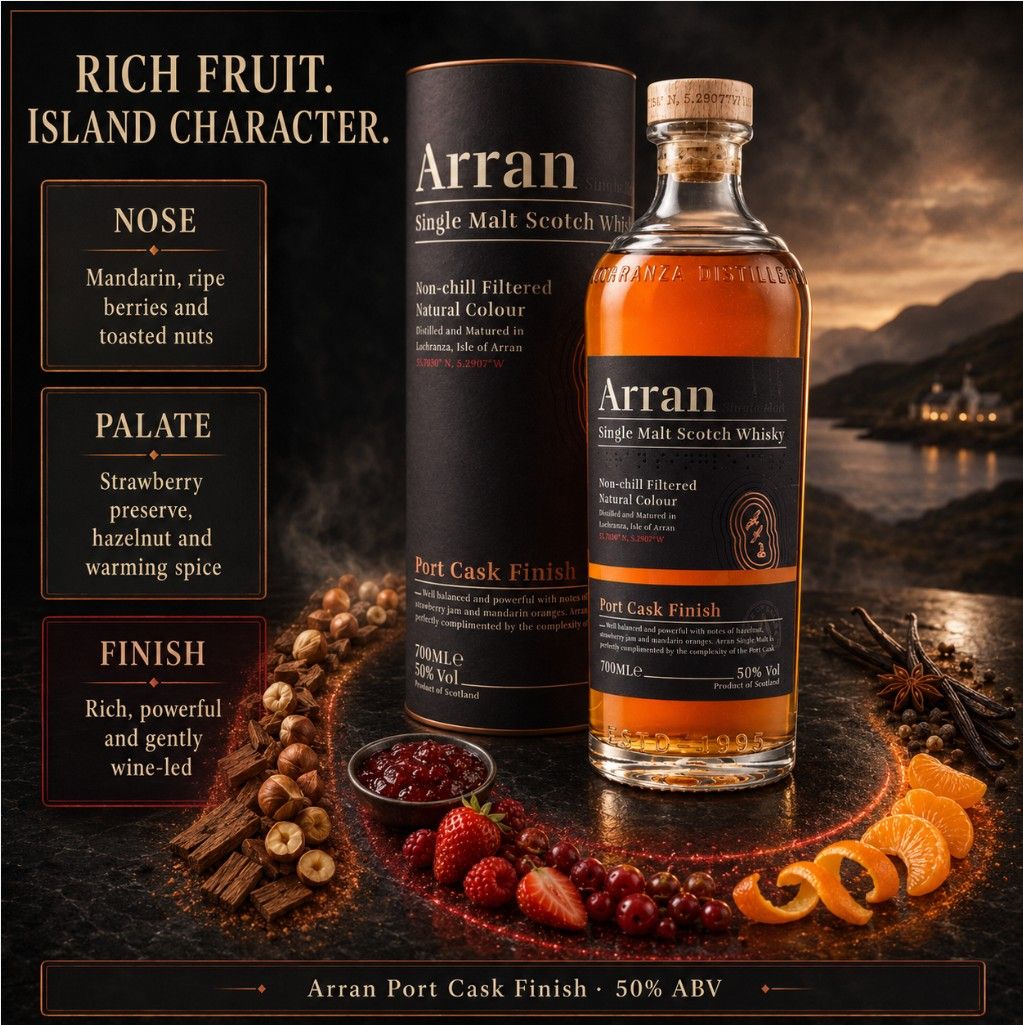
Bottled at a substantial 50% ABV, the result combines cinnamon, baked apple, strawberry jam and dried fruit with vanilla spice, ripe citrus, nuts, fudge and honey. Bitter orange, chocolate and cherries shape the finish, giving the whisky enough richness for an after-dinner dram without losing the energetic fruit associated with Lochranza Distillery.
It is an excellent demonstration of why Arran has become particularly well known for wine-cask finishing. The Port casks add colour, body and red-fruit depth, while the distillery’s citrus, orchard fruit and sweet malt remain clearly recognisable underneath.
Arran Port Cask Finish at a Glance
- Distillery: Lochranza Distillery
- Brand: Arran
- Whisky type: Island Single Malt Scotch Whisky
- Bottle size: 70cl
- Strength: 50% ABV
- Initial maturation: Traditional oak casks
- Initial maturation period: Approximately eight years
- Secondary maturation: Portuguese Port casks
- Age statement: None displayed
- Colour: Natural
- Filtration: Non-chill filtered
- Packaging: Cardboard presentation tube
- Region: Islands
- Country: Scotland
- Key flavours: Cinnamon, baked apple, vanilla, citrus, dried fruit, nuts, strawberry jam, mandarin, fudge, honey, bitter orange, chocolate and cherries
Although the whisky matures for approximately eight years before the Port finish, it is sold without a numerical age statement. The maturation period remains a useful production detail, but it should not be described as an official eight-year-old bottling unless that age appears on the label.
What Is Arran Port Cask Finish?
Arran Port Cask Finish is a single malt produced at Lochranza Distillery on the Isle of Arran.
The spirit begins its maturation in traditional oak casks, developing the fresh citrus, apple, vanilla and malt character associated with Arran. After approximately eight years, the whisky is transferred into casks that previously held Port wine.
This second maturation period adds:
- Red berries
- Strawberry jam
- Dried fruit
- Baked apple
- Chocolate
- Cherries
- Nutty depth
- Additional spice
- A richer texture
- Greater colour
The Port influence does not completely redefine the whisky. Arran’s Distillery Manager monitors the casks so that the wine-derived fruit and oak remain balanced with the underlying spirit. The official product description emphasises that the finish should complement rather than overwhelm the distillery character.
That balance is central to the bottle’s appeal.
A heavily wine-driven finish can sometimes feel closer to sweet fortified wine than single malt. Arran Port Cask Finish remains unmistakably whisky, with fresh citrus, vanilla, malt and spice supporting the richer red-fruit flavours.
Why Arran Spirit Works So Well with Port Casks
Arran’s spirit is naturally bright and fruit-forward.
The core profile commonly includes:
- Lemon zest
- Orange peel
- Green apple
- Pear
- Honey
- Vanilla
- Sweet malt
- Light cinnamon
- Clean oak
These flavours create an effective foundation for Port maturation.
The citrus prevents the wine influence from becoming excessively heavy. Apple and pear connect naturally with red berries and cherries, while vanilla and honey soften the drier tannin that may come from the cask.
Arran also distils slowly, encouraging the development and retention of fruity esters. Lochranza describes its distillation as running at around six to seven litres per minute, with the shape and operation of the stills designed to enhance the fruit created during fermentation.
Port therefore adds depth to an already fruity spirit rather than attempting to create fruit character from nothing.
The finished whisky moves from bright orchard and citrus notes into richer jam, dried fruit and chocolate, producing a progression that feels natural rather than forced.
What Is Whisky Cask Finishing?
Cask finishing is a secondary stage of maturation.
The whisky spends most of its life in one type of cask before being transferred into another barrel that previously held a different wine, beer or spirit.
The first cask establishes the principal structure of the whisky. The finishing cask then adds another layer of aroma, flavour, texture and colour.
For Arran Port Cask Finish, the process can be understood in two broad stages:
Primary Maturation
The whisky spends approximately eight years in traditional oak casks.
This develops the main Arran character:
- Citrus
- Orchard fruit
- Vanilla
- Sweet malt
- Light oak
- Gentle spice
Port Cask Finish
The mature whisky is transferred into Portuguese Port casks.
These add:
- Red fruit
- Dried fruit
- Berries
- Chocolate
- Nuts
- Richer sweetness
- Wine-derived tannin
- A fuller texture
A finishing cask must be emptied before Scotch whisky enters it. The change in the whisky comes from its interaction with the cask wood and compounds retained within that wood, rather than Port wine being mixed directly into the spirit.
Why the Length of the Finish Matters
There is no universal ideal period for a Port finish.
The right duration depends on:
- The age and condition of the whisky
- The activity of the Port casks
- Whether the wood is first-fill or refill
- Cask size
- Warehouse conditions
- The desired flavour profile
- The strength of the underlying distillery character
A particularly active Port cask may influence whisky quickly. Leaving the spirit in the wood for too long could introduce excessive tannin, jam-like sweetness or wine character.
A less active cask may need additional time to provide meaningful depth.
Arran therefore monitors the secondary maturation rather than relying on one rigid finishing period. The objective is to capture enough red fruit, sweetness and oak to transform the whisky while preserving the freshness of the original spirit.
This approach explains why the bottle still offers ripe citrus and vanilla beside its cherries, dried fruit and chocolate.
What Is Port Wine?
Port is a protected fortified wine produced in Portugal’s Douro region.
Fermentation is interrupted through the addition of grape spirit, retaining natural grape sweetness while raising the alcoholic strength. Port is produced in a wide range of styles, colours and sweetness levels, usually at approximately 19–22% ABV.
The broad Port family includes:
- Ruby
- Reserve Ruby
- Late Bottled Vintage
- Vintage
- Tawny
- Age-indicated Tawny
- Colheita
- White Port
- Rosé Port
Each style develops differently.
Ruby-style Ports generally preserve fresher red and dark fruit. Tawny styles undergo greater oxidative development in wood, creating more nuts, caramel, dried fruit and orange peel.
Arran identifies the maturation simply as selected Port casks from Portugal. The exact Port category is not specified in the product information, so the whisky should not automatically be described as Ruby-, Tawny- or Vintage-Port finished.
The flavour profile nevertheless shows characteristics commonly associated with both fresh fruit and mature fortified-wine wood:
- Strawberry jam
- Cherries
- Dried fruit
- Nuts
- Bitter orange
- Chocolate
What Do Port Casks Add to Whisky?
Port casks commonly bring a combination of fruit, sweetness, texture and spice.
Potential flavours include:
Red Berries
Raspberry, strawberry, redcurrant and blackberry can add brightness and a jam-like quality.
Stone Fruit
Plum and cherry create a deeper and rounder fruit profile than the citrus and apple found in many bourbon-matured malts.
Dried Fruit
Raisins, sultanas, dates and figs add concentration and connect the fruit with chocolate and spice.
Chocolate
Cocoa and dark chocolate often appear where Port-seasoned oak meets malt whisky, particularly during a longer or more active finish.
Nuts
Walnuts, hazelnuts and almonds provide dryness and stop the sweetness from becoming excessive.
Orange
Candied orange, mandarin and bitter orange bring freshness and structure.
Tannin
Wine-soaked oak can create a lightly drying sensation, giving the finish greater length and definition.
Arran’s own guide to cask finishing associates Port casks with berries, candied orange, honeyed sweetness, a velvety texture and oak spice.
Does the Port Finish Make Arran Port Cask Sweet?
The whisky is rich and fruit-led, but it is not simply sweet.
The sweeter flavours include:
- Baked apple
- Strawberry jam
- Vanilla
- Dried fruit
- Fudge
- Honey
- Cherries
- Ripe citrus
These are balanced by:
- Cinnamon
- Bitter orange
- Nuts
- Oak spice
- Chocolate
- Wine-derived tannin
- A robust 50% ABV strength
The palate begins with fruit and vanilla before becoming nuttier and more citrus-led.
The finish introduces bitter orange, chocolate and spice, preventing the whisky from ending like a dessert liqueur.
This balance also makes the bottle particularly effective with cheese. Salt, fat and savoury flavours provide a direct contrast with the whisky’s red fruit and honey, while the nuts and bitter orange connect with mature hard cheeses.
Arran recommends the Port Cask Finish as an after-dinner whisky and a natural partner for a cheeseboard.
Why Arran Bottles It at 50% ABV
A 50% bottling strength gives the Port Cask Finish considerably more presence than a whisky bottled at 40% or 43%.
The higher strength provides:
- A fuller texture
- More concentrated fruit
- Greater oak definition
- A longer finish
- Enough structure for water
- Better balance against active Port casks
The Port influence adds substantial sweetness, fruit and body. A lower ABV could make those flavours feel soft or indistinct.
At 50%, the whisky retains energy.
Cinnamon and citrus remain clear, the nuts provide structure and the bitter-orange finish stays lively.
The strength also allows the owner to explore the whisky through dilution. A few drops of water can reveal mandarin, fudge and honey while softening the alcohol and tannin.
Is Arran Port Cask Finish Cask Strength?
It is bottled at a high 50% ABV, but Arran does not describe the standard Port Cask Finish as a single-cask or naturally variable cask-strength release.
The whisky is assembled from a selection of casks and presented at a consistent strength.
This distinguishes it from a cask-strength bottling, where the alcohol level may vary according to the natural strength of the selected barrel or batch.
The fixed 50% presentation gives different releases a recognisable structure while still preserving substantial body and flavour.
Natural Colour and Non-Chill Filtration
Arran Port Cask Finish is bottled at natural colour.
Lochranza does not add caramel colouring to create artificial consistency between batches. The colour visible in the glass comes from the traditional oak maturation and the Port casks.
The whisky is also bottled without chill filtration.
Chill filtration removes naturally occurring compounds that can make whisky appear cloudy when cooled or diluted. Arran believes the process can also remove some of the texture and aromatic character of the spirit, so its malts bottled above 43% ABV are released without chill filtration.
As a result, the whisky may become slightly cloudy when water or ice is added.
That appearance is harmless and reflects the decision to preserve more of the natural oils and flavour compounds.
Arran Port Cask Finish Tasting Notes
The following tasting profile develops the official notes for the exact bottle while retaining the main character identified by Arran and HTFW.
Colour
Rich rose-gold to copper amber, with warm red-bronze highlights.
The Port finish provides greater depth than a purely bourbon-matured Arran, although the whisky remains brighter than a heavily sherried single malt.
Nose
Cinnamon and baked apple appear first.
The apple has a soft, oven-warmed quality, accompanied by vanilla, red berries and gentle oak spice.
As the whisky rests, additional aromas emerge:
- Strawberry jam
- Mandarin peel
- Dried cherries
- Honey
- Toasted nuts
- Vanilla fudge
- Light chocolate
The Port influence is immediately noticeable but not overpowering.
Fresh citrus and orchard fruit remain visible, preserving the clean and lively Lochranza character.
The 50% strength carries the aromas strongly. Allowing the whisky several minutes in the glass reduces the initial alcohol and gives the red fruit greater clarity.
Palate
The palate is full-bodied, warming and fruit-rich.
Vanilla spice forms the foundation, followed by ripe citrus, dried fruit and nuts.
Baked apple returns from the nose, now joined by strawberry jam and a darker cherry note. Cinnamon creates warmth without becoming aggressively hot.
The fruit gradually develops from fresh to concentrated:
- Mandarin and orange
- Apple and stone fruit
- Strawberry jam
- Dried cherry and raisin
- Bitter orange and chocolate
The texture is substantial at 50% ABV, with the Port casks adding a velvety quality while the nuts and citrus maintain balance.
A splash of water reveals additional mandarin, fudge and honey.
Finish
The finish is long, warming and increasingly bittersweet.
Spice and bitter orange appear first, followed by dark chocolate and cherries.
Nutty oak and a lightly drying wine tannin remain after the sweeter fruit fades.
The final impression combines:
- Orange peel
- Cocoa
- Red cherry
- Cinnamon
- Sweet oak
- A trace of honey
The chocolate and bitter orange stop the finish from becoming overly sugary, while the cherry preserves the Port-cask identity.
What Does Arran Port Cask Finish Taste Like with Water?
Water changes the balance from darker Port fruit towards brighter Arran spirit.
A few drops can reveal:
- Mandarin
- Orange oil
- Honey
- Vanilla fudge
- Softer apple
- Additional malt sweetness
- Reduced tannin
- A creamier texture
The strawberry and cherry remain, but they feel less jam-like.
Water can also separate the chocolate from the oak spice, making the finish feel more layered.
Begin with only a few drops.
The whisky is robust enough to accept dilution, but too much water may reduce the oily texture and mute the red-fruit concentration.
How to Drink Arran Port Cask Finish
The whisky is versatile enough to be enjoyed in several ways.
Neat
Pour a small measure into a tulip-shaped whisky glass.
Allow it to rest for five to ten minutes before tasting. This gives the alcohol time to settle and allows the baked apple, vanilla and strawberry aromas to develop.
Take a small first sip before returning to the nose.
The second taste should reveal more nuts, citrus and chocolate.
With Water
Add two or three drops initially.
Water highlights the mandarin, honey and fudge while softening the oak and alcohol.
Continue gradually until the preferred balance is reached.
Over Ice
One large cube provides controlled cooling and dilution.
As the whisky chills:
- Vanilla becomes creamier
- Strawberry becomes softer
- Cinnamon recedes
- Chocolate becomes more noticeable
- Bitter orange feels less intense
Smaller cubes melt quickly and may dilute the whisky before its flavour development can be appreciated.
As an After-Dinner Dram
Arran positions the Port Cask Finish as a particularly suitable after-dinner whisky.
Its combination of fruit, chocolate, nuts and oak works naturally after a rich meal, especially alongside cheese or a restrained dessert.
Food Pairings for Arran Port Cask Finish
The whisky pairs particularly well with cheese, chocolate, fruit and roasted meat.
Recommended pairings include:
- Mature cheddar
- Stilton
- Blue cheese
- Comté
- Manchego
- Toasted walnuts
- Dark chocolate
- Chocolate and orange desserts
- Cherry tart
- Apple crumble
- Christmas cake
- Fruit cake
- Roast duck
- Glazed ham
- Venison
- Charcuterie
Mature Cheese
Salt and savoury richness balance the Port-cask sweetness.
Hard cheese also reflects the whisky’s nutty oak character.
Blue Cheese
The combination of salt, cream and strong flavour can withstand the 50% ABV strength.
Honey and strawberry become brighter against the cheese.
Dark Chocolate
Chocolate mirrors the finish while its bitterness balances the vanilla, fudge and fruit.
Chocolate containing orange or cherries creates an especially direct pairing.
Apple Desserts
Apple crumble or baked apple reflects the nose, while cinnamon connects with the whisky’s spice.
Avoid an excessively sweet sauce, which could obscure the bitter-orange finish.
Roast Duck
Duck with cherry or berry sauce mirrors the red-fruit character while the savoury meat provides contrast.
Cocktails with Arran Port Cask Finish
The whisky is primarily suited to neat drinking, but its strength and clear flavour profile can work in spirit-forward cocktails.
Port Cask Old Fashioned
Use a small amount of demerara syrup and aromatic bitters.
Orange peel reinforces the bitter citrus finish, while the sugar supports the vanilla and baked apple.
Keep the sweetener restrained because the whisky already carries substantial fruit.
Rob Roy
Sweet vermouth adds herbs and dark fruit.
The Arran’s 50% strength remains present after stirring and dilution, while the Port cask connects naturally with the fortified-wine element.
Boulevardier
Bitter aperitivo and vermouth introduce orange, herbs and red fruit.
The whisky’s chocolate and cherry soften the bitterness without disappearing behind the modifiers.
Whisky Sour
Fresh lemon creates a sharp contrast with strawberry, honey and fudge.
The high bottling strength ensures that the Arran character survives shaking and dilution.
The Arran Wine Cask Finish Collection
Port forms part of a broader wine-cask programme at Lochranza.
The current Arran collection includes three particularly accessible finishes:
- Port Wine Cask Finish
- Sauternes Wine Cask Finish
- Amarone Wine Cask Finish
Each starts with Arran’s fresh and fruity spirit before introducing a different wine influence.
This makes the range particularly useful for comparative tasting.
The distillery character remains broadly consistent, while the finishing casks alter the fruit, sweetness, spice and texture.
The official Arran range presents Port alongside Sauternes and Amarone as a collection designed to demonstrate the influence of different cask types.
Arran Port Cask Finish Versus Sauternes Cask Finish
Arran Sauternes Cask Finish is also bottled at 50% ABV.
It matures in oak for approximately eight years before receiving a finish in casks from a small Sauternes producer in Bordeaux. Its profile centres on honey, citrus, apricot, melon, honeysuckle, vanilla and sultanas.
Port Cask Finish
- Red berries
- Baked apple
- Strawberry jam
- Dried fruit
- Nuts
- Bitter orange
- Chocolate
- Cherries
Sauternes Cask Finish
- Honey
- Apricot
- Melon
- Honeysuckle
- Citrus
- Vanilla
- Sultanas
- Toasted oak
Port is the darker and more red-fruit-led whisky.
Sauternes is lighter, more floral and more clearly honeyed.
The Port finish is particularly suitable with cheese and chocolate, while Sauternes works naturally with fruit desserts, fudge and creamy puddings.
Arran Port Cask Finish Versus Amarone Cask Finish
Arran Amarone Wine Cask Finish uses casks from an artisan producer of Amarone, a concentrated Italian red wine.
It is bottled at 50% ABV and offers poached pear, honey, almonds, cranberry, dark chocolate, cherry, Turkish delight, plum, apricot and cinnamon.
Port Cask Finish
- Cinnamon and baked apple
- Vanilla spice
- Dried fruit
- Nuts
- Strawberry jam
- Bitter orange
- Chocolate and cherry
Amarone Cask Finish
- Poached pear and honey
- Cranberry
- Toasted almonds
- Dark plum
- Turkish delight
- Dark chocolate
- Apricot and cinnamon
Both expressions use red-wine-derived casks, but their profiles differ.
Port feels richer, sweeter and more obviously fortified-wine-led.
Amarone is more vinous and structured, with plum, cranberry and bittersweet fruit.
The Port finish has the clearer jam-and-chocolate profile, while Amarone offers greater red-wine dryness and dark-fruit depth.
Arran Port Cask Finish Versus Sherry Cask – The Bodega
Arran Sherry Cask – The Bodega is fully matured in first-fill sherry hogsheads and bottled at 55.8% ABV.
Its profile includes chocolate raisins, mandarins, ripe figs, sweet cherries, pink pepper, hazelnuts and toasted oak.
Port Cask Finish
- Approximately eight years in traditional oak
- Secondary Port finish
- 50% ABV
- Baked apple and strawberry jam
- Dried fruit and nuts
- Bitter orange and chocolate
- Softer, wine-finished structure
The Bodega
- Full first-fill sherry maturation
- 55.8% ABV
- Chocolate raisins
- Ripe figs
- Sweet cherries
- Hazelnuts
- More concentrated dried-fruit character
The Bodega is darker, stronger and more cask-intensive.
Port Cask Finish retains more of Arran’s fresh citrus and orchard-fruit identity, using fortified-wine oak as a finishing influence rather than the complete maturation programme.
Arran Port Cask Finish Versus The Bothy Quarter Cask
Arran The Bothy Quarter Cask uses smaller American oak casks and is bottled at 56.2% ABV.
Quarter casks increase the ratio of whisky to wood surface, creating more rapid oak interaction and a profile with concentrated vanilla, citrus, spice and sweetness.
Port Cask Finish
- 50% ABV
- Port wine finish
- Red berries and dried fruit
- Chocolate and cherries
- Rich after-dinner style
The Bothy
- 56.2% ABV
- Small American oak casks
- Stronger vanilla and coconut
- Greater oak intensity
- Higher alcohol concentration
- No wine-derived red-fruit layer
The Bothy is the clearer choice for drinkers interested in American oak and higher proof.
Port Cask Finish offers a softer and more fruit-driven cask experiment.
Arran Port Cask Finish Versus Barrel Reserve
Arran Barrel Reserve is matured entirely in first-fill bourbon barrels and bottled at 43% ABV.
It combines casks aged approximately seven to eight years with older whisky, producing lemon zest, green apple, vanilla, cinnamon and sweet oak.
Barrel Reserve
- 43% ABV
- First-fill bourbon maturation
- Lemon and green apple
- Vanilla
- Light cinnamon
- Fresh and accessible
Port Cask Finish
- 50% ABV
- Traditional oak followed by Port
- Baked apple
- Strawberry jam
- Dried fruit and nuts
- Chocolate and cherry
- Fuller and richer
Barrel Reserve provides the cleaner view of youthful Arran spirit and bourbon oak.
Port Cask Finish demonstrates what happens when that fresh foundation is deepened through fortified-wine maturation.
Arran Port Cask Finish Versus Arran 10 Year Old
Arran 10 Year Old is the classic introduction to Lochranza Distillery.
Matured primarily in ex-bourbon casks with a smaller proportion of first-fill and refill sherry hogsheads, it is bottled at 46% ABV. Candied citrus, honey, apple, butterscotch, hazelnut and cinnamon define the profile.
Arran 10 Year Old
- 10-year age statement
- 46% ABV
- Bourbon-led with sherry support
- Candied citrus and honey
- Apple and sweet oak
- Hazelnut and cinnamon
- Core distillery expression
Port Cask Finish
- No displayed age statement
- Approximately eight years before finishing
- 50% ABV
- Port-derived berries and dried fruit
- Strawberry jam
- Chocolate and cherries
- Richer after-dinner profile
The 10 Year Old provides the most balanced and traditional expression of Arran.
Port Cask Finish is more specialised, using fortified-wine wood to intensify fruit and sweetness.
Arran Port Cask Finish Versus Madeira Cask
Arran Madeira Wine Cask is an earlier 50% ABV limited bottling with a profile of Christmas cake, orange marmalade, toffee and mixed spice.
Port Cask Finish
- Red berries
- Baked apple
- Strawberry jam
- Chocolate
- Cherries
- Bitter orange
Madeira Cask
- Christmas cake
- Orange marmalade
- Toffee
- Citrus tang
- Mixed spice
- More oxidative richness
Madeira gives greater marmalade and caramelised citrus.
Port produces fresher red fruit, jam and cherry.
Both work well as after-dinner whiskies, but the Port Cask Finish feels brighter and more berry-led.
Arran Port Cask Finish Versus the 13 Year Old Port Pipe
Arran 13 Year Old 2010 Small Batch Port Pipe provides a more mature and limited comparison with Arran’s use of Port wood.
It is a UK-exclusive small-batch release bottled at 53.2% ABV.
Standard Port Cask Finish
- Approximately eight years before finishing
- 50% ABV
- Larger ongoing cask-finish expression
- Baked apple and strawberry jam
- Vanilla, citrus and dried fruit
- Approachable fortified-wine style
13 Year Old Port Pipe
- 13-year age statement
- 2010 vintage
- 53.2% ABV
- Small-batch UK exclusive
- Longer maturation
- Greater collector focus
- More concentrated Port influence
The standard Port Cask Finish is the natural introduction.
The 13 Year Old Port Pipe is better suited to experienced Arran drinkers seeking greater age, strength and exclusivity.
More Arran Whiskies to Explore
The Arran collection at HTFW includes core expressions, wine finishes, peated Machrie Moor releases, single casks, old bottlings and highly aged whisky.
Arran 10 Year Old
Arran 10 Year Old is the essential starting point.
Its candied citrus, honey, apple and sweet oak provide a clear view of the Lochranza house style before a more active finishing cask is introduced.
Arran Barrel Reserve
Arran Barrel Reserve offers a lighter and more accessible bourbon-barrel profile at 43% ABV.
It is particularly useful for understanding the vanilla, citrus and green-apple foundation that Port casks later enrich.
Arran Sauternes Cask Finish
Arran Sauternes Cask Finish explores sweet Bordeaux wine casks through honey, apricot, melon and honeysuckle.
Arran Amarone Wine Cask Finish
Arran Amarone Wine Cask Finish provides a darker red-wine comparison, with plum, cranberry, chocolate and Turkish delight.
Arran Sherry Cask – The Bodega
Arran The Bodega offers full first-fill sherry maturation at 55.8% ABV.
It is the most direct option for drinkers seeking concentrated figs, raisins, cherries, nuts and oak.
Arran The Bothy Quarter Cask
Arran The Bothy increases American oak contact through smaller casks and is bottled at 56.2% ABV.
Arran Madeira Wine Cask
Arran Madeira Wine Cask offers an earlier limited wine-cask style based around marmalade, Christmas cake, toffee and spice.
Arran 13 Year Old Port Pipe
Arran 13 Year Old 2010 Port Pipe gives Port maturation greater age, strength and limited-release character.
Arran 18 Year Old
Arran 18 Year Old offers a more mature interpretation of Lochranza, with greater oak integration and depth.
Arran 21 Year Old
Arran 21 Year Old draws on some of the distillery’s older sherry stocks, offering ginger, dark chocolate, stewed fruit, orange and spice at 46% ABV.
The History of Lochranza Distillery
Lochranza Distillery was built during the 1990s as part of a plan to return legal whisky production to the Isle of Arran.
Construction was temporarily delayed when a pair of golden eagles nested near the site. The birds have remained closely connected with the distillery’s story and continue to return to the surrounding hills.
The first spirit flowed through the safe at 2:29pm on 29 June 1995, and the distillery officially opened on 17 August that year.
Its arrival restored legal distilling to Arran after a gap of more than 150 years.
The island had previously supported numerous small and often illicit distilleries, but commercial production had disappeared during the 19th century.
Lochranza’s early years were naturally dominated by young whisky, experimental finishes and gradually developing age statements. As the stock matured, Arran was able to establish a full range including:
- Barrel Reserve
- 10 Year Old
- 18 Year Old
- 21 Year Old
- 25 Year Old
- 30 Year Old
- Wine-cask finishes
- Single casks
- Machrie Moor peated whisky
The Port Cask Finish reflects the experimental and cask-focused approach that helped Arran build its reputation while the distillery itself was still young.
The Isle of Arran: Scotland in Miniature
Arran sits in the Firth of Clyde between the Ayrshire coast and the Kintyre peninsula.
The island is often described as “Scotland in miniature” because it contains a remarkable variety of landscapes within a relatively compact area.
The north is mountainous and rugged, while the south is lower, greener and more agricultural.
This contrast is now reflected through two distilleries owned by Isle of Arran Distillers:
- Lochranza Distillery in the north produces bright, fruity and predominantly unpeated Arran Single Malt.
- Lagg Distillery in the south produces a heavier and more consistently peated style.
Lochranza opened in 1995, while Lagg began distilling in 2019.
The Port Cask Finish belongs firmly to the northern Arran style: fresh fruit, citrus and clean malt enriched through carefully selected casks.
Water from Loch na Davie
Every Arran Single Malt begins with water collected in Loch na Davie, in the hills above Lochranza.
Rainwater flows down through the Easan Biorach burn before reaching the distillery. Arran credits the purity of this water with supporting the clean and sweet profile of its spirit.
Water performs several roles during whisky production:
- Mashing the barley
- Adjusting spirit strength before cask filling
- Reducing whisky before bottling
- Cleaning and cooling within the distillery
The Port Cask Finish is bottled at 50%, leaving enough concentration for the owner to add water according to personal preference.
How Arran Whisky Is Distilled
Arran uses malted barley, water and yeast to create a fermented wash before double distillation in copper pot stills.
The distillery operates its stills slowly to support reflux and encourage a clean, fruity spirit. Lochranza records its average new-make strength at around 69% ABV after the second distillation.
Copper removes heavier sulphur compounds and helps create softer, more aromatic esters.
The final character is influenced by:
- Barley quality
- Clear wort production
- Fermentation
- Still shape
- Distillation speed
- Spirit cut
- Cask selection
- Maturation
- Final vatting
The fresh and fruit-led new make is particularly suited to cask finishing because it can accept strong wine influence while retaining its own identity.
Arran and Wine-Cask Experimentation
Arran became known for cask finishing relatively early in its history.
A young distillery does not initially possess stocks old enough to support a broad age-statement range. Wine finishes provide another way to create distinctive expressions while the spirit continues to mature.
Arran explored casks including:
- Port
- Sauternes
- Amarone
- Madeira
- Marsala
- Côte-Rôtie
- Champagne
- Tokaji
- Various sherry styles
These releases helped demonstrate the versatility of the spirit.
More importantly, they established a disciplined approach to finishing. The wine cask should add flavour and complexity, but the underlying Arran character should remain clear.
The Port Cask Finish remains one of the most approachable examples of that philosophy.
Is Arran Port Cask Finish Limited?
The standard Port Cask Finish forms part of Arran’s recognised wine-finish collection rather than being an individually numbered single-cask release.
Availability may vary between markets and production batches, but no exact worldwide bottle outturn is attached to the standard expression.
It should therefore not be presented as a numbered limited edition unless a particular bottle or market release states otherwise.
Collector interest is more likely to focus on:
- Previous bottle designs
- Older labels
- Discontinued packaging
- Gift packs
- Earlier cask-finish batches
- Market-specific releases
- Single Port-pipe bottlings
The current bottle’s greatest strength remains its drinking profile rather than numerical rarity.
Is Arran Port Cask Finish Collectable?
It has some collector appeal, particularly within a complete Arran cask-finish collection.
Potential areas of interest include:
- Port, Sauternes and Amarone sets
- Old and current bottle designs
- Gift packs with branded glasses
- Earlier pre-redesign releases
- Comparisons with limited Port-pipe bottlings
- Complete Lochranza collections
However, the standard expression does not carry a confirmed limited outturn.
It should primarily be viewed as a premium drinking whisky rather than a speculative investment bottle.
Who Will Enjoy Arran Port Cask Finish?
The whisky should appeal particularly to drinkers who enjoy:
- Port-finished whisky
- Fruit-forward single malt
- Arran whisky
- Red berries and cherries
- Baked apple
- Chocolate and orange
- Higher-strength whisky
- Wine-cask finishes
- After-dinner drams
- Whisky and cheese pairings
- Natural-colour Scotch
- Non-chill-filtered bottlings
It may also suit bourbon drinkers moving into Scotch.
The vanilla, cinnamon and baked fruit offer familiar flavours, while the Port casks introduce berries, chocolate and fortified-wine depth.
Drinkers seeking peat smoke or strongly medicinal flavours should look instead towards Arran’s Machrie Moor releases or the more heavily peated whisky produced at Lagg.
Is Arran Port Cask Finish Suitable for Beginners?
The whisky is approachable in flavour but powerful in strength.
Its red fruit, vanilla, apple and chocolate are easy to understand, making the profile accessible to someone exploring wine-finished Scotch.
However, 50% ABV may feel intense to drinkers accustomed to 40% whisky.
A small amount of water makes it considerably gentler and reveals more mandarin, honey and fudge.
For a softer introduction to Arran, Barrel Reserve or the 10 Year Old may be more suitable. Port Cask Finish is the stronger next step for someone who already enjoys fruit-led single malt.
Is Arran Port Cask Finish Worth Buying?
Arran Port Cask Finish succeeds because it remains balanced between whisky and wine.
The Port casks add clear richness:
- Strawberry jam
- Dried fruit
- Chocolate
- Cherries
- Nuts
- Greater texture
Yet Arran’s original character continues to show through:
- Baked apple
- Mandarin
- Vanilla
- Citrus
- Sweet malt
- Cinnamon
The 50% ABV strength is especially effective.
It prevents the whisky from feeling soft or overly sweet and gives the drinker room to explore the spirit with water. Neat, the Port fruit and spice feel concentrated. Diluted, mandarin, honey and fudge move forward.
The bottle also offers an excellent entry into Arran’s wider wine-finish programme.
Tasted beside Sauternes and Amarone, it shows how three different wines can reshape the same fresh, fruit-led island spirit.
For drinkers seeking a rich after-dinner whisky, a cheese-pairing dram or a full-bodied introduction to Port-cask Scotch, Arran Port Cask Finish is a particularly compelling choice.
Frequently Asked Questions
What is Arran Port Cask Finish?
It is an Arran single malt matured initially in traditional oak casks for approximately eight years before being finished in selected Portuguese Port casks.
Where is Arran Port Cask Finish made?
It is produced at Lochranza Distillery on the Isle of Arran in Scotland.
What strength is it?
It is bottled at 50% ABV.
What size is the bottle?
The HTFW release contains 70cl.
Does Arran Port Cask Finish have an age statement?
No numerical age appears in the product name.
The whisky matures in traditional oak for approximately eight years before the Port finish, but it should not be labelled an eight-year-old unless that age is formally declared on the bottle.
What casks are used?
The whisky begins in traditional oak casks and is then transferred into Port casks sourced from Portugal.
What type of Port was in the casks?
The official product information identifies Portuguese Port casks but does not specify a particular Ruby, Tawny, LBV or Vintage category.
Is Port added directly to the whisky?
No.
The Port casks are drained before Scotch whisky enters them. The flavour develops through interaction with the seasoned oak.
What does Arran Port Cask Finish taste like?
Its principal flavours include cinnamon, baked apple, vanilla spice, ripe citrus, dried fruit, nuts, strawberry jam, mandarin, fudge, honey, bitter orange, chocolate and cherries.
Is it sweet?
It has substantial fruit, honey and vanilla sweetness, balanced by cinnamon, nuts, bitter orange, chocolate and drying oak.
Is it smoky?
No deliberate peat influence is identified.
The whisky is produced in the generally unpeated Lochranza style.
Is it natural colour?
Yes. Arran does not add caramel colouring to its single malts.
Is it chill filtered?
No. Arran whiskies bottled above 43% ABV are released without chill filtration.
Is it cask strength?
It is bottled at a robust fixed strength of 50% ABV, but it is not presented as a variable-strength single-cask release.
Should water be added?
Water is optional but recommended for exploration.
A few drops reveal additional mandarin, fudge, honey and softer vanilla.
Can it be served over ice?
Yes. One large cube provides gradual dilution and makes the fruit and chocolate feel softer.
Is it good with cheese?
Yes. Arran particularly recommends the Port Cask Finish with a cheeseboard.
Mature cheddar, blue cheese, Comté and Manchego are strong pairings.
Is it an after-dinner whisky?
Yes. Its red fruit, chocolate, nuts and warming 50% ABV presentation make it particularly suitable after a meal.
What is the difference between Arran Port and Sauternes Cask Finish?
Port adds darker red fruit, strawberry jam, chocolate and cherries.
Sauternes brings lighter honey, apricot, melon and floral sweetness.
What is the difference between Arran Port and Amarone Cask Finish?
Port is richer and more jam-led, with baked apple, dried fruit and chocolate.
Amarone is more vinous, with plum, cranberry, Turkish delight and bittersweet red fruit.
What is the difference between Arran Port and The Bodega?
The Port Cask Finish receives secondary maturation in fortified-wine casks and is bottled at 50%.
The Bodega is fully matured in first-fill sherry hogsheads and bottled at 55.8%, creating a darker and more concentrated dried-fruit profile.
What is the difference between Arran Port Cask Finish and the 13 Year Old Port Pipe?
The 13 Year Old is a vintage-dated, limited small-batch UK exclusive bottled at 53.2% ABV.
The standard Port Cask Finish is younger in style, more widely available and bottled at 50%.
Is Arran Port Cask Finish limited edition?
The standard expression is part of Arran’s wine-cask collection rather than an individually numbered single-cask release.
No confirmed total outturn is displayed.
Is Arran Port Cask Finish collectable?
Older bottle designs, gift packs and discontinued presentations may attract collectors, but the current release is best regarded as a drinking whisky.
When was Lochranza Distillery founded?
The first spirit ran on 29 June 1995, and the distillery officially opened on 17 August 1995.
Where does Lochranza get its water?
Its production water comes from Loch na Davie in the hills above the distillery.
Where can I buy Arran Port Cask Finish?
Arran Port Cask Finish Single Malt Scotch Whisky is available from Hard To Find Whisky while stocks remain.
Port Richness Without Losing Arran’s Freshness
A successful cask finish should not make the original whisky impossible to recognise.
It should create an additional dimension.
Arran Port Cask Finish achieves that balance particularly well.
The Port casks bring strawberry jam, dried fruit, chocolate, cherries and a richer texture. The underlying Arran spirit responds with baked apple, mandarin, vanilla and clean citrus.
At 50% ABV, neither side disappears.
The whisky begins sweet and fruit-forward, develops through spice and nuts, then finishes with bitter orange, chocolate and red cherry.
It is rich enough for the end of an evening, but fresh enough to avoid becoming heavy.
That combination explains why Port remains one of the most natural cask partners for Arran Single Malt. The wine adds depth, while Lochranza’s bright fruit keeps the final whisky alive.