
















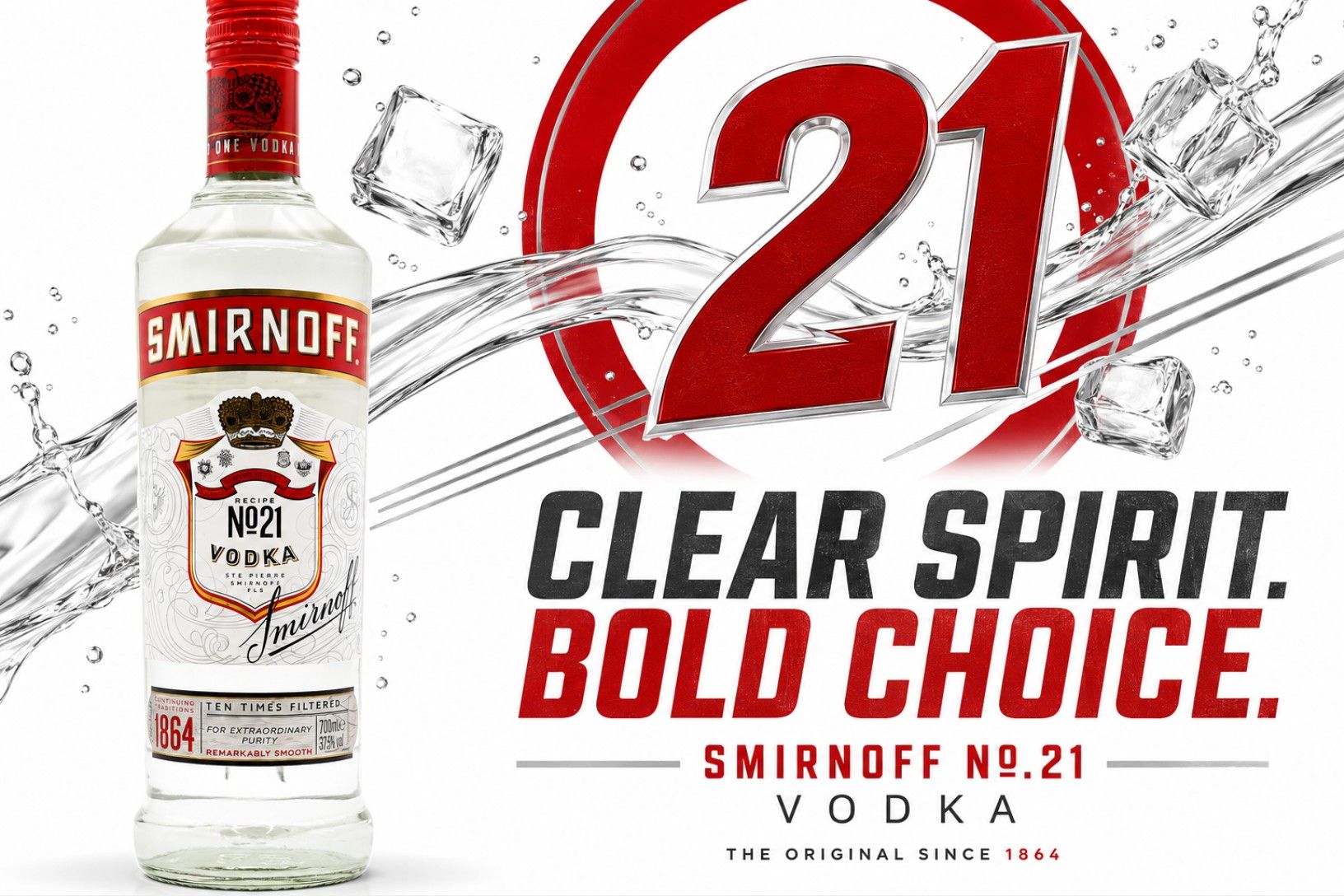
Few vodka brands are as instantly recognisable as Smirnoff.
The red label, clear bottle and familiar No. 21 branding have made Smirnoff No. 21 a staple of bars, restaurants and home drinks cabinets around the world. Yet its popularity is not built around an especially complicated proposition.
Smirnoff No. 21 is designed to be clean, crisp and versatile.
The UK expression is bottled at 37.5% ABV, undergoes three distillations and ten stages of filtration, and is deliberately produced with a relatively neutral profile that allows it to work across everything from a simple vodka and lemonade to a Martini, Espresso Martini, Bloody Mary or the famous Smirnoff Mule.
That versatility is arguably the most important thing to understand about the bottle.
It can be served:
- Chilled
- Over ice
- With lemonade
- With cola
- With tonic
- With orange juice
- With cranberry juice
- With ginger beer
- In classic vodka cocktails
For anyone searching for Smirnoff vodka, Smirnoff No. 21, what is Smirnoff, what does Smirnoff taste like, how to drink Smirnoff, what to mix with Smirnoff, Smirnoff cocktails or where to buy Smirnoff, here is everything worth knowing.
Shop Smirnoff No. 21 Red Label Vodka at Hard To Find Whisky.
Smirnoff No. 21 at a Glance
- Brand: Smirnoff
- Expression: No. 21 Red Label / Classic Vodka
- Spirit: Vodka
- Bottle size: 70cl
- UK ABV: 37.5%
- Distillation: Triple distilled
- Filtration: Filtered ten times
- Style: Clean, crisp and relatively neutral
- Finish: Dry and smooth
- Brand founded: 1864
- Founder: P.A. Smirnov
- Current owner: Diageo
- Best for: Mixed drinks, long drinks and classic vodka cocktails
What Is Smirnoff No. 21?
Smirnoff No. 21 is the flagship classic vodka at the centre of the Smirnoff range.
In the UK it is bottled at 37.5% ABV and is made using a process involving three distillations followed by ten stages of filtration. Smirnoff describes the finished vodka as having a smooth character and dry finish, while Diageo highlights its crisp taste and versatility in cocktails.
That relatively neutral character is intentional.
Vodka often performs a different job from whisky, rum or gin in a cocktail.
Where gin brings juniper and botanicals, rum may bring sugarcane character and whisky adds oak, grain and maturation flavours, vodka is frequently chosen because it provides alcoholic structure without overwhelming the other ingredients.
That makes Smirnoff No. 21 particularly useful when mixing with:
- Citrus
- Fruit juice
- Ginger beer
- Lemonade
- Cola
- Coffee
- Vermouth
- Tomato juice
Its job is often to carry the cocktail rather than dominate it.
Is Smirnoff No. 21 the Same as Smirnoff Red Label?
Yes.
Smirnoff No. 21 is the classic Red Label expression commonly referred to simply as Smirnoff Vodka.
HTFW lists the bottle as Smirnoff No. 21 Red Label Vodka, while Smirnoff itself currently markets it as Smirnoff No. 21 Classic Vodka. Both refer to the familiar core expression.
What Does the No. 21 Mean in Smirnoff?
The number is firmly established as part of the product name, but Smirnoff's current official UK material does not provide a detailed explanation for the historical origin of “No. 21”.
For that reason, it is better not to repeat the various unverified stories found online about recipe numbers or historic production codes.
What can be stated confidently is that No. 21 identifies Smirnoff's classic Red Label vodka, alongside other numbered expressions that have appeared within the wider Smirnoff portfolio.
How Strong Is Smirnoff No. 21?
The standard UK Smirnoff No. 21 is 37.5% ABV.
That means it sits slightly below the 40% ABV level common to many other vodkas, whiskies, rums and gins.
It is still a full-strength distilled spirit and should not be confused with Smirnoff Ice or Smirnoff's various lower-strength ready-to-drink products.
How Many Times Is Smirnoff Distilled?
Smirnoff confirms that No. 21 is distilled three times.
Triple distillation is one of the core production points Smirnoff repeatedly highlights when describing its flagship vodka.
The goal is a clean, smooth base suitable for a very broad range of drinks rather than a highly characterful spirit intended to dominate a cocktail.
How Many Times Is Smirnoff Filtered?
After distillation, Smirnoff No. 21 is filtered ten times.
The brand makes this one of the defining features of the expression.
Together, the three distillations and ten stages of filtration are intended to produce the clean and crisp style associated with No. 21.
What Does Smirnoff No. 21 Taste Like?
Vodka tasting can be more subtle than tasting aged whisky or flavoured rum.
Smirnoff No. 21 is deliberately designed around cleanliness and neutrality, with the official producer description highlighting a dry finish and smooth texture. HTFW similarly describes the vodka as crisp and clean.
Nose
The aroma is clean and restrained, with light grain-spirit character and a gentle alcoholic freshness.
There are no strong fruit, oak or botanical flavours competing for attention.
Palate
The palate is crisp, light and neutral, with enough body to remain noticeable when served chilled or over ice.
The principal impression is clean spirit rather than a strongly defined flavour such as vanilla, juniper or spice.
Finish
The finish is dry, clean and relatively smooth, exactly the characteristic Smirnoff emphasises in its official description.
This restrained flavour profile is a major reason the vodka works with so many mixers.
Is Smirnoff Sweet?
Standard Smirnoff No. 21 is not a sweet flavoured vodka.
Its official profile is built around a dry finish, rather than fruit or added flavour character.
Smirnoff does produce numerous flavoured expressions, including Raspberry Crush, Mango & Passionfruit Twist, Vanilla, Cherry Drop and Miami Peach, but those should be treated separately from classic No. 21. HTFW currently carries several of these alongside the original expression.
Is Smirnoff Smooth?
“Smooth” is subjective, but it is one of the characteristics the producer specifically aims for.
Smirnoff highlights its triple distillation and ten filtration stages alongside a dry finish and smooth drinking profile.
Serving the vodka properly chilled can further soften the perception of alcohol.
How Should You Drink Smirnoff?
There is no single correct way.
The core strength of Smirnoff No. 21 is versatility.
It can be enjoyed:
- Chilled
- Over ice
- With a simple mixer
- In a highball
- In a Martini
- In a Mule
- In an Espresso Martini
- In a Bloody Mary
- In a Screwdriver
- In a Passionfruit Martini
Smirnoff itself positions No. 21 for both drinking over ice and use across its classic cocktail collection.
Can You Drink Smirnoff Neat?
Yes.
Vodka does not have to be mixed.
If you want to taste Smirnoff No. 21 on its own, chilling it first is usually the most approachable way to do so.
A small chilled measure places the focus on:
- Clean spirit
- Texture
- Alcohol warmth
- Dryness
- Finish
Because No. 21 is deliberately neutral, neat drinking will not provide the layers of cask influence found in whisky or aged rum.
That is not a flaw.
It is simply a different style of spirit.
Smirnoff Over Ice
Another straightforward option is serving Smirnoff No. 21 over ice.
The brand itself recommends No. 21 with ice as one of the simplest ways to enjoy it.
As the vodka chills, the impression of alcohol becomes softer and the texture can feel slightly fuller.
Use one or two good-sized cubes rather than filling the entire glass with rapidly melting crushed ice if you want to taste the vodka itself.
What Is the Best Mixer for Smirnoff?
There is no single winner because neutral vodka works with so many different flavours.
Useful Smirnoff mixers include:
- Lemonade – sweet, citrus-led and easy drinking
- Ginger beer – spicy and refreshing
- Cola – familiar and sweeter
- Tonic water – drier and more bitter
- Soda water – clean and refreshing
- Orange juice – creates a Screwdriver
- Cranberry juice – tart and fruity
- Pineapple juice – tropical and sweeter
- Tomato juice – forms the base of a Bloody Mary
The best choice depends on whether you want the finished drink to be sweet, tart, spicy, dry or fruit-led.
Smirnoff and Lemonade
Vodka and lemonade is one of the easiest Smirnoff serves.
A simple version needs only:
- Smirnoff No. 21
- Lemonade
- Ice
- Lemon wedge
Pour the vodka into an ice-filled glass.
Top with chilled lemonade.
Stir gently.
Finish with fresh lemon.
Smirnoff also publishes longer lemonade-based No. 21 serves using fresh lemon and carbonated water, reinforcing how naturally its neutral vodka profile works with citrus.
Why Does Vodka Work With Lemonade?
Vodka supplies alcohol and structure without heavily altering the lemonade's citrus character.
The drink therefore remains:
- Light
- Sweet
- Citrusy
- Refreshing
It is also exceptionally easy to adjust.
Use more lemonade for a longer, lighter-tasting serve or less if you want the vodka to remain more prominent.
Smirnoff and Coke
Smirnoff and cola is another straightforward combination.
Cola contributes:
- Caramel
- Vanilla
- Citrus
- Spice
- Sweetness
while the vodka remains relatively neutral underneath.
Serve it over plenty of ice and finish with lime if you want to cut through some of the sweetness.
For anyone who finds neat vodka too intense, vodka and cola provides a familiar entry point.
Smirnoff and Tonic
Vodka and tonic is usually drier than vodka and lemonade or vodka and cola.
Tonic water brings:
- Quinine bitterness
- Carbonation
- Light citrus character
while Smirnoff provides the alcoholic base.
Serve with plenty of ice and fresh lime or lemon.
For someone who likes a Gin & Tonic but does not particularly enjoy juniper, vodka and tonic is an obvious alternative.
Smirnoff and Soda
Vodka soda is one of the simplest ways to lengthen Smirnoff while changing its flavour as little as possible.
Use:
- Smirnoff No. 21
- Soda water
- Ice
- Lime
Unlike lemonade or cola, soda adds almost no sweetness.
This allows the vodka's clean, dry character to remain much more apparent.
Smirnoff and Cranberry Juice
Vodka and cranberry is another established combination.
Cranberry provides acidity, fruit and a slightly tart character.
Fresh lime helps sharpen the drink further.
The combination also forms part of several more elaborate vodka cocktails, including the Cosmopolitan.
Smirnoff and Orange Juice: The Screwdriver
One of the easiest recognised vodka cocktails is the Screwdriver.
Smirnoff's official UK recipe uses:
- 25ml Smirnoff No. 21
- 120ml fresh orange juice
- Orange wedge
How to Make a Smirnoff Screwdriver
Fill a highball glass with ice.
Add the Smirnoff.
Top with fresh orange juice.
Stir gently.
Finish with an orange wedge.
That is the entire cocktail.
Why Is It Called a Screwdriver?
The drink's unusual name is generally associated with stories about workers stirring vodka and orange juice using screwdrivers when no bar spoon was available.
Like many old cocktail origin stories, the details have been repeated in several slightly different forms over the years.
What matters from a practical perspective is that the Screwdriver remains one of the simplest vodka cocktails possible:
Vodka + orange juice.
The Smirnoff Mule
If there is one cocktail with a particularly important connection to Smirnoff, it is the Moscow Mule.
Smirnoff's own history records the creation of the Mule in 1941, with John G. Martin and Jack Morgan associated with the development of the drink using Smirnoff vodka. Diageo has likewise described the Moscow Mule as having been invented using Smirnoff.
The combination is now one of the defining vodka highballs.
How to Make a Smirnoff Mule
The current official UK recipe uses:
- 50ml Smirnoff No. 21
- 150ml ginger beer
- 2 lime wedges
- Ice
- Lime and mint to garnish
Fill a copper mug or tall glass with ice.
Add the vodka.
Top with ginger beer.
Squeeze in the lime.
Stir gently.
Garnish with lime and mint.
Why Does the Moscow Mule Work?
The drink is based on contrast.
Vodka provides a clean alcoholic foundation.
Ginger beer brings spice, sweetness and carbonation.
Lime delivers acidity and freshness.
The neutral nature of Smirnoff allows the ginger and lime to remain prominent while still producing a properly structured cocktail.
The Smirnoff Martini
Vodka can also take centre stage in a much drier cocktail.
Smirnoff's official Martini recipe combines:
- 50ml Smirnoff No. 21
- 7ml dry vermouth
- Lemon twist
How to Make a Smirnoff Martini
Fill a shaker with ice.
Add Smirnoff No. 21 and dry vermouth.
Shake thoroughly.
Strain into a chilled Martini glass.
Finish with a lemon twist.
This is a dramatically different experience from vodka and lemonade.
There is nowhere for poor balance or excessive dilution to hide.
The vodka becomes the dominant ingredient.
Smirnoff Dirty Martini
For something more savoury, add olive brine.
Smirnoff's official Dirty Martini combines No. 21 with:
- Dry vermouth
- Olive juice
- Ice
- Olives to garnish
The brine gives the cocktail:
- Salinity
- Savoury depth
- Olive character
This is one of the clearest examples of why a relatively neutral vodka can be useful.
The spirit provides structure without fighting the delicate vermouth and olive flavours.
Smirnoff Espresso Martini
The Espresso Martini is another major use for No. 21.
Smirnoff's current UK recipe combines:
- 50ml Smirnoff No. 21
- 25ml coffee liqueur
- 20ml sugar syrup
- 40ml fresh espresso
- 3 coffee beans to garnish
How to Make a Smirnoff Espresso Martini
Add everything except the garnish to a cocktail shaker filled with ice.
Shake vigorously.
Strain into a chilled Martini or coupe glass.
Finish with three coffee beans.
Vodka is particularly effective here because it raises the alcoholic strength without competing heavily with the coffee.
If you're building the drink from bottles available at HTFW, Kahlúa Coffee Liqueur is an obvious coffee-liqueur option.
Smirnoff Passionfruit Martini
Smirnoff No. 21 also provides the spirit base for the brand's official Passionfruit Martini.
The current UK recipe uses:
- 50ml Smirnoff No. 21
- 25ml passion fruit liqueur
- 15ml vanilla syrup
- 35ml passion fruit juice
- Half a fresh passion fruit
This demonstrates another advantage of neutral vodka.
Passion fruit and vanilla remain the stars.
The vodka provides strength and structure without adding a competing flavour.
Smirnoff Bloody Mary
At the savoury end of the spectrum is the Bloody Mary.
Smirnoff's official version combines No. 21 with:
- Tomato juice
- Worcestershire sauce
- Hot sauce
- Black pepper
- Lemon
- Celery
- Olives
This may be the clearest demonstration of vodka's versatility.
The same bottle that works with coffee, passion fruit and lemonade can also work with tomato, chilli and Worcestershire sauce.
What Cocktails Can You Make With Smirnoff?
A bottle of No. 21 provides the base for a very broad cocktail range.
Some of the most useful options include:
- Moscow Mule – vodka, ginger beer and lime
- Vodka Martini – vodka and dry vermouth
- Dirty Martini – vodka, vermouth and olive brine
- Espresso Martini – vodka, coffee liqueur and espresso
- Bloody Mary – vodka, tomato and seasoning
- Screwdriver – vodka and orange juice
- Passionfruit Martini – vodka, passion fruit and vanilla
- Cosmopolitan – vodka, orange liqueur, cranberry and lime
Smirnoff's current cocktail library specifically features No. 21 across Mule, Martini, Espresso Martini, Bloody Mary and other classic-style recipes.
Why Is Smirnoff So Good for Cocktails?
The answer lies in what it doesn't taste strongly of.
A heavily botanical gin can completely alter a cocktail.
A smoky whisky can dominate.
A funky rum can shift the entire flavour profile.
Smirnoff No. 21 is deliberately much more neutral.
That means the bartender can decide where the flavour comes from.
Want coffee?
Add espresso.
Want citrus?
Add lemon or lime.
Want spice?
Add ginger beer.
Want fruit?
Add passion fruit, orange or cranberry.
The vodka provides the alcoholic backbone without forcing every cocktail to taste unmistakably of the base spirit.
The History of Smirnoff
Smirnoff traces its origins to 1864, when P.A. Smirnov founded the original vodka business.
Following the Russian Revolution, his son Vladimir relaunched the brand in Europe using the Anglicised spelling Smirnoff.
That distinction between Smirnov and Smirnoff is therefore rooted in the international history of the family brand rather than being a modern marketing invention.
Over time Smirnoff developed into an international vodka brand, eventually becoming part of Diageo, which remains its owner today.
Is Smirnoff Russian?
This needs a slightly more precise answer than simply yes or no.
Smirnoff has Russian origins.
P.A. Smirnov founded the original business in 1864, and the family name came from Russia. After the Russian Revolution, Vladimir Smirnov relaunched the business in Europe using the spelling Smirnoff.
Today, however, Smirnoff is a global brand owned by British drinks company Diageo, rather than a modern Russian-owned vodka company.
That distinction is important.
Its history is Russian.
Its modern corporate identity is international.
Who Owns Smirnoff?
Diageo owns Smirnoff.
Smirnoff's current official FAQ states this directly.
Diageo's vodka portfolio also includes brands such as Ketel One and Cîroc, while Smirnoff remains its major global mainstream vodka brand.
Why Is Smirnoff Called Smirnoff Instead of Smirnov?
The original family name was Smirnov.
After the upheaval surrounding the Russian Revolution, founder P.A. Smirnov's son Vladimir relaunched the brand in Europe using an Anglicised spelling of the family name: Smirnoff.
That spelling subsequently became the internationally recognised brand name.
How Old Is Smirnoff?
Smirnoff traces its history back to 1864.
That gives the brand more than 160 years of history as of 2026.
Its modern international identity is very different from the original 19th-century business, but the date remains the foundation used by Smirnoff itself when describing its heritage.
Why Is Smirnoff No. 21 So Popular?
There is no single reason.
Its strengths are largely practical:
- Recognisable brand
- Neutral flavour
- Broad cocktail compatibility
- Triple distillation
- Ten stages of filtration
- Full vodka strength
- Wide range of bottle sizes
- Large flavoured-vodka portfolio
Smirnoff itself describes No. 21 as the world's No. 1 vodka, while Diageo positions the expression as the core of its globally recognised Smirnoff range.
For the home drinker, however, the important point is simpler:
It works in an enormous number of drinks.
Smirnoff No. 21 vs Flavoured Smirnoff Vodka
No. 21 is the obvious starting point if you want a neutral vodka.
Smirnoff also has a large flavoured range.
HTFW currently carries expressions including:
- Smirnoff Raspberry Crush Vodka
- Smirnoff Mango & Passionfruit Twist Vodka
- Smirnoff Vanilla Vodka
- Smirnoff Cherry Drop Vodka
- Smirnoff Miami Peach Vodka
Choose Smirnoff No. 21 If:
- You want maximum cocktail versatility
- You prefer neutral vodka
- You want to control the flavour through mixers
- You make Martinis, Mules or Bloody Marys
- You want a classic vodka base
Choose a Flavoured Smirnoff If:
- You want fruit or vanilla already built into the spirit
- You prefer simpler two-ingredient drinks
- You want a sweeter style
- You are building cocktails around a particular flavour
Neither approach is universally better.
They simply serve different purposes.
Smirnoff Raspberry Crush
Smirnoff Raspberry Crush adds natural raspberry flavour to the familiar Smirnoff style, creating a much more fruit-led expression than No. 21.
It is particularly useful with:
- Lemonade
- Soda
- Cranberry
- Berry cocktails
If you want a traditional Martini or Mule, however, No. 21 remains the more flexible choice.
Smirnoff Mango & Passionfruit Twist
Smirnoff Mango & Passionfruit Twist moves firmly into tropical territory, combining mango sweetness with passion fruit character.
This makes it easier to build simple tropical long drinks without adding several separate fruit ingredients.
Smirnoff Vanilla
Smirnoff Vanilla Vodka introduces natural vanilla flavour for a sweeter, creamier style.
It can work particularly well in:
- Espresso Martinis
- Cola serves
- Coffee cocktails
- Dessert-style drinks
Again, the difference from No. 21 is clear.
No. 21 gives you neutrality.
Vanilla gives you flavour from the outset.
Smirnoff No. 21 Bottle Sizes
HTFW carries Smirnoff No. 21 in several formats, making it suitable for everything from individual home use to larger gatherings. The wider Smirnoff range currently includes the standard bottle alongside one-litre, magnum and miniature formats.
Available No. 21 formats include:
- 70cl standard bottle
- 1 litre bottle
- 1.5 litre magnum
- Miniature bottles
Browse the full Smirnoff range at HTFW.
Smirnoff No. 21 1 Litre
The Smirnoff No. 21 1 Litre offers the same classic 37.5% ABV vodka in a larger format.
It makes particular sense for:
- Cocktail making
- Home bars
- Events
- Regular vodka drinkers
Smirnoff No. 21 1.5 Litre Magnum
For an even larger format, HTFW also carries the Smirnoff No. 21 1.5 Litre Magnum at 37.5% ABV.
This gives you more than twice the volume of a standard 70cl bottle.
For most homes, 70cl will be perfectly sufficient.
For larger groups or frequent cocktail making, bigger formats can be more practical.
Smirnoff Miniatures
HTFW also carries Smirnoff No. 21 miniatures, retaining the same classic vodka style in a smaller format.
Miniatures can be useful for:
- Sampling
- Cocktail kits
- Tasting sets
- Travel-sized collections
- Individual measures
Is Smirnoff Gluten-Free?
Smirnoff's current UK product page describes Smirnoff No. 21 as gluten free.
Anyone purchasing because of a serious allergy or medical dietary requirement should still check the current bottle labelling and manufacturer information before consuming.
How Many Calories Are in Smirnoff?
Smirnoff's UK materials currently give the classic No. 21 expression as approximately 52–56 calories per 25ml, depending on which current Smirnoff UK page is referenced.
That small discrepancy is worth acknowledging rather than pretending there is a single perfectly consistent figure across the brand's current pages.
More importantly, mixers can dramatically change the calorie content of a finished drink.
Vodka with soda will be very different from vodka with full-sugar cola, lemonade or fruit juice.
Does Smirnoff Need to Be Refrigerated?
No.
Standard Smirnoff No. 21 is a 37.5% ABV distilled spirit and does not require refrigeration after opening.
Store it:
- Upright
- Properly sealed
- Away from direct sunlight
- Away from excessive heat
Chilling is a matter of serving preference rather than preservation.
Can You Put Smirnoff in the Freezer?
Yes.
Many people prefer vodka straight from the freezer because the lower temperature softens the sensation of alcohol and creates a slightly thicker texture.
At normal domestic freezer temperatures, a 37.5% ABV vodka should remain pourable rather than freezing into a solid block under typical conditions.
For cocktails, however, there is no requirement to freeze the bottle because shaking or stirring with ice will chill the drink anyway.
Does Smirnoff Go Off?
High-strength vodka is extremely stable compared with wine, beer or cream liqueur.
A properly stored bottle of Smirnoff No. 21 can remain usable for a very long time.
Once opened, gradual oxidation and evaporation may eventually cause subtle changes, particularly if only a small amount remains in a bottle containing a large volume of air.
For best quality:
- Keep the cap tightly closed
- Avoid sunlight
- Avoid high temperatures
- Store the bottle upright
What Is the Best Smirnoff Cocktail for Beginners?
The Smirnoff Mule is probably the strongest starting point.
It only requires:
- Smirnoff No. 21
- Ginger beer
- Lime
- Ice
It is easy to make, forgiving with measurements and offers enough flavour to appeal even if you do not normally drink vodka neat.
The Screwdriver is even simpler, but the Mule demonstrates more clearly how vodka can function inside a proper cocktail.
What Is the Best Smirnoff Cocktail for Tasting the Vodka?
Choose a Vodka Martini.
The drink contains little more than:
- Smirnoff No. 21
- Dry vermouth
- Lemon
There is nowhere for the vodka to hide.
If you want to understand how Smirnoff behaves as a spirit rather than simply as an alcohol base beneath juice or lemonade, this is the obvious cocktail.
What Is the Best Smirnoff Cocktail for Coffee Lovers?
The Espresso Martini.
Smirnoff's official UK recipe combines No. 21 with coffee liqueur, sugar syrup and fresh espresso.
The neutral vodka works well because it increases strength without interfering with the coffee.
What Is the Best Smirnoff Cocktail for Brunch?
The Bloody Mary remains the obvious answer.
Smirnoff No. 21 combines with tomato juice, Worcestershire sauce, hot sauce, pepper and citrus in the brand's current recipe.
It is one of the few classic cocktails where savoury flavours completely dominate.
Frequently Asked Questions About Smirnoff No. 21
What is Smirnoff No. 21?
Smirnoff No. 21 is the brand's classic Red Label vodka, triple distilled and filtered ten times. The UK expression is bottled at 37.5% ABV.
What does Smirnoff taste like?
Expect a clean, crisp and relatively neutral vodka with a dry finish, designed to work particularly well in mixed drinks and cocktails.
How many times is Smirnoff distilled?
Smirnoff No. 21 is triple distilled.
How many times is Smirnoff filtered?
It is filtered ten times.
What percentage is Smirnoff No. 21?
The standard UK bottle is 37.5% ABV.
Is Smirnoff Russian?
Smirnoff has Russian origins, tracing its history to P.A. Smirnov's business founded in 1864. After the Russian Revolution, his son Vladimir relaunched the brand in Europe using the Anglicised Smirnoff spelling. Today the brand is owned by Diageo.
Who owns Smirnoff?
Diageo owns Smirnoff.
Can you drink Smirnoff neat?
Yes. Smirnoff No. 21 can be enjoyed chilled, over ice or in cocktails.
What is the best mixer for Smirnoff?
Popular options include lemonade, ginger beer, cola, tonic, soda, orange juice and cranberry juice.
Can you mix Smirnoff with lemonade?
Yes. The clean vodka profile works particularly well with citrus-led mixers, and Smirnoff publishes several lemonade-based No. 21 serves.
Can you mix Smirnoff with Coke?
Yes. Cola's caramel, spice and citrus character works well with neutral vodka.
Can you mix Smirnoff with orange juice?
Yes. Vodka and orange juice creates a Screwdriver, with Smirnoff's official recipe using 25ml No. 21 and 120ml fresh orange juice.
How do you make a Moscow Mule with Smirnoff?
Smirnoff's UK recipe uses 50ml No. 21, 150ml ginger beer and two lime wedges, served over ice and garnished with lime and mint.
How do you make a Smirnoff Martini?
Combine 50ml Smirnoff No. 21 with 7ml dry vermouth, shake with ice and strain into a chilled Martini glass before garnishing with lemon.
Can Smirnoff be used in an Espresso Martini?
Yes. Smirnoff publishes an official Espresso Martini recipe using No. 21, coffee liqueur, fresh espresso and sugar syrup.
Is Smirnoff gluten-free?
Smirnoff's current UK No. 21 product page describes the vodka as gluten free.
Does Smirnoff need to be refrigerated?
No. It can be stored at room temperature away from heat and direct sunlight.
Where can I buy Smirnoff No. 21?
You can buy Smirnoff No. 21 Red Label Vodka online from Hard To Find Whisky.
Is Smirnoff No. 21 Worth Buying?
Smirnoff No. 21 succeeds because it does not try to be overly complicated.
It is a clean, triple-distilled, ten-times-filtered vodka designed to work almost anywhere vodka is required.
That gives one bottle an enormous number of possible uses.
Add ginger beer and lime for a Mule.
Add orange juice for a Screwdriver.
Add dry vermouth for a Martini.
Add coffee liqueur and espresso for an Espresso Martini.
Add tomato juice and seasoning for a Bloody Mary.
Or simply add lemonade, tonic, soda or cola.
For someone building a home cocktail cabinet, that versatility is valuable.
A heavily flavoured spirit may be excellent in two or three specific drinks.
Smirnoff No. 21 can form the base of dozens.
Final Thoughts
Smirnoff No. 21 Red Label Vodka is one of those bottles whose familiarity can make it easy to overlook what it actually does well.
The recipe is not built around an extravagant ingredient story or years of oak maturation.
Instead, Smirnoff focuses on consistency and versatility.
The vodka is:
- Triple distilled
- Filtered ten times
- 37.5% ABV in the UK
- Clean and crisp
- Finished relatively dry
That makes it exceptionally adaptable.
The same bottle can become a Smirnoff Mule, Vodka Martini, Espresso Martini, Bloody Mary, Screwdriver or simple vodka and lemonade without imposing a strong flavour that competes with the other ingredients.
Behind it is a brand tracing its history to P.A. Smirnov in 1864, before Vladimir Smirnov relaunched the name in Europe as Smirnoff following the Russian Revolution. Today it sits within the Diageo portfolio and remains the flagship expression in a range that now stretches from classic vodka to numerous fruit and flavoured releases.
For anyone searching for Smirnoff vodka, Smirnoff No. 21, what Smirnoff tastes like, how to drink Smirnoff, what to mix with Smirnoff, Smirnoff cocktails, Moscow Mule ingredients or where to buy Smirnoff, No. 21 remains the logical place to begin.
Shop Smirnoff No. 21 Red Label Vodka at Hard To Find Whisky.
Or explore the complete Smirnoff range at HTFW.